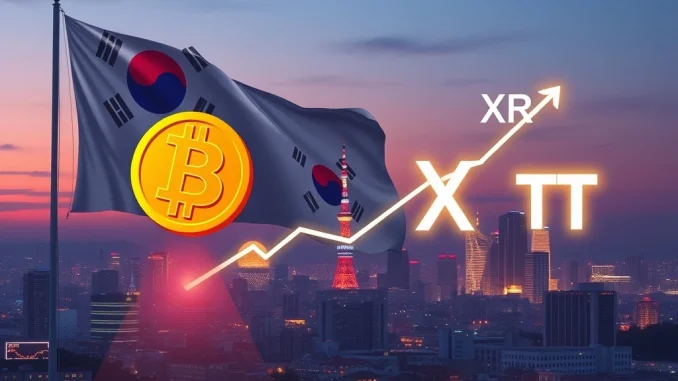
SEOUL, South Korea – January 15, 2025 – In a significant shift for one of the world’s most active cryptocurrency markets, Bitcoin (BTC) has fallen to third place in trading volume against the South Korean won for the first time in history. According to a comprehensive report from Digital Asset, this landmark change in 2025 sees XRP and Tether (USDT) surpassing the original cryptocurrency, signaling a potential evolution in regional trading preferences and market dynamics. This analysis, which reviewed data from 2013 through 2025, provides a crucial snapshot of changing investor behavior in a nation long known for its fervent crypto adoption.
Bitcoin Trading Volume Drops in Key Asian Market
The Digital Asset report delivers a clear and data-driven narrative. The analysis specifically examined trading volumes for the top eight digital assets by market capitalization—Bitcoin (BTC), Ethereum (ETH), Tether (USDT), XRP, USD Coin (USDC), Solana (SOL), Tron (TRX), and Dogecoin (DOGE)—across major South Korean exchanges. Consequently, the findings reveal a historic reversal. XRP recorded the highest annual trading volume in 2025 at approximately 335 trillion Korean won. Meanwhile, the stablecoin USDT secured a strong second place. Therefore, Bitcoin’s descent to third marks the end of its consistent dominance in the top two spots since trading began in the country.
This shift did not occur overnight. South Korea’s cryptocurrency ecosystem has undergone substantial transformation. For instance, regulatory frameworks have matured significantly since the early boom years. Additionally, the introduction of clearer digital asset laws in 2024 provided more structure for exchanges and investors alike. Market analysts point to several concurrent factors that may explain Bitcoin’s relative decline in trading activity. These factors include the growing institutional use of stablecoins for settlements and the rising utility of specific altcoins like XRP in cross-border payment corridors frequented by Korean businesses.
Analyzing the South Korean Crypto Landscape
South Korea represents a unique and influential cryptocurrency market. Often characterized by a high retail participation rate and a strong “Kimchi premium,” the market’s dynamics offer insights into broader Asian trends. The report’s longitudinal data from 2013 allows for a nuanced understanding of this evolution. Initially, Bitcoin overwhelmingly dominated trading pairs. However, the gradual rise of Ethereum for decentralized finance (DeFi) and non-fungible tokens (NFTs) began to diversify volume. More recently, the demand for stablecoins and assets tied to specific blockchain utilities has reshaped the hierarchy.
The prominence of XRP is particularly noteworthy. Ripple’s digital asset has maintained a consistent and strong following in South Korea, partly due to its partnerships with several Korean financial institutions for remittance testing. Furthermore, the legal clarity surrounding XRP following its U.S. court case in 2023 likely bolstered domestic trader confidence. Conversely, Bitcoin’s role may be evolving from a primary trading instrument to a longer-term store of value or institutional reserve asset within the same market, a shift that would naturally reduce its spot trading volume relative to utility-focused tokens.
Expert Perspective on Market Maturation
Financial technology experts interpreting the data emphasize context over alarm. “This is less about Bitcoin failing and more about the South Korean market maturing,” explains a Seoul-based fintech analyst cited in industry reviews. “High trading volume often indicates speculative activity or specific utility. The rise of USDT reflects its use as a safe-haven asset during volatility and a base currency for altcoin trading pairs. Similarly, XRP’s volume is heavily tied to its practical application in liquidity solutions. Bitcoin’s slightly lower relative volume could indicate it is being held more, not abandoned.” This perspective aligns with global trends where Bitcoin’s volatility has decreased compared to earlier cycles, potentially making it less attractive for daily arbitrage but more appealing for custody.
The Impact of Regulation and Institutional Adoption
The changing rankings also mirror the impact of South Korea’s progressive regulatory stance. The Virtual Asset User Protection Act, fully implemented in 2024, established stringent requirements for exchange reserves, transparency, and investor protection. These rules inadvertently favored assets with clearer regulatory profiles. Stablecoins like USDT and USDC, which are pegged to fiat currency reserves, fit neatly into enhanced compliance frameworks. Likewise, assets with defined use cases, such as XRP for payments, present a more straightforward value proposition for regulators than purely speculative assets.
Institutional activity has subtly influenced these volume metrics as well. While retail traders still power a significant portion of volume, local financial institutions and payment processors have begun piloting blockchain-based systems. Many of these pilots utilize specific tokens for efficiency. For example, a pilot for won-based stablecoin settlements would reduce volume for cross-border stablecoins like USDT over time. This institutional experimentation, while not yet massive in volume, points to a future where trading volume may be further fragmented across specialized digital assets serving specific economic functions.
Comparative Data and Market Metrics
The report provides a clear comparative breakdown. The following table summarizes the reported approximate trading volumes for the top three assets in 2025:
| Digital Asset | Approximate 2025 Trading Volume (Trillion KRW) | Market Position Change |
|---|---|---|
| XRP | 335 | ↑ Gained 1st |
| USDT (Tether) | Data Implied 2nd | ↑ Gained 2nd |
| Bitcoin (BTC) | Data Implied 3rd | ↓ Fell to 3rd |
Key takeaways from the broader data include:
- Stablecoin Dominance: The combined volume of USDT and USDC highlights the critical role of fiat-pegged assets in daily crypto market operations.
- Utility Over Hype: Assets with identifiable real-world use cases, like XRP for payments, are gaining sustained traction.
- Market Diversification: The spread of volume across eight major assets shows a healthier, less Bitcoin-centric ecosystem than in 2017 or 2021.
Conclusion
The news that Bitcoin has fallen to third in South Korean trading volume for the first time ever is a milestone that reflects maturation, not demise. It underscores a diversification of the digital asset landscape where utility, regulation, and specific market use cases drive activity alongside store-of-value narratives. For observers and participants, this shift offers critical insights into how advanced crypto economies evolve beyond initial speculation. The South Korean market, with its high adoption and progressive regulation, often serves as a leading indicator. Therefore, this change in the Bitcoin trading volume hierarchy may presage similar trends in other developed markets as they advance along the adoption curve, emphasizing a future where multiple digital assets thrive with distinct purposes.
FAQs
Q1: What does it mean that Bitcoin is third in trading volume?
It means that in 2025, the total value of Bitcoin bought and sold on South Korean exchanges was less than that of XRP and USDT. This indicates shifting trader focus but does not necessarily reflect a loss of Bitcoin’s overall value or importance.
Q2: Why is XRP so popular in South Korea?
XRP has longstanding partnerships with South Korean financial companies for remittance and payment solutions. Additionally, clearer regulation following its 2023 U.S. court case provided confidence to traders and institutions in the region.
Q3: Does lower trading volume make Bitcoin a worse investment?
Not inherently. Trading volume measures activity, not value. Lower relative volume can sometimes indicate an asset is being held long-term (“hodled”) rather than traded frequently. Investment quality depends on numerous factors beyond daily turnover.
Q4: How reliable is the data from the Digital Asset report?
The report is considered authoritative within the industry, compiling data from major licensed South Korean exchanges. Its longitudinal study from 2013 provides a credible historical baseline for analyzing 2025 trends.
Q5: Could Bitcoin regain the top spot in South Korean trading volume?
Yes, market rankings are dynamic. A major price rally, a new technological upgrade for Bitcoin, or shifts in global macroeconomic conditions could easily reignite high-volume trading activity for BTC in South Korea and elsewhere.
Updated insights and analysis added for better clarity.
This article was produced with AI assistance and reviewed by our editorial team for accuracy and quality.