Global, May 2025: The Bitcoin Stock-to-Flow (S2F) model remains a pivotal, yet debated, framework for assessing the cryptocurrency’s long-term value proposition. This model, which quantifies Bitcoin’s scarcity by comparing its existing supply to new production, offers investors a unique lens through which to view its potential. Today, as Bitcoin navigates post-halving markets and evolving regulatory landscapes, understanding the S2F model’s mechanics, historical context, and current implications is more relevant than ever for a nuanced market perspective.
The Bitcoin Stock-to-Flow Model Explained
At its core, the Bitcoin Stock-to-Flow model provides a quantitative measure of scarcity. Analysts calculate it by dividing the total existing supply of Bitcoin (the “stock”) by the amount of new Bitcoin minted each year (the “flow”). This yields a ratio. A higher S2F number indicates a harder, more scarce asset because the annual production is small relative to the total supply. Gold, for instance, has a high S2F ratio due to its slow annual production, which historically supports its value as a store of wealth. Proponents argue Bitcoin’s programmatically decreasing flow, especially after each halving event, makes it an increasingly scarce digital asset.
The model’s creator, known pseudonymously as PlanB, introduced it to the cryptocurrency community. He posited a correlation between Bitcoin’s S2F ratio and its market value. The underlying logic is simple: assets that are difficult to produce in large quantities relative to their existing stock often command higher valuations. This framework attempts to translate Bitcoin’s predictable, disinflationary monetary policy into a long-term price forecast.
Historical Performance and Halving Events
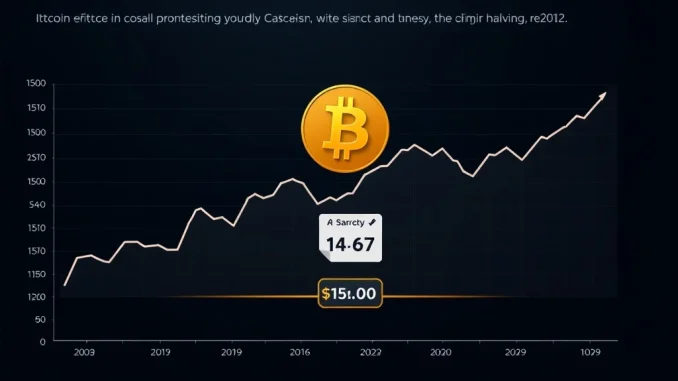
Historically, the S2F model gained attention for its apparent alignment with Bitcoin’s major market cycles, particularly around halving events. Bitcoin undergoes a halving approximately every four years, where the block reward for miners is cut in half. This event directly reduces the annual “flow” of new Bitcoin, causing the S2F ratio to jump significantly.
- 2012 Halving: Block reward reduced from 50 to 25 BTC. The S2F ratio increased, preceding a major bull market.
- 2016 Halving: Reward dropped from 25 to 12.5 BTC. Another rise in the S2F ratio coincided with a prolonged price ascent.
- 2020 Halving: Reward decreased to 6.25 BTC. The model again forecasted higher valuations, which materialized in the 2021 bull run.
- 2024 Halving: The most recent reduction to 3.125 BTC further elevated Bitcoin’s S2F, placing it in a scarcity bracket closer to precious metals.
This historical pattern forms the backbone of the model’s predictive claims. Each halving reduces the rate of new supply inflation, tightening the available flow against a growing stock. Consequently, many analysts monitor these events as fundamental catalysts, with the S2F model providing a structured timeline for potential value accrual.
Current Relevance and Market Context
In today’s market, the Bitcoin Stock-to-Flow model exists within a complex financial ecosystem. Its relevance is now tested against new variables that were less pronounced in earlier cycles. The proliferation of institutional investment through spot Bitcoin ETFs has created a substantial new source of demand. Simultaneously, macroeconomic factors like interest rate policies and global liquidity play a larger role in asset prices than a decade ago.
Furthermore, the model now contends with Bitcoin’s own maturation. Its total supply is approaching the 21 million cap, making each new coin a smaller percentage of the whole. This dynamic makes the S2F ratio extremely sensitive to the halving mechanism. Critics argue that while the model highlights scarcity, it does not directly account for demand shocks, regulatory developments, or technological shifts within the blockchain space. Therefore, modern investors often use the S2F as one tool among many, rather than a sole oracle.
Expert Perspectives on Model Utility
Financial analysts and cryptocurrency researchers offer a spectrum of views on the model’s current utility. Proponents maintain that its power lies in its simplicity and focus on Bitcoin’s immutable supply schedule—a feature unmatched by traditional assets. They view deviations from the model’s price projections as temporary, expecting long-term convergence as markets recognize Bitcoin’s fundamental scarcity.
Skeptics, however, emphasize its limitations. They note that correlation does not imply causation and that the model is a purely supply-side metric. Demand, driven by adoption, sentiment, and macroeconomics, is the other critical variable in any price equation. Many traditional economists caution against over-reliance on any single predictive model, especially in a nascent and volatile asset class. The consensus among seasoned market observers is that the S2F model is best understood as a thought-provoking framework for understanding scarcity, not a precise trading signal.
Comparative Scarcity: Bitcoin Versus Traditional Assets
To fully grasp the S2F model’s implications, comparing Bitcoin to established stores of value is instructive. The following table illustrates how Bitcoin’s scarcity profile has evolved and where it stands relative to other commodities.
| Asset | Stock (Est. Reserve) | Annual Flow (Production) | Stock-to-Flow Ratio |
|---|---|---|---|
| Gold | ~205,000 tonnes | ~3,300 tonnes | ~62 |
| Silver | ~1,740,000 tonnes | ~26,000 tonnes | ~67 |
| Bitcoin (Pre-2020 Halving) | ~18.3 million BTC | ~657,000 BTC | ~28 |
| Bitcoin (Post-2024 Halving) | ~19.7 million BTC | ~164,250 BTC | ~120 |
This data shows a dramatic shift. Following the 2024 halving, Bitcoin’s theoretical S2F ratio surpasses that of gold, entering uncharted territory for a digital asset. This quantitative scarcity is a fundamental tenet of the “digital gold” narrative. However, market valuation is not determined by scarcity alone. Perceived utility, security, and network effects also contribute to an asset’s ultimate price discovery, factors the S2F model does not quantify.
Conclusion
The Bitcoin Stock-to-Flow model today serves as a crucial educational tool for understanding the cryptocurrency’s engineered scarcity. It provides a clear, mathematical rationale for why many investors view Bitcoin as a unique, hard-asset in the digital age. While its predictive accuracy is debated, its core insight—that programmatically constrained supply is a foundational element of long-term value—remains compelling. For market participants, the model underscores the importance of Bitcoin’s halving cycles and its disinflationary nature. Ultimately, a comprehensive investment thesis should consider the S2F model’s scarcity signal alongside evolving demand dynamics, regulatory environments, and broader economic trends.
FAQs
Q1: What is the Bitcoin Stock-to-Flow model in simple terms?
The Stock-to-Flow (S2F) model measures Bitcoin’s scarcity. It divides the total number of Bitcoin in existence (the stock) by the number of new Bitcoin created each year (the flow). A higher number means the asset is more scarce, which the model suggests should support a higher value.
Q2: How does a Bitcoin halving affect the Stock-to-Flow ratio?
A halving cuts the block reward for miners in half, directly reducing the annual “flow” of new Bitcoin. With the “stock” continuing to grow slowly, this reduction in flow causes the S2F ratio to increase significantly, making Bitcoin quantitatively scarcer overnight.
Q3: Has the Stock-to-Flow model accurately predicted Bitcoin’s price in the past?
The model’s historical price projections have shown notable alignment with Bitcoin’s major bull markets following previous halvings. However, it has also experienced periods of significant deviation, leading to debate about its reliability as a precise forecasting tool.
Q4: What are the main criticisms of the S2F model?
Critics argue it is a purely supply-side model that ignores demand, market sentiment, regulation, and macroeconomic forces. They also note that past performance does not guarantee future results, and treating its output as a guaranteed price target can be misleading.
Q5: Should investors use the S2F model to make trading decisions today?
Most financial experts advise against using any single model for trading. The S2F model is best used as a framework for understanding Bitcoin’s long-term scarcity proposition. Prudent investors combine this insight with fundamental analysis, technical indicators, and risk management practices.