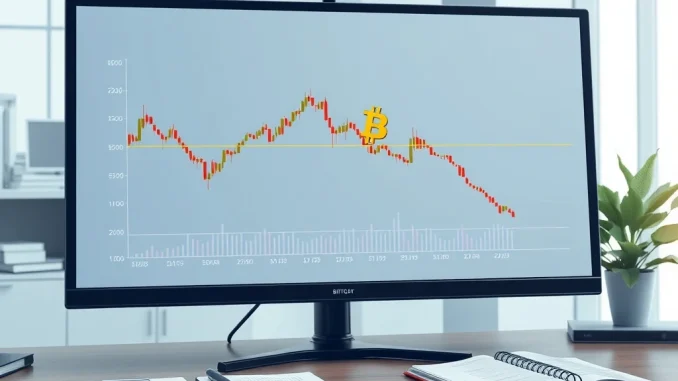
Global, March 2025: The cryptocurrency market faces a pivotal technical moment as Bitcoin records a weekly close below its 100-week Simple Moving Average (SMA). This significant breach of a long-term support level, observed by analysts across major trading platforms, has revived a bearish case that projects a potential 50% drawdown. The technical setup suggests a possible descent toward the $56,000 to $50,000 range in the coming months, marking a critical juncture for the world’s leading digital asset.
Understanding the 100-Week SMA Break and Its Historical Significance
A Simple Moving Average calculates the average price of an asset over a specified period. The 100-week SMA represents the average closing price of Bitcoin over the last 100 weeks, or nearly two years. Market technicians view this line as a major barometer of long-term trend health. A sustained price position above it typically signals a robust bull market, while a decisive break below often indicates profound weakness and a potential trend reversal. This is not the first time Bitcoin has tested this level. Historical analysis reveals that breaches of the 100-week SMA have preceded some of Bitcoin’s most significant corrective phases. For instance, the break in mid-2018 preceded the final capitulation into the $3,000 range during the crypto winter. Similarly, a touch and hold below this average occurred during the March 2020 liquidity crisis, though it was quickly reclaimed. The current weekly close below the line, therefore, is not an isolated signal but part of a pattern with substantial historical precedent. The critical question for traders and investors is whether this breach will be reclaimed swiftly, as in 2020, or if it will lead to a prolonged downtrend, echoing the 2018 scenario.
Technical Analysis: Mapping the Path to a Potential $50,000 Bitcoin
The projection of a drawdown toward $50,000 is not arbitrary. It is derived from the next major layer of technical support: the 200-week Simple Moving Average and its surrounding price band. The 200-week SMA is widely considered the ultimate bull market support line in multi-cycle analyses. Throughout Bitcoin’s history, even during severe bear markets, the price has often found a long-term floor at or near this moving average. As of the latest weekly close, this level resides roughly in the $56,000 region. However, technical targets are rarely precise points but rather zones. Analysts reference the “200-week band,” which accounts for the moving average itself and the historical price action around it during previous cycles. This creates a target zone between approximately $56,000 and $50,000. The logic follows a cascade of support breaks: failure to hold the 100-week SMA shifts focus to the next major historical support, which is the 200-week band. The timing estimate of March to April aligns with typical market cycles for such a move to develop, assuming selling pressure persists and no immediate bullish catalyst emerges to reverse the break.
The Role of Market Structure and On-Chain Data
Beyond pure price charts, on-chain analytics provide context for the technical breakdown. Metrics such as Exchange Net Flow can indicate whether coins are moving to exchanges for potential selling. The Realized Price—the average price at which all coins last moved—often acts as a aggregate cost basis and a psychological support level. Currently, the 100-week SMA breach coincides with other indicators showing decreased network activity and potential profit-taking from long-term holders. Furthermore, the broader macroeconomic environment in early 2025, including central bank policies and traditional market volatility, plays a contributing role. Cryptocurrency markets do not operate in a vacuum; they are increasingly correlated with risk assets like technology stocks. Therefore, the technical warning from the 100-week SMA must be interpreted alongside these fundamental and macroeconomic factors to assess the full probability and potential depth of a correction.
Comparing Current Dynamics to Previous Bitcoin Cycles
To assess the potential severity of the current situation, a comparative analysis with past cycles is essential. The table below outlines key characteristics of previous major 100-week SMA breaches.
| Cycle Period | Context of Break | Time Below 100-Wk SMA | Subsequent Drawdown to 200-Wk Band | Final Price Low |
|---|---|---|---|---|
| Q4 2018 | Post-2017 bull market exhaustion | ~5 months | ~50% from break level | ~$3,200 |
| Q1 2020 | Global COVID-19 liquidity shock | ~3 weeks (brief breach) | ~50% (rapid V-shaped recovery) | ~$3,850 |
| Q2 2022 | Post-2021 bull market, macro tightening | ~12 months | ~55% from break level | ~$15,500 |
This historical data reveals a pattern: breaches that occur after extended bull runs (2018, 2022) tend to lead to prolonged periods below the average and deeper drawdowns. The 2020 event was an exogenous shock with a rapid recovery. The current context—following the 2024 halving and a significant rally—more closely resembles the post-bull market scenarios, suggesting the market should prepare for a potentially extended corrective phase if the break is not swiftly invalidated.
Implications for Investors and the Broader Crypto Ecosystem
A sustained move toward $50,000 would have wide-ranging consequences. For investors, it underscores the importance of risk management and the difference between long-term conviction trading and short-term tactical positioning. Key implications include:
- Portfolio Rebalancing: A deep Bitcoin correction typically leads to even larger percentage declines in altcoins, a phenomenon known as “beta compression.”
- Derivatives Market Stress: Such a move would likely liquidate significant leveraged long positions across futures and perpetual swap markets, potentially amplifying volatility.
- Institutional Response: Perceived weakness in Bitcoin’s price structure could slow the pace of institutional adoption and product launches in the short term.
- Miner Economics: A drop to $50,000 would pressure mining profitability, potentially forcing less efficient operators offline and impacting network hash rate.
However, for long-term believers, a return to the 200-week band has historically represented a high-conviction accumulation zone, as it has marked cycle bottoms in the past. The current scenario presents a classic tension between short-term technical danger and long-term strategic opportunity.
Conclusion
The weekly close below Bitcoin’s 100-week Simple Moving Average is a serious technical development that market participants cannot ignore. It reactivates a historical bear case that points toward a significant correction, with the $56,000 to $50,000 range emerging as the next logical area of major support based on the 200-week band. While technical analysis provides a framework for potential outcomes, it is not a certainty. The market’s reaction in the coming weeks—specifically, its ability to reclaim the 100-week SMA—will be crucial in determining whether this is a brief deviation or the start of a deeper, multi-month drawdown. This moment highlights the volatile and cyclical nature of cryptocurrency markets, reminding investors of the importance of technical indicators like the 100-week SMA in navigating long-term trends.
FAQs
Q1: What is the 100-week SMA and why is it important for Bitcoin?
The 100-week Simple Moving Average (SMA) is the average of Bitcoin’s weekly closing prices over the past 100 weeks. It is considered a critical long-term trend indicator. A price above it generally signals a healthy bull trend, while a sustained break below can indicate major trend weakness and often precedes significant corrections.
Q2: Has Bitcoin broken below the 100-week SMA before?
Yes. Notable instances include prolonged breaks in 2018 and 2022, which led to deep bear markets, and a brief break in March 2020 during the COVID-19 market crash, which was quickly reversed in a V-shaped recovery.
Q3: What is the “200-week band” and why is $50,000 a target?
The 200-week band refers to the price area around Bitcoin’s 200-week SMA, a level historically known as ultimate bull market support. The $50,000 target is the lower bound of the estimated zone for this moving average and its historical support range, based on its projected trajectory over the coming months.
Q4: Does breaking the 100-week SMA guarantee Bitcoin will drop to $50,000?
No. Technical analysis identifies probabilities, not guarantees. The break is a strong warning signal, but Bitcoin could reclaim the level quickly, invalidating the bearish setup. The target is based on historical precedent and the next logical level of major support.
Q5: How should a long-term Bitcoin investor react to this technical signal?
A long-term investor might view a potential drop toward the 200-week band as a strategic accumulation opportunity, as it has marked cycle lows historically. However, they should also practice sound risk management, avoid over-leverage, and ensure their investment horizon aligns with Bitcoin’s proven volatility.
This article was produced with AI assistance and reviewed by our editorial team for accuracy and quality.