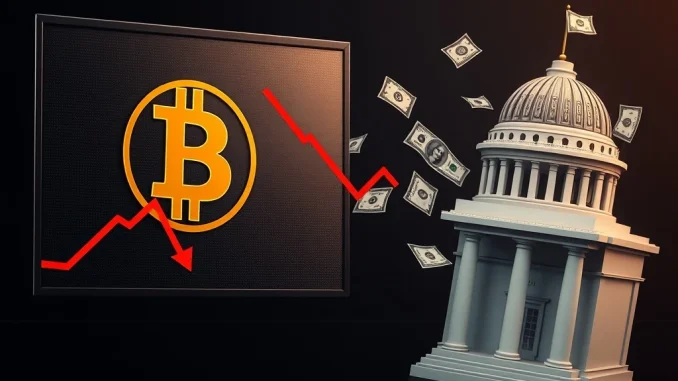
Global Markets, May 2025: The recent sharp correction in Bitcoin’s price has sent ripples through the cryptocurrency ecosystem, prompting widespread speculation about its cause. In a detailed analysis that cuts through the noise, former BitMEX CEO and noted market commentator Arthur Hayes presents a compelling, macro-driven thesis. He argues the primary catalyst for the Bitcoin selloff is not a flaw in crypto technology or regulatory crackdowns, but a contraction in US dollar liquidity and a significant rise in the US Treasury’s cash balance—forces far removed from the digital asset space yet profoundly impactful upon it.
Arthur Hayes Explains the Real Source of the Bitcoin Selloff
Arthur Hayes, known for his deep dives into the intersection of macro finance and cryptocurrency, has consistently framed Bitcoin as a risk asset sensitive to global liquidity conditions. His latest commentary builds on this foundational view. Hayes directs attention away from crypto-centric narratives—such as exchange-traded fund (ETF) flows or miner selling pressure—and toward the mechanics of the United States Treasury Department and the Federal Reserve. He posits that when the US government engages in significant debt issuance and parks the proceeds in its Treasury General Account (TGA) at the Fed, it effectively removes dollars from the financial system. This drain on dollar liquidity, Hayes explains, creates a risk-off environment where leveraged positions across all asset classes, including Bitcoin, become untenable, forcing widespread deleveraging and selling.
The Mechanics of Dollar Liquidity and Market Impact
To understand Hayes’s argument, one must grasp two key concepts: the Treasury General Account and the reverse repo facility. The TGA is essentially the federal government’s checking account at the Fed. When it grows rapidly, it signals the Treasury is building a cash buffer, often through bond sales, which pulls money from bank reserves. Concurrently, the Fed’s quantitative tightening (QT) program further reduces system liquidity. Hayes meticulously tracks these balances, correlating their expansion with periods of market stress.
- Treasury Cash Buildup: Large-scale debt issuance to fund government operations increases the TGA balance, directly subtracting liquidity from the banking sector.
- Federal Reserve Balance Sheet Runoff: The Fed’s ongoing QT program allows bonds to mature without reinvestment, a passive yet persistent drain.
- The Liquidity Squeeze: The combined effect acts as a stealth tightening of financial conditions, raising short-term funding rates and pressuring assets bought with cheap leverage.
This environment historically disadvantages speculative growth assets. Bitcoin, despite its decentralized nature, has demonstrated a high correlation to tech stocks and other liquidity-sensitive instruments during such phases, as seen in 2018 and 2022.
Historical Context and the 2022 Parallel
The current market dynamic bears resemblance to the liquidity crisis of 2022, a period Hayes analyzed extensively. That year, aggressive Fed rate hikes coupled with QT precipitated a dramatic collapse in crypto asset prices. Hayes’s framework then, as now, highlighted that crypto markets do not operate in a vacuum. They are a component of the broader global financial system and are therefore hostage to its liquidity tides. The recent selloff, according to this analysis, is not a unique crypto event but a repeat of a familiar macro pattern. It underscores Bitcoin’s maturation from a niche internet experiment to an asset class that responds predictably to traditional financial signals, a sign of its integration rather than its failure.
Implications for Investors and the Crypto Market
Hayes’s explanation carries significant implications for market participants. If the selloff is primarily a function of dollar liquidity, then monitoring crypto-specific news may provide less predictive power than watching Treasury issuance calendars and Fed balance sheet trends. It shifts the analytical focus from on-chain metrics alone to include macro indicators like TGA balances, reverse repo usage, and broad dollar strength indices.
This perspective also suggests potential catalysts for a reversal. A sustained decline in the TGA, indicating the Treasury is spending its cash hoard, would inject liquidity back into the banking system. Similarly, any signal from the Fed about slowing or pausing its QT program could be interpreted as a positive turning point for liquidity and, by extension, for Bitcoin and related assets. It frames the market’s path forward as being contingent on fiscal and monetary policy decisions made in Washington, D.C., not just developments within the crypto industry.
Conclusion
Arthur Hayes provides a crucial, high-level framework for understanding the recent Bitcoin selloff. By attributing the price pressure to tightening US dollar liquidity and a swelling Treasury cash balance, he moves the conversation beyond simplistic crypto narratives. This analysis reinforces the reality that cryptocurrency markets are now deeply embedded within the global financial system, making them susceptible to its underlying liquidity currents. For investors, the lesson is clear: navigating the volatile crypto landscape requires one eye on blockchain analytics and the other firmly fixed on the balance sheets of the US Treasury and the Federal Reserve. The real source of the selloff, therefore, may be found not in a crypto whitepaper, but in the mundane mechanics of sovereign debt management.
FAQs
Q1: What is the Treasury General Account (TGA)?
The Treasury General Account is the primary operating bank account of the United States Department of the Treasury, held at the Federal Reserve. When its balance increases, it signifies the government has raised cash, typically through selling bonds, which removes that cash from the commercial banking system, reducing overall dollar liquidity.
Q2: How does a rising TGA balance affect Bitcoin?
A rapidly rising TGA balance drains dollar liquidity from the financial system. This creates a tighter, more risk-averse environment where leveraged positions become expensive to maintain, often leading to forced selling of speculative assets like Bitcoin as investors and funds deleverage.
Q3: Is this Bitcoin selloff different from past ones?
According to Arthur Hayes’s analysis, the fundamental driver is similar to past selloffs tied to liquidity contractions, such as in 2022. The catalyst is macroeconomic (dollar liquidity) rather than a specific crypto black swan event (e.g., exchange collapse), though the market outcome appears similar.
Q4: What would signal an end to this liquidity-driven selloff?
Key signals would include a sustained drawdown in the TGA balance (as the Treasury spends its cash), a pause or pivot in the Federal Reserve’s quantitative tightening program, or other policy actions explicitly designed to inject liquidity back into the financial system.
Q5: Does this mean Bitcoin is just a risk-on stock now?
Hayes’s analysis suggests Bitcoin currently trades with a high sensitivity to global dollar liquidity, similar to other high-growth, risk-sensitive assets. This does not negate its long-term value proposition as decentralized digital property, but it highlights its present-day correlation with macro liquidity conditions in traditional markets.
Updated insights and analysis added for better clarity.
This article was produced with AI assistance and reviewed by our editorial team for accuracy and quality.