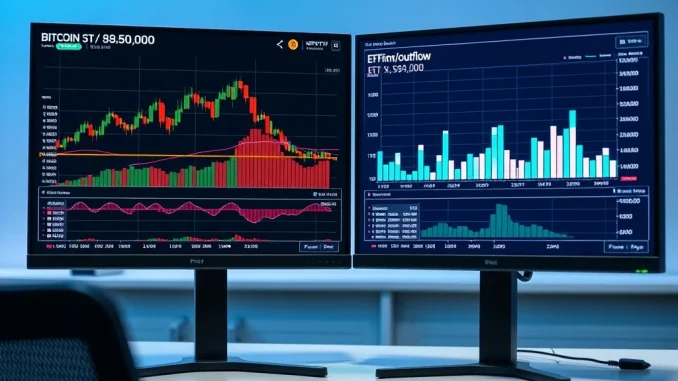
Global Markets, April 2025: Bitcoin’s price action has entered a phase of consolidation that has both traders and analysts watching institutional flows with heightened attention. According to a detailed market report from algorithmic trading firm Wintermute, the world’s leading cryptocurrency has been effectively range-bound between $85,000 and $94,000 for approximately two months. This persistent trading band highlights a market in search of a definitive catalyst, with recent data pointing squarely toward activity in United States-based spot Bitcoin exchange-traded funds (ETFs) as the primary variable influencing short-term trends.
Bitcoin Price Consolidation and the US Institutional Influence
The current trading range, spanning roughly $9,000, represents a significant period of equilibrium following Bitcoin’s historic climb above the $100,000 psychological level earlier in the year. Wintermute’s analysis identifies sustained selling pressure originating from U.S. institutional investors as the dominant force behind this consolidation. The firm’s report correlates two critical data points to support this conclusion. First, the market observed substantial net outflows from U.S. spot Bitcoin ETFs throughout the previous week. These funds, which directly hold Bitcoin, serve as a transparent proxy for institutional and large-scale investor appetite. Concurrently, the Coinbase Premium—the difference in Bitcoin’s price on the U.S.-based Coinbase exchange versus global averages—has maintained a persistent discount. This discount is a classic indicator of net selling pressure within the U.S. market, as sellers on Coinbase accept slightly lower prices to execute their trades quickly.
Decoding the ETF Flow Variable and Market Mechanics
To understand why ETF flows hold such sway, one must examine the structure of these financial instruments. A U.S. spot Bitcoin ETF is a regulated fund that purchases and holds actual Bitcoin in custody. When investors buy shares of the ETF, the fund’s authorized participants (typically large financial institutions) create new shares by delivering cash to the issuer, which then uses that cash to buy more Bitcoin on the open market. This process creates direct buy-side pressure. The reverse is also true. Net outflows occur when investors redeem shares, forcing the fund to sell Bitcoin to return cash, thereby creating sell-side pressure. The table below illustrates the typical flow mechanism:
| Investor Action | ETF Process | Bitcoin Market Impact |
|---|---|---|
| Buys ETF Shares | Creation of new shares; cash is used to buy BTC | Buying pressure; potentially positive for price |
| Sells ETF Shares | Redemption of shares; BTC is sold to raise cash | Selling pressure; potentially negative for price |
This direct, high-volume linkage means that aggregate ETF flows have become one of the most immediate and measurable sources of institutional demand or supply in the Bitcoin ecosystem. The recent trend of outflows, therefore, acts as a consistent headwind, preventing the price from sustaining a breakout above the upper bound of its current range near $94,000.
Macroeconomic Crosscurrents and the Federal Reserve’s Role
Beyond the digital asset-specific dynamics, Wintermute’s report cautions that this week carries a high probability of increased volatility due to external macroeconomic events. The most significant of these is the upcoming meeting of the U.S. Federal Open Market Committee (FOMC). The FOMC’s decisions on interest rates and its communicated outlook for monetary policy have profound effects on global risk assets, including cryptocurrencies. Higher interest rates generally strengthen the U.S. dollar and increase the opportunity cost of holding non-yielding assets like Bitcoin, making them less attractive to investors. Conversely, a dovish stance or signals of future rate cuts can weaken the dollar and fuel capital into growth-oriented and alternative assets. Wintermute’s analysis suggests that the interplay between ETF fund flows and the direction of the U.S. dollar will be the key duo to watch. A shift back to net inflows for Bitcoin ETFs, combined with a weaker dollar environment following the FOMC meeting, could provide the necessary thrust for Bitcoin to attempt a decisive break past the mid-$90,000s resistance.
Historical Context and the Nature of Crypto Market Cycles
Extended consolidation phases are not uncommon in Bitcoin’s history. Following major bullish impulses, the market often enters periods of re-accumulation where price moves sideways within a defined range. This allows the market to absorb profit-taking, onboard new investors at a stable price, and build a new foundation for the next trend. The 60-day range between $85,000 and $94,000 can be viewed through this lens. The lower boundary near $85,000 has repeatedly acted as strong support, indicating a floor of buying interest, while the $94,000 level has capped rallies, representing a ceiling of selling supply. Breaking conclusively above this ceiling requires a catalyst that can overcome the selling pressure identified by Wintermute. Historically, such catalysts have included major regulatory clarity, technological upgrades, or—as is the current focus—a sustained surge in institutional capital allocation as reflected in ETF flow data.
Conclusion
In summary, the bitcoin price finds itself at a technical and fundamental inflection point. Wintermute’s report provides a clear framework for understanding the current stalemate: U.S. institutional selling, primarily channeled through spot ETF redemptions, is applying consistent pressure that contains rallies. The immediate future of the market hinges on a potential shift in this dynamic. Traders and long-term holders alike are advised to monitor two critical gauges: the daily net flows of U.S. spot Bitcoin ETFs and the macroeconomic signals emanating from the Federal Reserve. A convergence of positive ETF inflows and a benign dollar outlook could be the key that unlocks the next phase for Bitcoin’s price, making the current range a crucial battleground for market direction.
FAQs
Q1: What does “range-bound” mean for Bitcoin’s price?
A1: “Range-bound” describes a market condition where the price of an asset, like Bitcoin, consistently trades between a specific high price (resistance) and a specific low price (support) for an extended period, without breaking out in either direction. In this case, the range is between approximately $85,000 and $94,000.
Q2: How do U.S. spot Bitcoin ETF flows affect the price?
A2: U.S. spot Bitcoin ETFs must buy Bitcoin when investors put new money into the fund (inflows) and sell Bitcoin when investors withdraw money (outflows). Therefore, sustained net inflows create consistent buying demand that can push the price up, while net outflows create selling supply that can push the price down or limit its rise.
Q3: What is the Coinbase Premium and why is it important?
A3: The Coinbase Premium is the difference between Bitcoin’s price on the Coinbase exchange (popular with U.S. investors) and its price on other global exchanges. A persistent negative premium, or discount, suggests that selling pressure on Coinbase is higher than elsewhere, often indicating net selling by U.S.-based entities.
Q4: Why does the U.S. Federal Reserve meeting matter for Bitcoin?
A4: The Federal Reserve sets U.S. interest rates and guides monetary policy. Its decisions influence the strength of the U.S. dollar and the overall appetite for riskier investments. A hawkish Fed (focused on fighting inflation with higher rates) can strengthen the dollar and dampen demand for crypto. A dovish Fed can have the opposite effect.
Q5: Who is Wintermute and why is their report significant?
A5: Wintermute is a leading global algorithmic trading firm and liquidity provider in the digital assets space. Their market reports are considered significant because they are based on high-volume, real-time trading data and analysis, providing an institutional perspective on market structure and flows that may not be visible to retail traders.