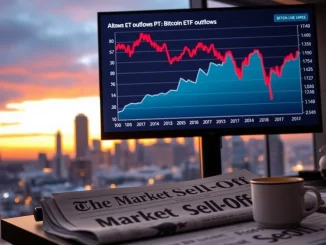
NEW YORK, April 1, 2026 — The cryptocurrency market opens the second quarter reeling from a historic collapse, as Bitcoin recorded its third-worst first-quarter performance in thirteen years. The flagship digital asset plunged 23.21% during Q1 2026, closing March at levels not seen since late 2024. This dramatic Bitcoin Q1 2026 crash stems primarily from escalating geopolitical conflicts and tightening macroeconomic conditions that have shaken investor confidence globally. Trading desks from Singapore to London reported sustained selling pressure throughout the quarter, with the downturn accelerating sharply in March as several national governments announced new regulatory frameworks for digital assets.
Analyzing the Bitcoin Q1 2026 Crash: A Quarter of Unrelenting Pressure
The 23.21% decline marks Bitcoin’s most severe first-quarter drop since 2022 and its third-worst Q1 performance since 2013, according to data from CoinMetrics. The sell-off was not a single event but a cascade. It began with moderate losses in January, accelerated through February, and culminated in a steep March decline that erased nearly $300 billion from the total cryptocurrency market capitalization. Consequently, analysts at JPMorgan Chase noted in a March 31 client report that Bitcoin’s correlation with traditional risk assets like the NASDAQ reached its highest level in two years. This high correlation suggests that cryptocurrency is losing its perceived status as an uncorrelated, alternative asset during the current crisis.
Chronologically, the downturn aligned precisely with a series of geopolitical escalations. In mid-January, renewed tensions in the South China Sea disrupted supply chains and rattled Asian markets. Subsequently, by early February, the breakdown of a major Middle Eastern peace accord triggered a flight to safety, strengthening the U.S. dollar and pressuring all dollar-denominated risk assets, including Bitcoin. Finally, March saw the European Union’s provisional agreement on the comprehensive Markets in Crypto-Assets (MiCA) framework, which introduced stricter capital and disclosure requirements for exchanges, causing institutional deleveraging.
Geopolitical Pressure and Macroeconomic Headwinds Shake Crypto Markets
The impact of these combined forces extends far beyond a simple price chart. Market structure shows clear signs of stress. For instance, the aggregate open interest in Bitcoin futures contracts across major exchanges fell by over 35% during the quarter, indicating a mass exodus of leveraged speculative capital. Furthermore, on-chain data from Glassnode reveals that the number of Bitcoin addresses holding a balance for more than a year declined slightly, breaking a multi-year trend of accumulation. This suggests some long-term holders, often called “HODLers,” began distributing their coins under pressure.
- Institutional Outflows: Digital asset investment products, like those from Grayscale and Purpose, experienced net outflows for nine consecutive weeks, totaling approximately $2.8 billion.
- Mining Strain: The hash price, a measure of mining revenue, hit an 18-month low, squeezing miners’ profitability and potentially forcing smaller operations to sell Bitcoin reserves to cover operational costs.
- Retail Sentiment Collapse: The Crypto Fear & Greed Index, a popular sentiment gauge, spent 11 consecutive weeks in “Extreme Fear” territory, its longest such streak since the 2022 bear market.
Expert Analysis: A Crisis of Confidence, Not Technology
Dr. Lina Zhang, a senior fellow at the MIT Digital Currency Initiative, attributes the crash to a crisis of confidence rather than a failure of Bitcoin’s underlying protocol. “The network itself has never been more secure or robust,” Zhang stated in an interview. “The 23% drop reflects a repricing of external risk premiums—geopolitical uncertainty, regulatory overhang, and the opportunity cost of holding a non-yielding asset in a high-rate environment. The technology is sound; the macro narrative has turned against it, for now.” Similarly, Marcus Thielen, head of research at DeFi Research, pointed to specific capital flow patterns. “We tracked substantial OTC (over-the-counter) block sales from large holders to institutional custody providers, likely representing forced liquidations or portfolio rebalancing by macro funds,” Thielen explained, referencing data his firm published on March 28.
Historical Context: How This Crash Compares to Previous Bitcoin Downturns
To understand the severity of the Q1 2026 decline, it must be placed in historical context. While significant, the drop remains less severe than the catastrophic quarters that defined previous crypto winters. For example, the current decline lacks the single catastrophic failure, like the collapse of FTX in Q4 2022, that typically catalyzes the deepest bear markets. The table below compares key metrics from Bitcoin’s worst historical quarters to Q1 2026.
| Quarter | Price Decline | Primary Catalyst | Time to Recover Previous High |
|---|---|---|---|
| Q1 2018 | -49.7% | Post-2017 bubble burst, regulatory crackdowns | ~3.5 years |
| Q2 2022 (LUNA/UST collapse) | -56.2% | Algorithmic stablecoin failure, leverage unwinding | ~1.5 years (ongoing) |
| Q1 2026 | -23.21% | Geopolitical tension, macro pressure, regulatory news | TBD |
| Q4 2013 | -44.5% | Mt. Gox exchange issues, China banning financial institutions | ~3 years |
This comparative analysis reveals a critical distinction: past crashes often involved a direct, existential threat to the crypto ecosystem itself. In contrast, the Q1 2026 downturn appears driven by external, macroeconomic factors. Therefore, the path to recovery may hinge more on global financial stability than on internal industry fixes.
The Path Forward: Regulatory Clarity and Macro Stabilization
Looking ahead, market participants are focusing on two sequential catalysts for stabilization. First, the final text and implementation timeline of the EU’s MiCA regulation, expected by Q3 2026, will provide much-needed clarity. Once the rules are known, institutions can properly model compliance costs and resume strategic allocations. Second, and more importantly, any de-escalation in the key geopolitical flashpoints would likely trigger a rapid relief rally across all risk assets. The scheduled G20 finance ministers meeting in March 2026 is now a critical date on the calendar, as it may produce a coordinated statement on digital asset oversight.
Industry and Investor Reactions: A Shift in Strategy
The crash has prompted visible strategic shifts. Major asset managers like BlackRock and Fidelity, which launched spot Bitcoin ETFs in 2024, have paused new marketing campaigns for these products, according to industry sources. Conversely, some venture capital firms are reportedly increasing their pace of deal-making in blockchain infrastructure, betting on lower valuations. On social media and crypto forums, the dominant retail investor sentiment has shifted from “buying the dip” to a cautious “wait and see” approach, with many citing the need for a clear weekly close above the 200-day moving average as a prerequisite for re-entry.
Conclusion
The Bitcoin Q1 2026 crash represents a significant stress test for the digital asset class, driven by a confluence of external geopolitical and macroeconomic pressures. The 23.21% decline underscores Bitcoin’s growing, albeit painful, integration into the global financial system, where it now reacts to the same forces that move stocks and bonds. While the technical network remains robust, the price action reflects a severe repricing of risk. The key takeaways are the heightened correlation with traditional markets, the strain on mining and institutional frameworks, and the market’s current dependence on macro stabilization. Investors should monitor regulatory developments from the EU and geopolitical headlines, as these external factors, not internal blockchain metrics, will likely dictate the next major trend for Bitcoin’s price.
Frequently Asked Questions
Q1: What caused Bitcoin to drop 23% in Q1 2026?
The primary drivers were escalating geopolitical tensions, particularly in Asia and the Middle East, and broader macroeconomic pressures like high interest rates. These factors caused a flight to safety, strengthening the U.S. dollar and prompting sell-offs in risk assets including Bitcoin.
Q2: How does this crash compare to Bitcoin’s worst historical quarters?
At -23.21%, the Q1 2026 drop is severe but less extreme than quarters like Q2 2022 (-56.2%) or Q1 2018 (-49.7%). Historically, the worst crashes involved direct industry failures, while this one is more tied to external global factors.
Q3: What are experts saying will happen next with Bitcoin’s price?
Analysts like those at MIT and DeFi Research state recovery depends on macro stabilization and regulatory clarity, not Bitcoin’s technology. Most forecasts suggest a period of consolidation until geopolitical tensions ease or clear regulatory frameworks are established.
Q4: Should I buy Bitcoin after this big drop?
This is a personal investment decision. However, analysts caution that the current downturn is driven by external uncertainty. Potential buyers should be aware of the high volatility and ensure any investment aligns with their risk tolerance and portfolio strategy.
Q5: How did other cryptocurrencies perform during this Bitcoin crash?
Most major cryptocurrencies, or “altcoins,” experienced similar or steeper declines, as Bitcoin often sets the market trend. The total cryptocurrency market capitalization fell by roughly $300 billion in Q1 2026.
Q6: How does this affect Bitcoin miners?
Miners are under significant strain. The hash price, their key revenue metric, hit an 18-month low. This pressure may force less efficient mining operations to sell Bitcoin from their treasuries to cover electricity and hardware costs, potentially adding more selling pressure to the market.
Updated insights and analysis added for better clarity.
This article was produced with AI assistance and reviewed by our editorial team for accuracy and quality.