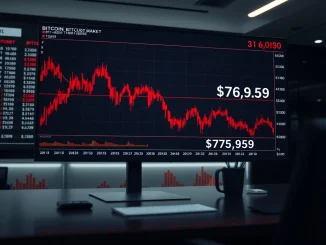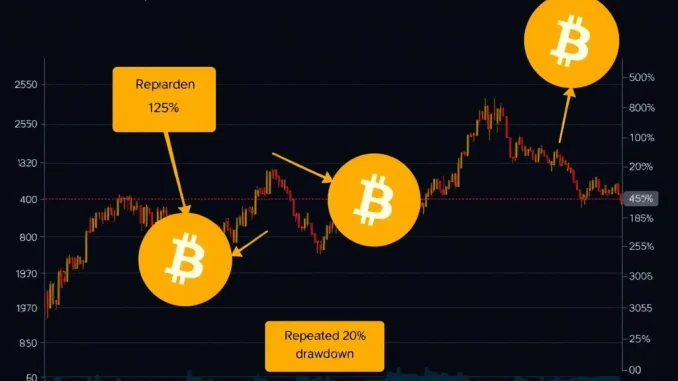
Global, April 2025: The cryptocurrency market faces renewed scrutiny as Bitcoin, the flagship digital asset, experiences a pattern of significant price retracements. Digital asset services firm Matrixport has published analysis suggesting that repeated 20% Bitcoin pullbacks, occurring as the price approaches its 200-week moving average support, could indicate the early stages of a bear market phase. This pattern mirrors historical precedents where similar volatility preceded prolonged downtrends, raising questions about the current market structure’s resilience.
Bitcoin Pullbacks and the Fragile Market Phase
Matrixport’s research team has identified a concerning trend in Bitcoin’s recent price action. The asset has undergone multiple corrections of approximately 20% from local highs within a compressed timeframe. While pullbacks are a normal feature of volatile asset classes, the frequency and depth of these declines have drawn comparisons to periods that marked transitions from bull market exuberance to bear market consolidation. The analysis points to weakening momentum and a potential shift in investor sentiment, where each rally meets with substantial selling pressure. Historically, such patterns often reflect a change in the underlying supply-demand dynamics, where long-term holders begin distributing assets or new buyers fail to absorb available sell-side liquidity.
Technical Context: The 200-Week Moving Average Support
A critical element in Matrixport’s assessment is Bitcoin’s proximity to its 200-week simple moving average (SMA). This long-term trend indicator has served as a major support level in previous cycles, often acting as a final line of defense before more severe bear markets ensue. The current price action sees Bitcoin testing this zone repeatedly. The significance of this level is twofold. First, it represents a multi-year average price that long-term investors watch closely. Second, a decisive and sustained break below it has, in past instances, opened the door to significantly lower prices. The fact that the price is nearing this support amid repeated sharp pullbacks, rather than during a single capitulation event, suggests a grinding, distributional phase may be underway.
Exchange Balance Dynamics and On-Chain Signals
Supporting the price action analysis is on-chain data, particularly the trend of falling exchange balances. A sustained decline in Bitcoin held on centralized exchanges typically indicates coins are moving into long-term storage or cold wallets, an action often associated with accumulation. However, in the current context, Matrixport analysts caution that this trend must be interpreted alongside price performance. If coins are leaving exchanges during a period of price weakness and high volatility, it may not signal confident accumulation but rather a movement to alternative custody solutions amid market uncertainty or preparation for different use cases like collateral. The divergence between a theoretically bullish signal (declining exchange supply) and bearish price action creates a complex puzzle for market participants.
Historical Parallels to Past Bear Cycle Inceptions
Examining Bitcoin’s price history reveals patterns that bear resemblance to the current environment. For instance, in early 2018, after the peak of the previous bull market, Bitcoin experienced a series of sharp, failed rallies followed by 20-30% declines before eventually entering a prolonged bear market. Similarly, in mid-2019, a strong rally peaked and then gave way to a series of lower highs and lower lows, characterized by abrupt sell-offs. The common thread in these periods was not a single crash, but a process of weakening structure where support levels were tested with increasing frequency. Matrixport’s report suggests the market may be in a similar process of discovery, where it is probing for a sustainable price floor amid shifting macroeconomic and regulatory headwinds.
Key characteristics of these historical transitions include:
- Increased Volatility Compression: Periods of low volatility followed by explosive, directional moves.
- Failed Breakouts: Attempts to surpass previous highs are quickly rejected.
- Weakening Momentum Indicators: Tools like the Relative Strength Index (RSI) show lower highs even during price rallies.
- Shift in Narrative: Market focus moves from long-term adoption stories to short-term liquidity and leverage concerns.
The Role of Macroeconomic and Liquidity Conditions
Beyond pure technical analysis, the current market operates within a specific macroeconomic framework. Rising interest rates, quantitative tightening by major central banks, and potential recessions in key economies create a hostile environment for speculative risk assets. Bitcoin, despite its narrative as an inflation hedge or digital gold, has shown high correlation with technology stocks and other risk-on assets during periods of liquidity withdrawal. Therefore, the repeated pullbacks may be less about Bitcoin’s inherent value and more about the global rotation away from risk. Matrixport’s analysis implicitly acknowledges this by framing the price action within a broader “fragile phase,” suggesting external pressures are exacerbating internal market weaknesses.
Market Structure and Derivatives Influence
The modern cryptocurrency market is heavily influenced by derivatives trading, including perpetual swaps and futures contracts. The prevalence of leverage can amplify both rallies and declines. Repeated 20% pullbacks are often sufficient to trigger mass liquidations of leveraged long positions, creating a self-reinforcing feedback loop. When a market is over-leveraged on the long side, a modest price decline can force cascading sells, quickly turning a correction into a steep plunge. Matrixport’s observation of the pullback pattern may be pointing to a market structure that remains overly reliant on leverage, making it prone to these violent deleveraging events. A shift towards a bear phase often involves the systematic unwinding of this excessive leverage, a process that is rarely smooth.
Conclusion: Navigating a Period of Heightened Uncertainty
The pattern of repeated 20% Bitcoin pullbacks, as highlighted by Matrixport, serves as a significant cautionary signal for market participants. While not a definitive predictor, it aligns with technical indicators like the test of the 200-week SMA and creates a historical parallel to the beginnings of past bear cycles. The current environment demands heightened risk management and a focus on market structure over short-term narrative. Whether this develops into a full-fledged bear phase will depend on Bitcoin’s ability to hold key support levels, changes in global liquidity conditions, and the underlying health of on-chain metrics. For investors, understanding these dynamics is crucial for distinguishing between normal volatility and a fundamental change in market trend.
FAQs
Q1: What is a 20% pullback in financial markets?
A 20% pullback refers to a decline in an asset’s price of 20% from a recent peak. It is a significant correction that often signals a shift in sentiment and can indicate the exhaustion of a prior trend.
Q2: Why is the 200-week moving average important for Bitcoin?
The 200-week simple moving average is a long-term trend indicator. In Bitcoin’s history, it has acted as major support during bull markets and a key level to watch. A sustained break below it has often preceded extended bear markets.
Q3: What does falling exchange balance typically indicate?
A falling Bitcoin balance on centralized exchanges usually suggests coins are being withdrawn to private wallets for long-term holding (“hodling”) or other uses. It is generally seen as a reduction in immediate sell-side pressure, though context is critical.
Q4: How does the current market compare to the start of the 2018 bear market?
Similarities include a series of sharp rejections from lower highs and tests of long-term support after a major bull run. Differences include a more mature market structure, institutional involvement, and a distinct macroeconomic backdrop.
Q5: Should repeated pullbacks always be interpreted as bearish?
Not always. In a strong bull market, sharp pullbacks can be healthy consolidations that shake out weak hands. However, when they occur with increasing frequency near key support levels and amid weakening momentum, they raise the probability of a trend change.