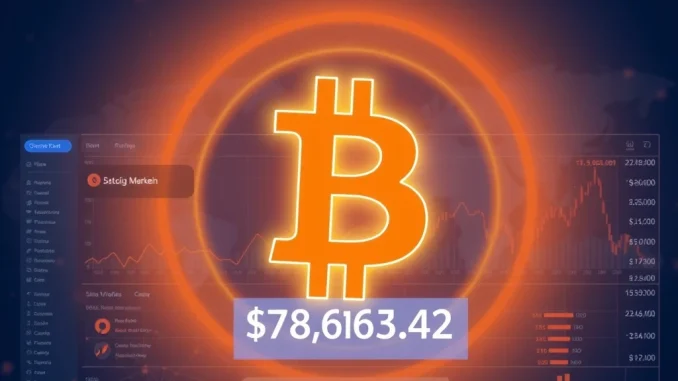
Global, April 2025: The cryptocurrency market witnessed a significant milestone as Bitcoin (BTC), the world’s leading digital asset, surged past the $78,000 mark. According to data from CoinPulseHQ, Bitcoin is currently trading at $78,062.42 on the Binance USDT market. This price level represents a crucial psychological and technical threshold, reigniting discussions about market cycles, institutional adoption, and the evolving role of digital assets in the global financial landscape. The move comes amidst a complex interplay of macroeconomic factors and blockchain-specific developments.
Bitcoin Price Analysis: The Path to $78,000
The ascent to $78,000 did not occur in isolation. Analysts point to a confluence of factors that provided the necessary momentum for this breakout. A primary driver has been the sustained inflow into U.S.-listed spot Bitcoin Exchange-Traded Funds (ETFs). Since their approval, these financial instruments have funneled billions of dollars from traditional finance into Bitcoin, creating consistent buy-side pressure that has steadily eroded overhead resistance levels. Furthermore, the recent Bitcoin halving event in early 2024 continues to exert a long-tail effect on market supply dynamics. The halving mechanism, coded into Bitcoin’s protocol, cut the block reward for miners in half, effectively reducing the new supply of Bitcoin entering the market daily. This programmed scarcity is a fundamental tenet of Bitcoin’s value proposition.
Market sentiment has also shifted notably. On-chain data reveals a decrease in the amount of Bitcoin held on exchanges, suggesting a trend toward long-term holding, or ‘hodling,’ by investors. This reduction in readily available supply on trading platforms can amplify price movements when demand increases. The current trading volume accompanying the price rise indicates strong conviction behind the move, rather than a speculative spike. Technical analysts observe that breaking through the previous all-time high resistance zone was critical, and holding above $78,000 could establish a new support floor for the next phase of the market cycle.
Historical Context and Market Cycles
To understand the significance of the $78,000 level, one must examine Bitcoin’s historical performance. Bitcoin operates in multi-year cycles often characterized by periods of explosive growth followed by consolidation and drawdowns. The previous cycle peak occurred in late 2021, when Bitcoin approached the $69,000 level. The subsequent bear market saw prices retract by over 70%, bottoming near $16,000 in late 2022. The recovery from that low has been methodical, with the market first reclaiming the $30,000 and $50,000 levels before finally challenging and exceeding its old highs. This new peak invalidates the idea of a simple repeat of past cycles and suggests a maturation of the market structure.
- 2017 Cycle: Peak near $20,000, followed by a ~80% decline.
- 2021 Cycle: Peak near $69,000, followed by a ~75% decline.
- 2025 Movement: Break above $78,000 establishes a new all-time high, shifting the entire historical price framework.
This breakthrough is psychologically important for investors. It demonstrates resilience and growth potential beyond previous limits, potentially attracting a new wave of institutional and retail interest that had been waiting for a confirmed breakout into uncharted territory.
Macroeconomic Backdrop and Institutional Influence
The broader financial environment plays a non-negligible role. In an era of persistent inflation concerns and expansive fiscal policies in major economies, assets with perceived scarcity like Bitcoin continue to attract attention as potential hedges. While its correlation to traditional markets has fluctuated, Bitcoin is increasingly viewed as a distinct asset class rather than purely a speculative tech stock. The behavior of large-scale investors, often called ‘whales,’ and corporate treasuries adding Bitcoin to their balance sheets has provided a layer of stability and legitimacy previously absent. The approval and success of regulated financial products, such as the spot ETFs, have created a bridge between Wall Street and the crypto ecosystem, facilitating easier access for pension funds, endowments, and registered investment advisors.
Implications for the Cryptocurrency Ecosystem
Bitcoin’s performance has a profound ripple effect across the entire digital asset space. Often referred to as ‘digital gold,’ Bitcoin’s price strength can buoy sentiment for the broader market. However, the relationship is complex. A rising Bitcoin tide does not necessarily lift all altcoins equally. Capital rotation is a common phenomenon, where profits from Bitcoin are later deployed into other cryptocurrencies. The current rally may test the thesis of ‘altcoin season,’ where alternative digital assets significantly outperform Bitcoin. Key areas to watch include:
- Layer-1 Networks: Platforms like Ethereum, Solana, and Avalanche.
- Decentralized Finance (DeFi): Total Value Locked (TVL) in lending and trading protocols.
- Market Dominance: Bitcoin’s share of the total cryptocurrency market cap.
Furthermore, the mining industry experiences direct impact. Higher Bitcoin prices improve miner profitability, especially post-halving, which could lead to increased investment in mining infrastructure and hash rate, further securing the network. This economic incentive is vital for Bitcoin’s decentralized security model.
Regulatory and Security Considerations
With higher prices and mainstream attention comes increased regulatory scrutiny. Financial authorities worldwide are accelerating efforts to establish clear frameworks for cryptocurrency trading, custody, and taxation. A stable, high-price environment may encourage more deliberate and structured regulatory approaches rather than reactive measures. For investors, security remains paramount. The value locked in the Bitcoin network makes it a constant target for sophisticated threats. The industry response has been the professionalization of custody solutions, including regulated custodians, multi-signature wallets, and institutional-grade security protocols, which are now more critical than ever.
Conclusion
Bitcoin’s rise above $78,000 is a landmark event that underscores the asset’s growing integration into the global financial system. This move is supported by tangible developments like ETF inflows, the post-halving supply shock, and shifting holder behavior, rather than mere speculation. While cryptocurrency markets are inherently volatile and past performance is no guarantee of future results, breaking into new price territory represents a significant evolution in Bitcoin’s narrative. It transitions the conversation from recovery to potential new growth phases, demanding attention from investors, regulators, and technologists alike. The coming weeks will be crucial in determining whether this level holds as a foundation for the next chapter or becomes a point of consolidation.
FAQs
Q1: What does Bitcoin trading at $78,000 mean?
It signifies Bitcoin has reached a new all-time high, exceeding its previous peak from 2021. This is a major psychological and technical milestone that suggests a new phase in its market cycle, often attracting increased media and investor attention.
Q2: What primarily caused Bitcoin to rise above $78,000?
Analysts attribute the rise to sustained capital inflows from U.S. spot Bitcoin ETFs, the continued effects of the 2024 halving reducing new supply, and a macroeconomic environment where some investors seek assets with hard-capped supply as a potential inflation hedge.
Q3: How does Bitcoin’s new high affect other cryptocurrencies?
Historically, a strong Bitcoin can improve overall market sentiment. However, capital often flows from Bitcoin into other assets later in a cycle. The impact varies by project, with attention shifting to fundamentals, ecosystem growth, and technological developments.
Q4: Is Bitcoin considered a safe investment at this price?
Bitcoin remains a highly volatile asset. Its price can experience significant swings. “Safe” is a relative term; it is considered a high-risk, high-potential-reward asset class. Investors are advised to conduct thorough research and only invest capital they are prepared to lose.
Q5: What are the key risks to Bitcoin’s price at this level?
Key risks include sudden shifts in macroeconomic policy (like interest rate hikes), regulatory crackdowns in major economies, large-scale security breaches or exchange failures, technological vulnerabilities, and a sharp reversal in ETF flows leading to sell pressure.
This article was produced with AI assistance and reviewed by our editorial team for accuracy and quality.