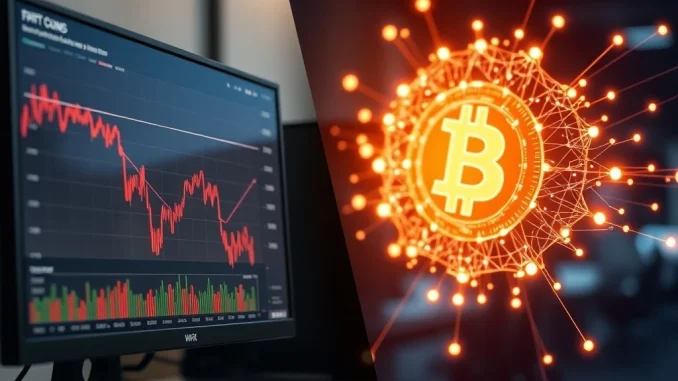
Global, May 2025: The cryptocurrency market faces a significant recalibration as the price of Bitcoin (BTC) falls below the $69,000 threshold. This decline effectively erases the cumulative market gains established over the preceding 15 months, marking a pivotal moment for investor sentiment and portfolio strategy. Concurrently, market data indicates notable capital rotation into alternative crypto assets, with projects in the artificial intelligence sector, such as DeepSnitch AI, attracting increased attention amid speculative listing rumors on major exchanges.
Bitcoin Price Decline Resets the Market Clock
The descent of Bitcoin below $69,000 represents more than a routine market correction. Analysis of historical price data confirms this level as a critical support zone established during the previous bullish cycle. The breach signifies a technical and psychological setback for the market, wiping out gains that had been steadily accumulating since early 2024. This retracement places Bitcoin’s price back to a level not consistently seen in over a year, forcing a reassessment of market dynamics. Several interrelated factors typically contribute to such a contraction:
- Macroeconomic Pressure: Shifts in central bank policies, particularly interest rate expectations, directly impact liquidity available for risk assets like cryptocurrencies.
- Profit-Taking and Leverage Unwinding: After an extended period of gains, institutional and large-scale retail investors often secure profits, triggering sell-offs. This can be exacerbated by the liquidation of over-leveraged long positions in derivatives markets.
- Network Activity and Miner Economics: Changes in transaction fee revenue and the cost of mining can influence selling pressure from network validators.
The immediate consequence is a repricing of risk across the entire digital asset ecosystem, with altcoins often experiencing amplified volatility.
Investor Behavior and the Search for Refuge
Historically, sharp contractions in Bitcoin’s dominance have coincided with capital flows into perceived high-growth alternative sectors. The current market movement appears to follow this pattern, with a segment of investors seeking exposure to narratives distinct from the store-of-value thesis underpinning Bitcoin. The artificial intelligence and decentralized compute sector has emerged as a primary beneficiary. Projects that demonstrably merge blockchain technology with tangible AI utilities are capturing investor interest. This rotation is not merely speculative; it reflects a broader investment thesis around the convergence of two transformative technologies. Market participants are allocating funds to projects they believe could capture value in a future where blockchain facilitates trust, data provenance, and decentralized access for AI models and applications.
Understanding the AI Token Narrative
The interest in tokens like DeepSnitch AI stems from a fundamental market evolution. Unlike earlier cycles driven primarily by monetary policy and adoption narratives, the current landscape increasingly values utility and real-world application. AI-centric crypto projects propose solutions ranging from decentralized data marketplaces and verifiable compute power to AI-driven trading agents and content verification tools. The promise is to create an open, permissionless infrastructure for AI development, countering the centralized control of major tech corporations. When rumors surface regarding a potential listing of such a token on a top-tier exchange, it catalyzes attention. A listing implies enhanced liquidity, greater visibility, and a degree of vetting, which can reduce perceived risk for a certain class of investors compared to smaller, less liquid platforms.
Analyzing the Impact of Listing Rumors on Market Sentiment
Rumors of an impending listing on a major exchange like Binance, Coinbase, or Kraken can create a powerful feedback loop in cryptocurrency markets. The mechanism is straightforward: anticipation of increased accessibility and legitimacy drives buying interest, which raises the price and trading volume, thereby making the asset more attractive to the exchange’s listing committee. It is a self-reinforcing cycle. However, this dynamic requires careful scrutiny. The market has witnessed numerous instances where listing rumors were unfounded, leading to volatile ‘pump and dump’ scenarios. Responsible reporting and analysis must differentiate between verified announcements, credible speculation from industry insiders, and baseless social media hype. The influx of buyers into any asset based on rumors alone represents a high-risk, high-volatility strategy that contrasts sharply with the long-term, fundamentals-based approach advocated by many financial advisors.
Historical Context and Market Cycles
The current market phase bears resemblance to past cycles where Bitcoin consolidates or retraces after a major rally, allowing alternative narratives and technologies to flourish. The 2017-2018 cycle saw the rise of ‘Web3’ and smart contract platforms, while the 2020-2021 cycle was defined by decentralized finance (DeFi) and non-fungible tokens (NFTs). Each phase demonstrated that while Bitcoin often sets the overall market tone, innovation and capital flows continue in specific sectors. The AI and decentralized physical infrastructure (DePIN) narrative may be positioning itself as the defining theme of the mid-2020s. Understanding this cyclical nature is crucial for investors. It provides context that today’s market movements are part of a longer-term process of maturation and sector rotation within the broader digital asset space, rather than an isolated event.
Conclusion
The decline of the Bitcoin price below $69,000 serves as a stark reminder of the cryptocurrency market’s inherent volatility, erasing a significant span of market gains. This reset compels a strategic pivot among investors, many of whom are exploring growth-oriented sectors like AI-integrated blockchain projects. The notable interest in assets such as DeepSnitch AI, fueled partly by listing rumors, underscores the market’s continuous search for the next innovation vector. However, this shift also highlights the critical importance of due diligence, distinguishing between transformative technological potential and short-term speculative fervor. The evolving landscape demands that participants balance opportunity with a clear-eyed assessment of risk and fundamental value.
FAQs
Q1: What does it mean that Bitcoin erased 15 months of market gains?
It means the current price of Bitcoin has fallen back to a level it first reached approximately 15 months ago. All the price appreciation that occurred between then and the recent peak has been lost in this correction, resetting the portfolio value of anyone who bought during that period to breakeven or a loss.
Q2: Why do investors move to tokens like DeepSnitch AI when Bitcoin falls?
This behavior, known as ‘sector rotation,’ occurs when investors seek higher potential returns in alternative assets. A declining Bitcoin market can push capital into newer, smaller-cap projects with different growth narratives, such as AI and blockchain integration, in hopes of outperforming the market leader during a consolidation phase.
Q3: How credible are cryptocurrency listing rumors?
Listing rumors vary widely in credibility. Some originate from official exchange communications or reputable insiders, while many are baseless speculation on social media. Investors should treat all unconfirmed rumors with extreme caution and look for official announcements from the projects or exchanges themselves.
Q4: What are the main risks of investing based on listing rumors?
The primary risks include extreme volatility, the potential for the rumor to be false (leading to a sharp price drop), and the possibility of market manipulation. Prices often rise sharply in anticipation and can fall even faster if the listing does not materialize, resulting in significant financial losses.
Q5: Is the AI sector a sustainable trend in cryptocurrency?
Many analysts believe the integration of AI and blockchain addresses a genuine need for decentralized, transparent, and accessible AI infrastructure. While individual projects may succeed or fail, the underlying trend of combining these technologies is considered by many to be a substantive, long-term thematic investment area, distinct from passing fads.
Updated insights and analysis added for better clarity.
This article was produced with AI assistance and reviewed by our editorial team for accuracy and quality.