
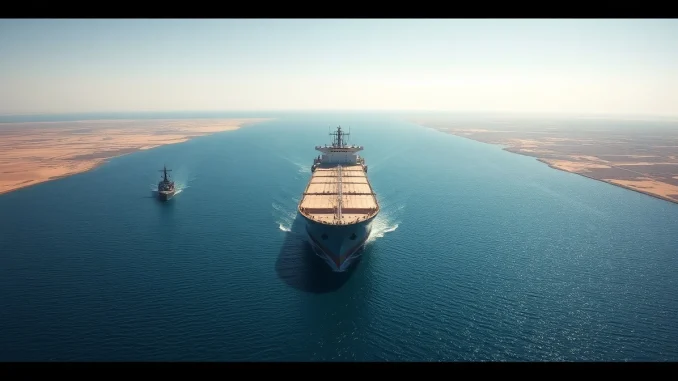
Bitcoin fell sharply to $70,623 on Sunday, April 12, 2026, as global markets reacted to a major US geopolitical move. The trigger was an announcement from US President Donald Trump confirming a naval blockade of the Strait of Hormuz following collapsed peace talks with Iran. Simultaneously, oil prices surged 9.5% to $105 per barrel, highlighting the immediate financial shockwaves from the escalating confrontation.
Bitcoin and Oil React to Strait of Hormuz Blockade
According to market data from TradingView, Bitcoin’s price dropped 1.9% to $71,686 immediately after President Trump’s post on Truth Social. The decline accelerated as US futures markets opened, pushing BTC to a daily low of $70,623—a 2.7% drop on the day. This move correlated directly with a violent spike in Brent crude oil, which jumped to $105 per barrel within thirty minutes of trading. The Strait of Hormuz is a vital maritime chokepoint, handling an estimated 21 million barrels of oil daily, or about one-fifth of global consumption. Any threat to this passage sends immediate ripples through energy markets. Historically, such geopolitical oil shocks have created volatility across asset classes, including digital assets like Bitcoin. This event follows six weeks of heightened US-Iran tensions that have roiled financial markets, producing the most unstable oil trading conditions since Russia’s invasion of Ukraine in 2022.
Also read: EU Crypto Regulation Shift: ECB Backs Dramatic Power Transfer to ESMA
The Geopolitical Trigger: Failed Talks and a Naval Order
President Trump stated that peace talks failed because Iran “refused to end its nuclear weapons program,” which he called the only issue that “really mattered.” He did not address other reported Iranian demands, including war reparations and the unfreezing of blocked financial assets. In his social media post, Trump labeled Iran’s actions—such as laying mines in the waterway and demanding tolls from shipping—as “world extortion.” He subsequently ordered the US Navy to block any vessels that paid Iran and to destroy the mines. This direct order marks a significant escalation from the conflict that began on February 28, 2026, with a US airstrike that killed Iran’s Supreme Leader, Ayatollah Ali Khamenei. The blockade represents a tangible move from rhetoric to enforced economic and military pressure.
Market Mechanics and Correlation Shifts
What does this mean for investors? The simultaneous drop in Bitcoin and surge in oil challenges recent narratives. For much of early 2026, Bitcoin had been touted by some analysts as a potential digital hedge against inflation and geopolitical instability. However, its negative reaction to this event suggests its price drivers remain complex and tied to broader market liquidity and risk sentiment. When traditional safe-havens like gold and the US dollar see inflows during crises, cryptocurrencies can sometimes behave more like risk-on tech stocks. Data from the past six weeks shows this relationship is not static. Despite the initial Sunday sell-off, Bitcoin’s overall performance since the conflict’s start on February 28 is up roughly 7.4%, outperforming both the S&P 500 and gold over the same period. This suggests Bitcoin can recover from geopolitical shocks, but its immediate reaction is often one of correlation with market-wide risk aversion.
Also read: Malicious AI Routers Exposed: How Crypto Credentials Are Being Stolen
Historical Context and Oil Market Volatility
The current volatility in oil markets is not without precedent, but its scale is notable. The 9.5% intraday jump is among the largest since the early 2022 crisis. According to reports from energy analysts, such spikes are typically short-lived unless a physical supply disruption occurs. The US blockade is currently a threat to supply, not an actual stoppage. The financial market reaction is pricing in the risk of that stoppage becoming reality. For context, a prolonged closure of the Strait could remove up to 20% of global seaborne oil from the market. This scenario would likely trigger a sustained price boom and potentially severe global economic consequences. The table below shows key oil price spikes linked to Hormuz tensions:
Recent Events Impacting Hormuz and Oil Prices
- Early 2022: Russia-Ukraine war causes broad commodity volatility.
- 2019-2020: Tanker attacks and seizures near the Strait led to temporary price increases of 5-10%.
- 2018: US re-imposition of sanctions on Iran created supply fears, pushing prices higher for months.
- April 12, 2026: US blockade announcement causes immediate 9.5% spike.
Bitcoin’s Resilience and Long-Term Trajectory
Despite the Sunday dip, Bitcoin’s medium-term chart tells a different story. The cryptocurrency has clawed back significant ground since its October 2025 high of $126,080. Its 7.4% gain since the US-Iran conflict began in late February indicates underlying resilience. Industry watchers note that Bitcoin’s network continues operating unaffected by geopolitical borders or central bank policies. This decoupling from traditional finance fundamentals is a key part of its value proposition. However, its price on centralized exchanges remains susceptible to the same liquidity crunches and margin calls that affect other speculative assets during market panics. The implication is clear: while Bitcoin’s technology is independent, its current market valuation is not fully insulated from global risk-off events. This could signal a maturation phase where it is treated as a legitimate, yet volatile, macro asset by institutional traders.
The Sanctions and Crypto Dimension
A related issue involves the use of cryptocurrency for sanctions evasion. A recent analysis from blockchain intelligence firm Chainalysis warned that paying Iran in digital assets could put shippers at legal risk. The US Treasury has increasingly focused on the potential for cryptocurrencies to circumvent traditional financial sanctions. This geopolitical event, therefore, intersects directly with regulatory scrutiny of crypto. It places digital asset firms in a difficult position, needing to balance privacy with compliance. The blockade announcement will likely intensify debates in Washington and other capitals about the role of decentralized finance in global security.
Conclusion
The April 12 market moves underscore the deep interconnection between geopolitics, traditional commodities, and digital assets. The Bitcoin price drop alongside oil’s surge demonstrates that in moments of acute crisis, correlations between asset classes can converge sharply. The US blockade of the Strait of Hormuz is a developing situation with significant potential to disrupt global energy supplies and financial stability. For Bitcoin investors, the event is a reminder that the asset’s journey to becoming a recognized store of value will be punctuated by periods where it trades in line with broader market fear. Its recovery and performance over the longer six-week conflict period, however, suggest a capacity to absorb geopolitical shocks that many traditional assets lack.
FAQs
Q1: Why did Bitcoin’s price fall after the Hormuz blockade news?
Bitcoin’s price fell due to a market-wide shift to risk-off sentiment. Traders often sell volatile assets like cryptocurrencies during geopolitical crises to raise cash or move into perceived safe havens like the US dollar and Treasury bonds. The immediate oil price spike also raised fears of inflation and slower economic growth, which can hurt speculative assets.
Q2: How significant is the Strait of Hormuz to global oil markets?
It is critically important. Approximately 21 million barrels of oil pass through the Strait daily, representing about 20% of global oil consumption and a third of all seaborne traded oil. Any threat to this transit route has an immediate and substantial impact on global oil prices and energy security.
Q3: Has Bitcoin performed well since the US-Iran conflict started?
Yes, on a medium-term basis. Despite the April 12 drop, Bitcoin’s price is up about 7.4% since the conflict escalated on February 28, 2026. This performance has outpaced traditional benchmarks like the S&P 500 and gold over the same period.
Q4: What did President Trump say caused the peace talks to fail?
In a post on Truth Social, President Trump stated the talks collapsed because Iran refused to end its nuclear weapons program, which he described as the only issue that “really mattered.” He did not address other reported Iranian demands for reparations and unfrozen assets.
Q5: Could this event lead to stricter crypto regulations?
Potentially. Geopolitical tensions often accelerate regulatory scrutiny. The US and other governments are already focused on preventing the use of cryptocurrencies to evade sanctions. A high-profile conflict involving a nation-state like Iran may push regulators to enact stricter compliance rules for crypto exchanges and service providers.

This article was produced with AI assistance and reviewed by our editorial team for accuracy and quality.



Be the first to comment