February 2026: The cryptocurrency market enters a new phase of discernment. Recent Bitcoin price news today highlights a consolidation period, with the flagship asset trading within a defined range. This relative stability in the benchmark cryptocurrency has redirected trader attention toward altcoins, sparking a notable debate. The market now contrasts two distinct narratives: the speculative appeal of established memecoins like Bonk and the emerging, utility-focused promise of AI-driven projects such as DeepSnitch AI. This divergence represents a broader search for what traders term ‘asymmetric returns’—investments with a high potential upside relative to their risk.
Bitcoin Price News Today: Setting the Stage for Altcoin Activity
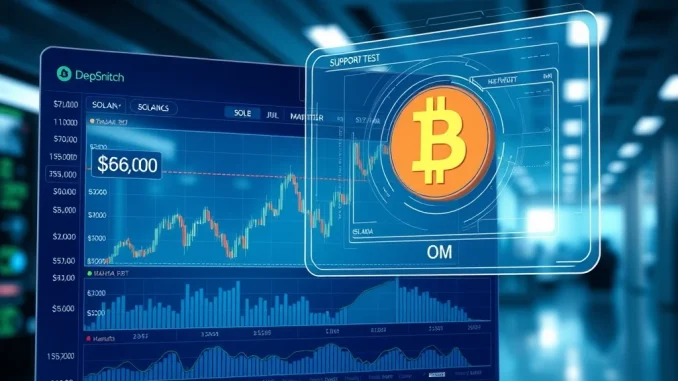
As of mid-February 2026, Bitcoin has demonstrated a period of relative stability after the volatility of previous quarters. Analysts point to several contributing factors. Institutional adoption through regulated exchange-traded products has matured, providing a more stable base of demand. Furthermore, macroeconomic indicators, including interest rate trajectories, have created a less turbulent backdrop for risk assets. This consolidation phase for Bitcoin is a classic market behavior. When the primary market driver enters a range-bound state, capital often flows into secondary assets as participants seek higher percentage gains. This environment creates the fertile ground for the current focus on tokens like Bonk and DeepSnitch AI. The shifting market sentiment is less about a flight from Bitcoin and more about a tactical redeployment of speculative capital within the broader digital asset ecosystem.
The Memecoin Phenomenon: Understanding Bonk’s Market Position
Bonk emerged in the previous market cycle as a community-driven memecoin on the Solana blockchain. Its rise followed a familiar pattern: viral social media promotion, a mascot-centric culture, and rapid, speculative price appreciation driven by retail trader enthusiasm. In 2026, Bonk maintains a significant market capitalization and liquidity, cementing its status as one of the leading assets in its category. Its potential for sharp, rapid rallies—or ‘asymmetric returns’—stems from its high volatility and dedicated community. However, this potential is counterbalanced by significant risk. Memecoins typically lack fundamental utility or revenue-generating mechanisms. Their value is almost entirely derived from collective sentiment and network effects, making them highly susceptible to dramatic downturns. For traders, Bonk represents a pure sentiment play, a bet on the continued power of viral narratives and community momentum in a liquid asset.
The Fundamental Risks of Memecoin Investing
Investing in assets like Bonk requires an understanding of their inherent structure. Unlike projects building underlying technology, most memecoins have a fixed supply and no active development team with a roadmap funded by the treasury. Price action is predominantly driven by trading activity on decentralized and centralized exchanges. This creates a market dynamic where large holders, or ‘whales,’ can have an outsized impact on price. Furthermore, the lack of tangible utility means there is no fundamental floor to the price based on usage or cash flow. While communities can be resilient, the history of cryptocurrencies is littered with memecoins that lost 90% or more of their value when sentiment shifted. Traders hunting for breakout coins in this segment are engaging in a high-stakes game of timing and momentum.
DeepSnitch AI: The Emergence of a Utility-Focused Narrative
In contrast, DeepSnitch AI enters the conversation as a project purportedly built on a foundation of technological utility. While specific details of its protocol are defined by its developers, the general thesis of AI-centric cryptocurrencies is gaining traction. These projects typically aim to leverage blockchain technology to create decentralized markets for AI services, computational resources, or data verification. The investment thesis for a token like DeepSnitch AI is fundamentally different from that of a memecoin. Proponents argue its long-term value should correlate with the adoption and usage of its underlying network. If the platform facilitates valuable AI services, demand for the native token to pay for those services could increase. This creates a potential path for value appreciation based on ecosystem growth rather than sentiment alone. The ‘asymmetric return’ potential here lies in the early-stage valuation of a project that could, in theory, capture a segment of the burgeoning AI economy.
Evaluating the AI Crypto Thesis
The intersection of artificial intelligence and blockchain is a complex and evolving field. Legitimate questions exist about the practical advantages of a decentralized AI service over centralized offerings from established tech giants. Proponents argue for benefits like censorship resistance, privacy, and incentivized data sharing. However, the technological hurdles are significant. Projects must demonstrate not only a working product but also a sustainable economic model that attracts both AI service providers and consumers. For a token like DeepSnitch AI, the risks include technological failure, inability to achieve critical network adoption, and competition from both other crypto projects and traditional Web2 companies. The ‘moonshot’ potential is tied to the massive projected growth of the AI industry, but capturing any meaningful portion of that value is an immense challenge.
Comparative Analysis: Asymmetric Returns in Different Wrappers
The race for asymmetric returns between assets like Bonk and DeepSnitch AI illustrates a core tension in the cryptocurrency market. It is a contest between different forms of speculation.
- Bonk (Memecoin Speculation): The bet is primarily on social dynamics and market psychology. Returns are sought through timing the ebb and flow of community hype and trader momentum. The time horizon is often short to medium-term.
- DeepSnitch AI (Utility Speculation): The bet is on technological execution and ecosystem adoption. Returns are sought through early identification of a platform that will see fundamental growth. The time horizon is typically medium to long-term.
Both carry high risk. The memecoin can collapse if community attention wanes. The utility token can fail if the technology does not deliver or find users. The key difference for investors lies in the narrative they are buying into and their own risk tolerance and research methodology.
Broader Market Implications and Trader Psychology
The activity around these altcoins occurs within the context of Bitcoin’s price behavior. A stable or rising Bitcoin price often boosts overall market confidence, allowing more speculative capital to flow into altcoins. Conversely, a sharp Bitcoin downturn usually correlates with a ‘risk-off’ environment where all altcoins, regardless of narrative, suffer. This relationship underscores that while traders hunt for breakout coins, they remain tethered to the macroeconomic and sentiment drivers affecting the entire asset class. The hunt for 100x returns, or ‘moonshots,’ is a perennial feature of crypto markets, but it intensifies during periods of Bitcoin-led stability or bullishness. It reflects a cycle where early-stage projects and niche narratives gain attention, attract capital, and either succeed, fail, or evolve into the next cycle’s established players.
Conclusion
The current Bitcoin price news today reveals a market in a state of strategic rotation. With Bitcoin itself in a consolidation phase, trader focus has shifted toward identifying the next source of significant growth. This has set the stage for a clear dichotomy: the established, sentiment-driven volatility of memecoins like Bonk versus the nascent, utility-driven promise of AI projects like DeepSnitch AI. Both represent quests for asymmetric returns, but they are founded on radically different theses. One leverages the powerful force of internet culture and community, while the other bets on the convergence of two transformative technologies. For the market observer, this dynamic is less about which asset will ‘outshine’ the other in the short term and more about understanding the two dominant speculative narratives competing for capital in February 2026. The ultimate outcome will depend on a combination of technological progress, community endurance, and broader financial market conditions.
FAQs
Q1: What does ‘asymmetric returns’ mean in cryptocurrency trading?
In finance, asymmetric returns refer to an investment where the potential upside is significantly greater than the potential downside. In crypto, this often describes high-risk altcoins that could theoretically yield multiples on the initial investment, though they carry a high risk of total loss.
Q2: How does Bitcoin’s price stability affect altcoins like Bonk and DeepSnitch AI?
When Bitcoin’s price is stable or rising gradually, it generally fosters positive sentiment across the cryptocurrency market. This often leads to increased trading activity and capital flows into altcoins as investors search for higher percentage gains than Bitcoin might offer in that moment.
Q3: What are the main risks of investing in memecoins like Bonk?
The primary risks include extreme volatility, lack of fundamental utility or underlying cash flow, high concentration of ownership where a few holders can manipulate price, and total reliance on community sentiment and social media trends, which can change rapidly.
Q4: What should investors look for in an AI cryptocurrency project like DeepSnitch AI?
Key factors include a clear and technically viable whitepaper, a demonstrable product or testnet, an experienced development team with relevant expertise, a sustainable token economic model that ties usage to value, and a realistic path to user adoption against significant competition.
Q5: Is the search for ‘100x moonshots’ a healthy part of the crypto market?
It is a natural byproduct of a high-risk, high-reward asset class. While it drives innovation and capital formation for new projects, it also attracts speculation and can lead to significant investor losses. A healthy market requires a balance between speculative exploration and investment based on fundamental research and risk management.
This article was produced with AI assistance and reviewed by our editorial team for accuracy and quality.