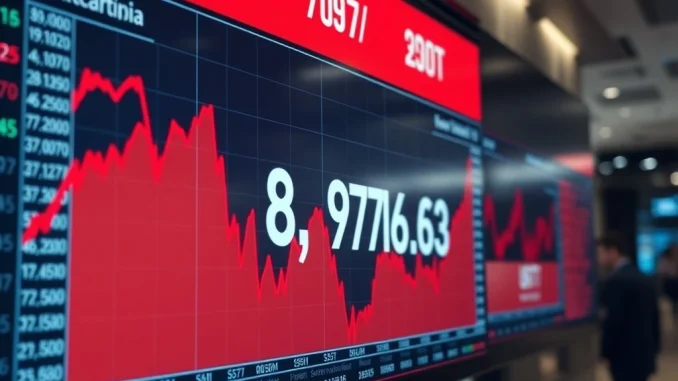
Global Cryptocurrency Markets, April 2025: Bitcoin, the world’s leading digital asset, has experienced a significant price correction, falling below the psychologically important $75,000 threshold. According to real-time data from CoinPulseHQ market monitoring, BTC is currently trading at $74,951.96 on the Binance USDT perpetual futures market. This movement represents a notable shift in short-term market sentiment and breaches a key support level that traders had been watching closely.
Bitcoin Price Dips Below Critical $75,000 Level
The descent below $75,000 marks a pivotal moment in Bitcoin’s recent trading pattern. Throughout the preceding weeks, the $75,000 to $78,000 range had acted as a consolidation zone, with the lower bound serving as a strong support. The breach suggests a change in the balance between buying and selling pressure. Market analysts point to several concurrent factors that may have contributed to this downward movement. These include broader macroeconomic indicators, profit-taking by large holders after a sustained rally, and adjustments in derivatives market positioning. The price action reflects the inherent volatility of the cryptocurrency asset class, where multi-thousand-dollar swings, while significant in nominal terms, represent a standard percentage move within historical context.
Analyzing the Current Cryptocurrency Market Context
To understand this price movement, one must consider the broader market environment. Bitcoin’s price does not exist in a vacuum; it reacts to a complex web of influences.
- Macroeconomic Pressures: Shifts in traditional finance, such as changes in interest rate expectations or strength in the U.S. Dollar Index (DXY), often create headwinds or tailwinds for risk assets like Bitcoin.
- On-Chain Metrics: Data from the blockchain itself provides clues. Analysts examine exchange inflows and outflows to gauge whether coins are moving to custody (a holding signal) or to exchanges (a potential selling signal). The Net Unrealized Profit/Loss (NUPL) metric can also indicate whether the market is in a state of extreme greed or fear.
- Derivatives Market Health: The funding rates on perpetual swap markets and the open interest across futures exchanges offer insight into leverage levels. High leverage can exacerbate both upward and downward price moves.
Current data suggests a cooling of excessive leverage and a normalization of funding rates, which some analysts view as a healthy reset for a sustainable long-term trend.
Historical Precedents and Volatility Cycles
Bitcoin’s history is characterized by cycles of rapid appreciation followed by periods of correction and consolidation. A pullback of this magnitude, while capturing headlines, is not unprecedented. For context, during the 2021 bull market, Bitcoin experienced multiple corrections exceeding 20% before reaching its eventual cycle high. These phases often serve to shake out weak hands, redistribute coins, and establish a stronger foundation for the next leg up. The key for investors is to differentiate between healthy corrections within a bull market and the beginning of a macro trend reversal. Technical analysts are now closely watching the next major support levels, which may lie around $72,000 and $68,000, based on previous areas of price congestion and moving averages.
Implications for Traders and Long-Term Holders
The market reaction to this price drop varies significantly between different participant groups.
| Participant Type | Typical Reaction | Primary Focus |
|---|---|---|
| Short-Term Traders | Adjust stop-losses, seek short opportunities, or look for oversold bounce signals. | Price action, order book depth, and short-term momentum indicators. |
| Long-Term Investors (HODLers) | Often view dips as potential accumulation opportunities, unfazed by daily volatility. | Network fundamentals, adoption metrics, and multi-year macroeconomic trends. |
| Institutional Entities | May execute pre-planned buying strategies at defined price levels or pause inflows to assess stability. | Regulatory developments, custody solutions, and portfolio correlation benefits. |
This divergence in strategy highlights the dual nature of Bitcoin as both a high-volatility trading instrument and a nascent store-of-value asset. The current price provides a real-time case study in these differing philosophies.
The Role of Market Structure and Liquidity
Modern cryptocurrency markets are deep and complex. The price quoted on Binance USDT pairs is a global benchmark, but liquidity is distributed across dozens of regulated and unregulated exchanges. A move below a round number like $75,000 can trigger a cascade of automated sell orders and liquidations in leveraged positions, creating a self-reinforcing, albeit temporary, downward spiral. Market makers and algorithmic trading firms play a crucial role in providing liquidity during these volatile spells, buying when others are panicking and selling during euphoria. The efficiency with which the market absorbs this selling pressure will be a key determinant of whether the drop is a brief flash or the start of a deeper trend.
Conclusion
Bitcoin’s price movement below $75,000 is a significant market event that underscores the asset’s volatile nature. While the headline figure captures attention, the underlying causes—ranging from macroeconomics to derivatives market mechanics—provide the true story. For the cryptocurrency market as a whole, Bitcoin often acts as a bellwether; its price stability or instability can influence sentiment across altcoins and decentralized finance (DeFi) tokens. Investors and observers should monitor how the market consolidates following this drop, paying close attention to volume, on-chain holder behavior, and broader financial conditions. The breach of this key Bitcoin support level is not merely a number change but a moment that tests the conviction of different market participants and the resilience of the current market structure.
FAQs
Q1: Why is the $75,000 level considered important for Bitcoin?
Round number price levels like $75,000 often become psychological benchmarks for traders. They frequently coincide with areas where large volumes of stop-loss orders are placed or where technical analysis identifies previous support/resistance, making them self-fulfilling points of interest.
Q2: Does this price drop mean the bull market is over?
Not necessarily. Bull markets are historically punctuated by sharp corrections. A single drop below a support level does not define a macro trend reversal. Analysts look for a series of lower highs and lower lows, weakening fundamentals, and shifting macro conditions to declare a bull market over.
Q3: How does Bitcoin’s current volatility compare to its history?
While the nominal dollar move seems large, the percentage volatility is within historical norms for Bitcoin. In its earlier years, daily swings of 10-20% were common. As the market has matured and institutionalized, volatility has decreased on a percentage basis, though absolute dollar moves can remain large due to the higher price.
Q4: What should an average investor do in response to this news?
An average investor should avoid making impulsive decisions based on short-term price action. They should refer to their pre-defined investment plan, which should account for volatility. For many, this means maintaining a long-term perspective and not trying to time the market based on daily headlines.
Q5: Where can I find reliable, real-time data on Bitcoin’s price?
Reputable data aggregators like CoinMarketCap, CoinGecko, and TradingView compile prices from multiple major exchanges to provide a global average. For specific exchange prices, visiting the exchange’s own website or API (like Binance’s) provides the most direct data, though it reflects only that venue’s order book.
This article was produced with AI assistance and reviewed by our editorial team for accuracy and quality.