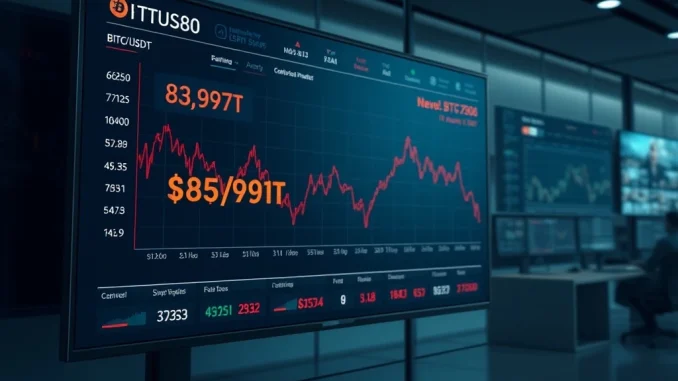
Bitcoin Price Plummets: BTC Falls Below $86,000 in Market Correction
Global, May 2025: The Bitcoin price has fallen below the $86,000 threshold, a significant psychological and technical level for market participants. According to real-time data from CoinPulseHQ market monitoring, BTC is currently trading at $85,974.04 on the Binance USDT perpetual futures market. This move represents a notable pullback from recent highs and has sparked analysis across the digital asset sector regarding its underlying causes and potential trajectory.
Bitcoin Price Action and Immediate Market Context
The breach below $86,000 marks a clear shift in short-term momentum for the world’s leading cryptocurrency. Market analysts point to a confluence of factors contributing to this downward pressure. The decline follows a period of consolidation after Bitcoin’s attempt to challenge the $90,000 resistance level earlier this month. Trading volume data indicates increased selling activity, particularly in the Asian and European trading sessions, which often act as leading indicators for broader market sentiment.
Liquidity analysis shows thinning order books around the $86,000 support level, which may have accelerated the drop once it was breached. This price action is not occurring in isolation. The broader cryptocurrency market capitalization has seen a correlated decrease of approximately 4.2% over the last 24 hours, suggesting a macro-driven move rather than an asset-specific event. Historical data reveals that similar corrections have occurred following prolonged periods of low volatility, which the market experienced throughout much of April.
Analyzing the Drivers Behind the BTC Price Drop
Several fundamental and technical drivers are under scrutiny for their role in the current Bitcoin price movement. On-chain data provides critical insights into holder behavior and network health.
- Exchange Net Flow: Data from Glassnode and CryptoQuant indicates a slight increase in Bitcoin moving to exchanges over the past 48 hours, often a precursor to selling pressure.
- Miner Activity: Hash rate remains stable, but some analysts note that miners may be liquidating a portion of their holdings to cover operational costs following the recent halving event.
- Macroeconomic Factors: Traditional finance markets are experiencing volatility due to shifting expectations around central bank interest rate policies, which frequently impact risk assets like Bitcoin.
- Regulatory Developments: Ongoing discussions about digital asset frameworks in major economies like the United States and the European Union create an environment of uncertainty.
The following table illustrates key support and resistance levels identified by technical analysts:
| Support Level | Resistance Level | Significance |
|---|---|---|
| $84,200 | $86,800 | Previous consolidation zone |
| $82,500 | $88,000 | 200-day moving average / Psychological level |
| $80,000 | $90,000 | Major psychological and technical barrier |
Historical Precedents and Market Psychology
Bitcoin’s history is characterized by cyclical volatility. A review of past corrections provides context for the current BTC price movement. In the 2021 bull market, Bitcoin experienced multiple drawdowns exceeding 20% before resuming its upward trend. The current pullback from recent highs sits at approximately 8%, which remains within the range of typical market fluctuations.
Market sentiment, as measured by tools like the Crypto Fear & Greed Index, has shifted from “Greed” to “Neutral” over the past week. This cooling of sentiment can be a healthy development, potentially shaking out over-leveraged positions and establishing a stronger foundation for future price appreciation. Long-term holders, defined as addresses holding Bitcoin for more than 155 days, continue to accumulate, suggesting underlying confidence in the asset’s fundamental value proposition despite short-term price action.
Implications for Investors and the Cryptocurrency Ecosystem
The movement of the Bitcoin price below $86,000 has immediate implications for various market participants. For retail investors, it underscores the importance of risk management and the volatile nature of cryptocurrency assets. Institutional investors, who have increased their exposure to Bitcoin through spot ETFs and corporate treasuries, often view such pullbacks as potential entry points, provided their long-term thesis remains intact.
The derivatives market shows increased activity, with open interest in futures contracts remaining elevated. However, funding rates have normalized from previously high levels, reducing the risk of a cascading liquidation event. For the broader cryptocurrency ecosystem, Bitcoin’s price often acts as a tide that lifts or lowers all boats. Altcoins have generally exhibited higher beta, meaning they tend to fall more sharply during Bitcoin downturns but may also recover more quickly during rallies.
Network fundamentals for Bitcoin remain robust. The hash rate, a measure of computational power securing the network, sits near all-time highs, indicating strong miner commitment. Transaction fees have normalized after a brief spike, suggesting healthy block space demand without congestion. These on-chain metrics provide a counter-narrative to pure price analysis, highlighting the distinction between network utility and speculative trading value.
Conclusion
The Bitcoin price falling below $86,000 represents a significant technical development within the current market cycle. While short-term sentiment may be negatively impacted, historical analysis suggests such corrections are a normal feature of Bitcoin’s market behavior. The fundamental health of the Bitcoin network remains strong, supported by high security, increasing institutional adoption, and its established role as a digital store of value. Market participants will closely watch whether key support levels hold and monitor macroeconomic developments that influence all risk assets. The current BTC price action serves as a reminder of the asset’s inherent volatility and the importance of a disciplined, long-term investment perspective.
FAQs
Q1: Why did Bitcoin fall below $86,000?
The decline is attributed to a combination of technical selling after failing to break resistance, potential miner selling post-halving, and broader risk-off sentiment in global markets affecting all speculative assets.
Q2: Is this a major crash or a normal correction?
Based on historical volatility patterns, a drop of this magnitude (approximately 8% from recent highs) falls within the range of a normal market correction rather than a major crash, which typically involves declines exceeding 20%.
Q3: What are the key support levels to watch now?
Analysts are watching the $84,200 level (previous consolidation zone), followed by the $82,500 area, which aligns with the 200-day moving average and represents a major psychological support.
Q4: How does this affect other cryptocurrencies?
Bitcoin often sets the trend for the broader crypto market. Most major altcoins are correlated with BTC and have likely experienced similar or greater percentage declines during this move.
Q5: Should investors buy the dip?
Investment decisions depend on individual risk tolerance, time horizon, and strategy. Some long-term investors view such corrections as accumulation opportunities, while traders may wait for clearer signs of a trend reversal. Always conduct your own research.
Q6: What on-chain metrics suggest about Bitcoin’s health?
Key on-chain metrics like hash rate (security) remain strong, and long-term holder accumulation continues, suggesting underlying network health despite short-term price volatility.
Related News
- Metaplanet's Bold Bitcoin Strategy: Doubling Down with New MARS and MERCURY Equity Plans
- Bitcoin Hash Ribbons Indicator Flashes Crucial Buy Signal: Analyzing the Miner Capitulation Recovery
- ETH daily high income cashing! ——RICH Miner cloud mining launches an application based on Ethereum to convert into daily income
Related: UQUID Simplifies Web3 Shopping: A New Era for Crypto Payments and Global Commerce
Related: Bitcoin Price Compression: How BTC's Tightening Range Signals an Impending Breakout