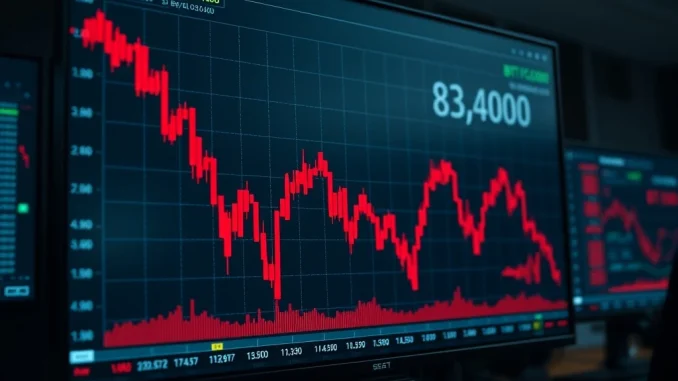
Global Cryptocurrency Markets, April 2025: The price of Bitcoin (BTC) has fallen below the psychologically significant $84,000 threshold, a move that captures the attention of investors and analysts worldwide. According to real-time data from CoinPulseHQ market monitoring, Bitcoin is currently trading at $83,967.75 on the Binance USDT perpetual futures market. This decline represents a notable shift in the short-term trajectory of the world’s leading digital asset, prompting a closer examination of market dynamics and underlying factors.
Bitcoin Price Drops Below Key Support Level
The descent below $84,000 marks a breach of a recent consolidation zone that had provided support for Bitcoin over the preceding trading sessions. Market data indicates selling pressure increased during the Asian and early European trading hours, leading to a gradual erosion of the support level. This price action is not an isolated event but part of the inherent volatility that characterizes digital asset markets. Analysts often monitor such key round-number levels, as they can act as both technical support and resistance, influencing trader psychology and automated trading algorithms. The move brings Bitcoin’s price back to a region last seen approximately two weeks ago, effectively unwinding a portion of the gains accrued during the latest bullish impulse.
Analyzing the Cryptocurrency Market Context
To understand the significance of this price movement, one must consider the broader market environment. Several concurrent factors typically contribute to such shifts.
- Macroeconomic Sentiment: Traditional financial markets, including equities and bonds, often influence cryptocurrency investor sentiment. Shifts in interest rate expectations or geopolitical tensions can trigger correlated movements across asset classes.
- On-Chain Metrics: Data from the Bitcoin blockchain itself provides clues. Metrics like exchange inflows (suggesting selling intent), miner outflow, and the activity of long-term holders offer a fundamental backdrop to price action.
- Leverage Flush: The derivatives market, where the reported price is from, is highly sensitive to leverage. A sharp price drop can trigger liquidations of over-leveraged long positions, exacerbating the downward move in a cascade effect.
This dip occurs within a longer-term context that remains broadly constructive for many market participants, who view pullbacks as healthy corrections within a larger trend.
Historical Precedents and Volatility Cycles
Bitcoin’s history is a study in volatility. Corrections of 10-20% from local highs are common and have frequently preceded further upward movements. For instance, during the 2023-2024 cycle, Bitcoin experienced multiple drawdowns exceeding 15% before ultimately reaching new all-time highs. This pattern of rapid advances followed by sharp consolidations is a hallmark of the asset’s price discovery process. The current pullback, while noteworthy, falls within the range of expected volatility for Bitcoin, especially when considered against its year-to-date performance. Understanding this cyclical nature helps investors maintain perspective during periods of short-term price stress.
Implications for Traders and Long-Term Investors
The reaction to this price movement differs significantly between short-term traders and long-term holders. Active traders may view the break below $84,000 as a signal to adjust their strategies, potentially implementing risk management measures or seeking short-term opportunities. Key levels to watch now include potential support zones around $82,000 and $80,000. Conversely, investors with a multi-year horizon often employ a different framework. They might assess the change in price against fundamental metrics like network security, adoption trends, and the evolving regulatory landscape. For them, short-term volatility is a secondary concern to the long-term thesis of Bitcoin as a decentralized digital store of value. This dichotomy in market participant behavior is a core feature of cryptocurrency markets.
The Role of Market Structure and Liquidity
Market structure plays a crucial role in how prices move. The reported price from Binance, one of the world’s largest cryptocurrency exchanges by volume, reflects a deep and liquid market. However, liquidity can thin during rapid moves, leading to increased slippage for large orders. The presence of institutional participants through regulated products like spot Bitcoin ETFs has also changed the market’s character, potentially dampening extreme volatility over time while increasing correlation with traditional finance. The current price action tests the resilience of this evolving market structure and the depth of buy-side liquidity at lower price levels.
Conclusion
Bitcoin’s fall below the $84,000 mark is a significant short-term market event that underscores the asset’s volatile nature. While the immediate price of $83,967.75 captures headlines, the more critical analysis lies in the context: the health of the broader crypto ecosystem, underlying on-chain fundamentals, and the macroeconomic climate. For market observers, this move serves as a reminder of the importance of robust risk management and a focus on long-term fundamentals over short-term price fluctuations. The Bitcoin price will continue to be a key barometer for digital asset sentiment, and its journey below this level will be closely watched for signals of the next market phase.
FAQs
Q1: Why did Bitcoin fall below $84,000?
Bitcoin’s price is influenced by a combination of factors including broader market sentiment, profit-taking after a rally, changes in leverage within derivatives markets, and reactions to macroeconomic news. A specific, single cause is rarely identifiable.
Q2: Is this a major crash for Bitcoin?
Based on historical standards, a move of this magnitude is considered a normal correction within a volatile market. Major crashes are typically defined by much larger percentage drawdowns (e.g., 50% or more) over a sustained period.
Q3: What does this mean for other cryptocurrencies (altcoins)?
Bitcoin often sets the tone for the broader cryptocurrency market. A sustained drop in Bitcoin’s price frequently leads to correlated declines in major altcoins, often with even greater magnitude due to their higher beta relative to BTC.
Q4: Where can I reliably check the current Bitcoin price?
Reputable sources include major exchange websites like Binance and Coinbase, as well as established aggregate data providers like CoinMarketCap, CoinGecko, and TradingView, which compile prices from multiple trading venues.
Q5: What are key support levels to watch now?
Following a break below $84,000, traders often watch previous areas of consolidation for potential support. These might include levels around $82,000 and the psychologically important $80,000 round number, though these are dynamic and based on technical analysis.