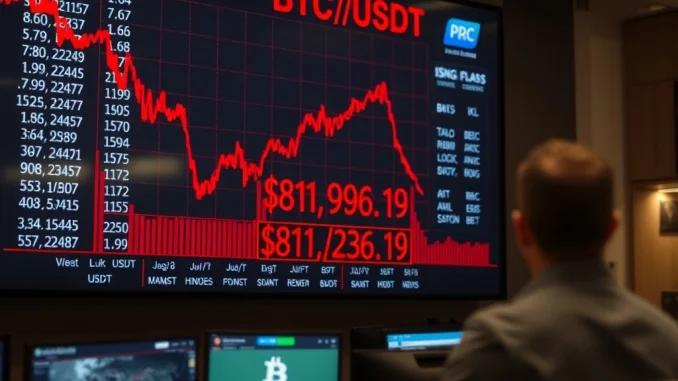
Global, May 2025: The cryptocurrency market experienced a significant correction today as the price of Bitcoin (BTC) fell below the $82,000 threshold. According to real-time data from CoinPulseHQ, Bitcoin is currently trading at $81,956.01 on the Binance USDT perpetual futures market. This move represents a notable pullback from recent highs and has captured the attention of traders and analysts worldwide, prompting a closer examination of market dynamics and underlying factors.
Bitcoin Price Dips Below Key Psychological Level
The descent below $82,000 marks a critical juncture for the world’s leading digital asset. Market participants often watch round-number levels like $80,000 or $82,000 for signs of support or resistance. A break below such a level can trigger automated sell orders and influence short-term trader sentiment. The current price action reflects a broader cooling-off period following an extended rally earlier in the year. This volatility is not unprecedented for Bitcoin, an asset class known for its significant price swings. Historical data consistently shows that sharp corrections are a common feature within longer-term bullish trends, serving to shake out over-leveraged positions and establish healthier foundations for future growth.
To understand the scale of this movement, it is helpful to view it within a recent timeframe. The table below illustrates a simplified snapshot of Bitcoin’s price action over the past week, highlighting the volatility leading to the current level.
| Date | Approximate Price High | Key Event / Note |
|---|---|---|
| 7 Days Ago | $84,500 | Period of consolidation after a rally |
| 3 Days Ago | $83,200 | Initial signs of selling pressure |
| 1 Day Ago | $82,800 | Support tested at $82,500 |
| Current | $81,956.01 | Support broken below $82,000 |
Analyzing the Cryptocurrency Market Context
Bitcoin does not trade in a vacuum. Its price movement often correlates with, or reacts to, several interconnected factors. Analysts are currently assessing a confluence of elements that may have contributed to this downturn. Firstly, broader macroeconomic indicators, such as shifts in interest rate expectations or strength in traditional equity markets, can influence capital flows into and out of risk assets like cryptocurrency. Secondly, on-chain metrics provide a data-driven view of network activity. Metrics like exchange inflows (suggesting selling pressure) versus accumulation by long-term holders can offer clues about market participant behavior.
Furthermore, the derivatives market plays a crucial role. High levels of leverage, measured by funding rates across perpetual swap markets, can exacerbate price moves in either direction. A market crowded with long positions can become vulnerable to a cascade of liquidations during a downturn, accelerating the decline. Other potential contextual factors include:
- Regulatory Developments: News or rumors concerning digital asset regulation in major economies can create uncertainty.
- Network Activity: Changes in transaction volume or fee pressure on the Bitcoin blockchain.
- Institutional Flows: Data from spot Bitcoin exchange-traded funds (ETFs) regarding daily inflows or outflows.
- Global Liquidity Conditions: The overall availability of capital in financial markets.
Historical Precedents and Volatility Cycles
For seasoned observers, a pullback of this magnitude is a familiar pattern. Bitcoin’s history is characterized by cycles of explosive growth followed by steep corrections. For instance, during the 2017 bull run, Bitcoin experienced multiple drawdowns exceeding 30% before ultimately reaching its then-peak. Similarly, the 2021 cycle saw several sharp declines within the broader uptrend. These corrections serve important market functions. They transfer assets from weak-handed, short-term speculators to conviction-driven long-term investors, a process often described as “shaking the tree.” This current move below $82,000, while significant, is being measured against the asset’s historical volatility profile to gauge whether it represents a healthy consolidation or the beginning of a deeper trend change.
Implications for Traders and Long-Term Investors
The reaction to this price action differs fundamentally between two primary groups: active traders and long-term, or “HODL,” investors. For traders utilizing technical analysis, the break below $82,000 becomes a new data point. They will now watch for how the price interacts with the next potential support zones, which could be around $80,000 or lower. Volume analysis during this decline is also critical; a high-volume sell-off suggests strong conviction from sellers, while lower volume might indicate a lack of follow-through. Risk management, including the use of stop-loss orders and careful position sizing, is paramount in such conditions.
For long-term investors who subscribe to Bitcoin’s value proposition as a decentralized store of value or digital gold, short-term price fluctuations are often viewed as noise. Their investment thesis is typically based on fundamental beliefs about network adoption, scarcity (the halving cycle), and macroeconomic trends like currency debasement, rather than daily price charts. For this cohort, periods of price decline can present strategic accumulation opportunities, a practice known as “dollar-cost averaging” (DCA) into the asset. The key distinction lies in the time horizon and the underlying reason for holding the asset.
Conclusion
Today’s market activity, with the Bitcoin price falling below $82,000 to trade at $81,956.01, underscores the inherent volatility of the cryptocurrency asset class. This movement is a reminder of the dynamic and often unpredictable nature of digital asset markets. While the immediate cause may be a combination of technical breakdowns, derivative market liquidations, and shifting macro sentiment, the longer-term trajectory for Bitcoin will depend on broader adoption trends, regulatory clarity, and its evolving role in the global financial system. As always, market participants are advised to conduct their own research, understand the risks involved, and invest only what they can afford to lose. The coming days will be crucial in determining whether this is a brief stumble or a sign of a more sustained shift in market structure.
FAQs
Q1: Why did Bitcoin’s price fall below $82,000?
Bitcoin’s price is influenced by many factors. This specific decline likely resulted from a combination of technical selling after breaking a key support level, potential liquidations of over-leveraged long positions in derivatives markets, and broader macroeconomic sentiment affecting risk assets.
Q2: Is this a crash or a normal correction?
Based on historical patterns, a move of this size is consistent with a normal market correction within a volatile asset class. Bitcoin has frequently experienced pullbacks of 20-30% during its long-term bull markets. Whether it deepens into a more severe crash depends on subsequent price action and market fundamentals.
Q3: What is the difference between the spot price and the futures price mentioned?
The article references the Binance USDT perpetual futures market. A futures price is an agreement to buy or sell an asset at a future date. It can sometimes trade at a slight premium or discount to the spot price, which is the current market price for immediate settlement. They are closely linked but can diverge due to funding rates and market sentiment.
Q4: What should I do if I own Bitcoin?
There is no one-size-fits-all answer. Your action should align with your investment strategy and risk tolerance. Long-term investors may see this as a non-event or a buying opportunity. Active traders might adjust their positions based on their technical analysis. It is crucial to avoid making panic-driven decisions.
Q5: Where can I find reliable, real-time Bitcoin price data?
Reputable cryptocurrency data aggregators like CoinGecko, CoinMarketCap, and TradingView provide real-time price feeds from multiple exchanges. It’s also common to check prices directly on major trading platforms like Binance, Coinbase, or Kraken. Always use multiple sources to verify data.