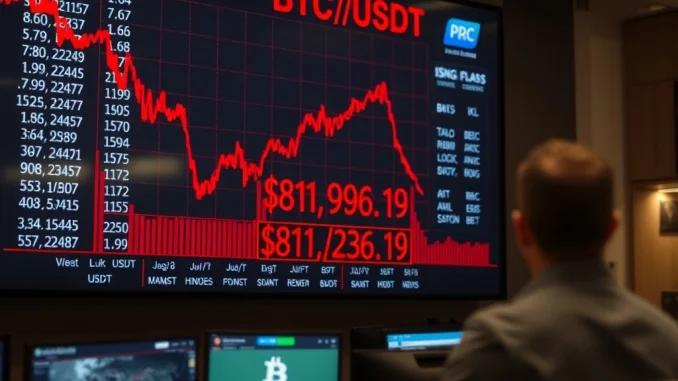
Global, May 2025: The cryptocurrency market witnessed a significant correction today as the Bitcoin price fell below the psychologically important $82,000 level. According to real-time data from CoinPulseHQ market monitoring, BTC is currently trading at $81,926.19 on the Binance USDT perpetual futures market. This move represents a notable pullback from recent highs and has sparked analysis across trading desks worldwide regarding its drivers and potential duration.
Bitcoin Price Action and Immediate Market Context
The descent below $82,000 marks a clear technical breakdown for the world’s leading digital asset. Market data shows sustained selling pressure throughout the early trading sessions, with the asset failing to hold support levels established over the preceding week. This price movement is not occurring in isolation. Analysts immediately cross-referenced the drop against broader market indicators. Trading volume spiked significantly during the decline, indicating strong conviction among sellers. Furthermore, the move correlated with a sharp increase in the funding rates for perpetual swap contracts, which had reached elevated levels, often preceding a market cool-down or correction as leveraged long positions become expensive to maintain.
This price action follows a period of consolidation where Bitcoin struggled to reclaim its all-time high territory. The failure to gather upward momentum above $85,000 likely contributed to the bearish sentiment that culminated in today’s drop. On-chain data providers also reported an increase in coin movement from older wallets to exchanges, a metric often interpreted as a precursor to selling activity from long-term holders seeking to realize profits.
Analyzing the Drivers Behind the Cryptocurrency Market Dip
Several interconnected factors typically contribute to sudden downward movements in crypto asset valuations. Identifying the primary catalysts requires examining macro-financial conditions, sector-specific news, and technical market structure.
- Macroeconomic Pressure: Global financial markets have exhibited heightened sensitivity to interest rate expectations and inflation data. A stronger-than-anticipated U.S. dollar index (DXY) often creates headwinds for risk assets, including cryptocurrencies. Any hawkish commentary from central banks can trigger capital rotation out of speculative assets.
- Profit-Taking and Leverage Unwind: After a substantial rally, it is common for traders to secure profits. This selling can cascade, especially if it triggers liquidations in the highly leveraged derivatives market. A drop below key support levels can force automated systems to sell, exacerbating the downward move.
- Market Sentiment and News Flow: While no single catastrophic news event preceded this drop, the cumulative effect of regulatory discussions, network fee fluctuations, or miner selling can gradually shift sentiment from bullish to cautious.
- Technical Breakdown: From a chartist perspective, the breach of the $82,000 level was a critical failure. This price point acted as both a round-number psychological support and a convergence zone for several moving averages. Its loss provided a clear signal to algorithmic and discretionary traders to reduce exposure or initiate short positions.
Historical Precedent for Bitcoin Volatility
To understand the current Bitcoin price movement, one must view it through the lens of the asset’s historical behavior. Bitcoin is renowned for its volatility, with drawdowns of 10-20% occurring regularly even within long-term bull markets. For instance, during the 2021 cycle, Bitcoin experienced multiple corrections exceeding 30% on its path to a then all-time high. These pullbacks serve to shake out over-leveraged speculation, reset derivatives markets, and allow the asset to establish a healthier foundation for its next leg higher. Seasoned market participants often note that such volatility is a feature, not a bug, of an emerging, globally traded digital asset class that operates 24/7 without traditional market closures.
The Ripple Effect on Altcoins and the Broader Crypto Ecosystem
Bitcoin’s role as the market leader means its price movements have profound implications for the entire digital asset space. Historically, a significant drop in BTC’s value has a correlated, and often amplified, effect on alternative cryptocurrencies (altcoins). This phenomenon, often called “Bitcoin dominance,” was evident in today’s trading. Major altcoins like Ethereum (ETH), Solana (SOL), and Cardano (ADA) posted percentage losses that generally exceeded Bitcoin’s decline. This highlights a flight to relative safety, where traders exit riskier, higher-beta assets first during a downturn. The total cryptocurrency market capitalization fell in tandem, erasing billions in nominal value across thousands of projects. Furthermore, decentralized finance (DeFi) protocols often see reduced total value locked (TVL) during such periods, as the underlying collateral value of crypto assets declines.
Institutional Perspective and On-Chain Metrics
Institutional analysts are scrutinizing on-chain data for clues about future direction. Key metrics include:
- Exchange Net Flow: A sustained flow of Bitcoin onto exchanges can signal intent to sell, while movement off exchanges (into cold storage) suggests accumulation.
- Miner Reserve: Monitoring whether miners are holding or selling their newly minted coins provides insight into industry cash flow pressures.
- Realized Price & MVRV Ratio: These metrics compare the current price to the average price at which all coins last moved, helping to gauge whether the market is in a state of overall profit or loss, which influences holder behavior.
Early data suggests an increase in coins moving to exchanges, aligning with the sell-off, but the overall supply held by long-term holders remains near historically high levels, indicating core conviction has not broken.
Conclusion: Navigating Market Uncertainty
The event of the Bitcoin price falling below $82,000 serves as a stark reminder of the inherent volatility within the cryptocurrency market. While the immediate move is bearish, it exists within the context of Bitcoin’s multi-year narrative of adoption and technological integration. For investors, such periods underscore the importance of risk management, avoiding excessive leverage, and maintaining a long-term perspective grounded in the fundamental properties of blockchain technology. Market corrections, while challenging, often create opportunities for disciplined investors to engage with the asset at more favorable valuations. The coming days will be critical in observing whether Bitcoin can reclaim lost support or if further consolidation at lower levels is necessary. The broader implications for portfolio strategy and the digital asset class remain a focal point for financial analysts globally.
FAQs
Q1: Why did Bitcoin’s price fall below $82,000?
The drop is likely due to a combination of factors including broader macroeconomic pressures, profit-taking after a rally, an unwind of over-leveraged long positions in derivatives markets, and a technical breakdown of key support levels.
Q2: How low could the Bitcoin price go following this drop?
Predicting exact price targets is speculative. Traders will watch for established support levels, such as $78,000 or $75,000, based on previous consolidation zones and on-chain data. Market sentiment and macro conditions will be the ultimate guide.
Q3: Does this mean the bull market for Bitcoin is over?
Not necessarily. Historically, Bitcoin has experienced severe corrections within long-term uptrends. A single day’s price action does not define a multi-month or multi-year market cycle. The fundamental drivers of adoption, such as institutional investment and technological development, remain ongoing.
Q4: Should I sell my Bitcoin now?
This is a personal financial decision that depends on your investment horizon, risk tolerance, and original thesis. Many long-term investors view volatility as a normal characteristic and may use downturns to dollar-cost average into positions, while short-term traders may adjust their strategies based on technical signals.
Q5: How does Bitcoin’s drop affect other cryptocurrencies like Ethereum?
Bitcoin is the market leader, so its price movements heavily influence the entire crypto sector. Typically, during a Bitcoin downturn, altcoins experience equal or greater percentage losses as risk appetite diminishes across the board.
Q6: Where can I find reliable, real-time data on Bitcoin’s price?
Reputable sources include data aggregators like CoinGecko and CoinMarketCap, as well as trading views on established exchanges like Binance, Coinbase, and Kraken. Always verify data across multiple platforms.