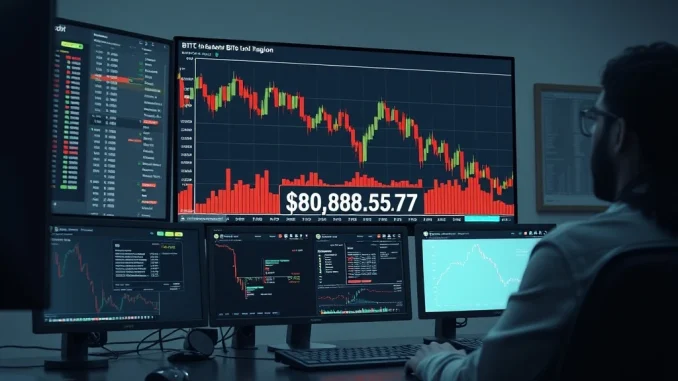
Global, May 2025: The Bitcoin price has experienced a notable decline, falling below the $81,000 threshold. According to data from CoinPulseHQ market monitoring, BTC is currently trading at $80,868.87 on the Binance USDT perpetual futures market. This movement represents a significant shift in the short-term market sentiment for the world’s leading cryptocurrency, prompting analysis from traders and observers worldwide.
Bitcoin Price Dips Below Key Psychological Level
The descent of the Bitcoin price below $81,000 marks a key moment in the current market cycle. While daily fluctuations are common in cryptocurrency markets, breaches of round-number levels often attract heightened attention. The specific price point of $80,868.87, as recorded on Binance, one of the world’s largest digital asset exchanges, provides a concrete data point for assessing market conditions. This movement follows a period of relative consolidation and occurs amidst a complex global macroeconomic backdrop. Analysts typically scrutinize such moves for clues about underlying supply and demand dynamics, institutional flows, and broader risk appetite in financial markets.
Analyzing the Context of the Cryptocurrency Market Decline
To understand the significance of BTC falling below $81,000, one must consider the broader market context. Cryptocurrency prices are influenced by a confluence of factors, not isolated events.
- Macroeconomic Indicators: Traditional finance metrics like interest rate expectations, inflation data, and strength of the U.S. dollar can heavily impact digital asset valuations. Bitcoin is increasingly viewed as a risk-on asset, sensitive to shifts in global liquidity.
- On-Chain Metrics: Data from the Bitcoin blockchain itself, such as exchange inflows and outflows, miner activity, and wallet holdings, provides a fundamental view of network health and holder behavior.
- Regulatory Developments: News concerning cryptocurrency regulation in major economies like the United States, the European Union, and parts of Asia can trigger immediate market reactions, both positive and negative.
- Technical Analysis Levels: Traders often identify support and resistance levels on price charts. A break below a level like $81,000 can trigger automated selling or a reassessment of short-term price targets.
This current dip represents a test of recent market structure. The price action will be closely watched to see if it finds support at a lower level or continues its descent.
Historical Precedents and Market Volatility
Bitcoin’s history is characterized by significant volatility. Sharp corrections within larger bullish trends are not uncommon. For instance, during the 2021 bull market, BTC experienced multiple drawdowns exceeding 20% before ultimately reaching new highs. These periods often serve to shake out over-leveraged positions and can establish stronger foundations for future growth. The current market environment in 2025, with increased institutional participation and more sophisticated financial products like spot Bitcoin ETFs, may alter the character of these swings, but volatility remains an inherent feature. Understanding this historical context is crucial for separating short-term noise from long-term trend changes.
Implications for Traders and Long-Term Investors
The reaction to Bitcoin falling below $81,000 will differ significantly between various market participants. Day traders and short-term speculators may view this as an opportunity for short positions or a signal to exit long holdings. Conversely, long-term investors, often referred to as ‘HODLers,’ might see a price dip as a potential accumulation zone, especially if their investment thesis remains unchanged regarding Bitcoin’s long-term value proposition as a decentralized store of value. The critical distinction lies in time horizon and risk tolerance. For the broader cryptocurrency ecosystem, a sustained drop in Bitcoin’s price often leads to correlated declines in altcoins, as BTC dominance—its share of the total crypto market capitalization—can increase during risk-off periods.
| Metric | Detail |
|---|---|
| Current Price (Binance USDT) | $80,868.87 |
| Key Level Breached | Below $81,000 |
| Data Source | CoinPulseHQ Market Monitoring |
| Primary Market | Binance Perpetual Futures (USDT pair) |
Conclusion
The Bitcoin price movement below $81,000 is a significant data point in the ongoing narrative of the 2025 cryptocurrency market. While the immediate cause may be attributed to a combination of technical selling, macroeconomic pressures, or sector-specific news, its true importance will be determined by the market’s subsequent behavior. Does the price find stable support, or does the decline accelerate? This event underscores the inherent volatility of digital asset markets and highlights the importance of conducting thorough research, employing sound risk management, and maintaining a perspective aligned with one’s individual investment goals. Monitoring the Bitcoin price for stability or further deviation will be a key focus for the global financial community in the coming days.
FAQs
Q1: Why did Bitcoin fall below $81,000?
Bitcoin’s price is influenced by many factors, including broader financial market sentiment, macroeconomic data, regulatory news, and internal market dynamics like trading volume and leverage. A specific, single cause is rarely identifiable; it is typically a combination of these elements leading to increased selling pressure.
Q2: Is this a major crash for Bitcoin?
Based on the information provided, this is a price correction. The term “crash” is subjective but generally implies a rapid, deep, and sustained decline. A move below a specific threshold like $81,000 is a notable market event but requires context regarding its depth and duration to be classified further.
Q3: How does this affect other cryptocurrencies?
Bitcoin is often considered the market leader for cryptocurrencies. Significant moves in its price frequently have a correlative effect on the wider digital asset market, with many altcoins experiencing similar or more pronounced volatility. This phenomenon is known as ‘market correlation.’
Q4: Should I buy Bitcoin now that the price has dropped?
This is a personal financial decision that depends on your investment strategy, risk tolerance, and research. Price dips can be seen as buying opportunities by some investors, but they do not guarantee future gains. Always conduct your own due diligence and consider consulting a qualified financial advisor.
Q5: Where can I find reliable, real-time Bitcoin price data?
Reputable cryptocurrency data aggregators like CoinMarketCap, CoinGecko, and TradingView provide real-time price feeds from multiple exchanges. It’s also common to check prices directly on major trading platforms like Binance, Coinbase, or Kraken. The data in this report originated from CoinPulseHQ’s monitoring of the Binance market.
This article was produced with AI assistance and reviewed by our editorial team for accuracy and quality.