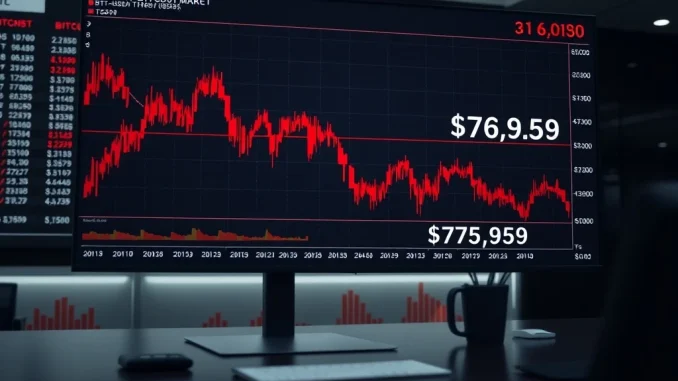
Global, May 2025: The cryptocurrency market witnessed a significant correction today as the price of Bitcoin (BTC) fell below the $77,000 mark. According to real-time data from CoinPulseHQ, Bitcoin is currently trading at $76,959.56 on the Binance USDT perpetual futures market. This move represents a notable pullback from recent highs and has captured the attention of traders and analysts worldwide, prompting a closer examination of market dynamics and underlying factors.
Bitcoin Price Dips Below Key Level
The descent below $77,000 marks a clear technical and psychological shift for the world’s leading digital asset. Market monitoring services recorded a steady decline in buying pressure throughout the early trading sessions, leading to the breach of this short-term support zone. The Binance USDT pair, often considered a benchmark for global liquidity, reflects the immediate sentiment among a broad base of traders. This price action is not occurring in isolation; it follows a period of consolidation after Bitcoin’s attempt to challenge its all-time high. Analysts are now scrutinizing order book depth and exchange flows to gauge whether this is a healthy correction or the precursor to a deeper retracement. Historical data shows that such movements are common within Bitcoin’s volatile lifecycle, often serving to shake out over-leveraged positions and establish a stronger foundation for future moves.
Analyzing the Cryptocurrency Market Context
To understand this price movement, one must consider the broader cryptocurrency ecosystem. Bitcoin often acts as a market leader, with its performance influencing altcoins and the overall sector sentiment.
- Market Correlation: Early indicators show most major altcoins following Bitcoin’s downward trajectory, though with varying degrees of intensity.
- Trading Volume: Spot and derivatives trading volumes have spiked significantly, indicating heightened activity and potential liquidations.
- Macroeconomic Factors: External pressures, such as shifting expectations around interest rates or traditional equity market performance, can indirectly affect crypto asset valuations.
- On-Chain Metrics: Data from blockchain analysts may reveal changes in exchange reserves, miner behavior, or the movement of long-held coins, providing clues about holder sentiment.
This event underscores the inherent volatility of digital asset markets. For institutional and retail participants, such volatility necessitates robust risk management strategies, including clear position sizing and the use of stop-loss orders.
Historical Perspective on Bitcoin Volatility
Bitcoin’s history is punctuated by sharp corrections. A review of past cycles reveals that pullbacks of 20-30% are not uncommon, even within strong bull markets. For instance, during the 2021 bull run, Bitcoin experienced multiple drawdowns exceeding 20% before ultimately reaching new highs. These corrections often serve to reset overbought technical indicators and cool excessive speculation. The current decline, while noteworthy, fits within the established pattern of Bitcoin’s price discovery process. Long-term investors, often referred to as ‘HODLers,’ typically view these dips as potential accumulation opportunities, while short-term traders may see them as signals to adjust their strategies. The key differentiator is often the fundamental health of the network, which remains strong with high hash rates and sustained developer activity.
Implications for Traders and the Crypto Ecosystem
The immediate consequence of Bitcoin’s drop is a repricing of risk across the entire digital asset space. Leveraged positions are most vulnerable, as margin calls can force liquidations, potentially exacerbating the downward move.
| Factor | Potential Impact |
|---|---|
| Derivatives Market | Increased funding rates may normalize; high liquidations can increase volatility. |
| Investor Psychology | Tests the conviction of recent buyers; may deter new capital in the short term. |
| Project Funding | Venture capital flows into crypto startups can be sensitive to prolonged bearish sentiment. |
| Regulatory Discourse | Price instability often reignites discussions about market stability and investor protection. |
For the ecosystem, healthy corrections can strengthen the market by removing excess leverage. They also provide a reality check for projects and valuations, potentially redirecting focus toward fundamental utility rather than pure speculation. Market infrastructure, including exchanges and custody services, is stress-tested during such periods, highlighting the importance of operational resilience.
Conclusion
Bitcoin’s fall below $77,000 is a significant market event that highlights the asset’s characteristic volatility. While the current Bitcoin price of $76,959.56 represents a pullback, it is an expected feature of its market cycle. The movement provides critical data on market structure, liquidity, and participant behavior. For observers and participants, the focus should remain on long-term trends, network fundamentals, and disciplined investment approaches rather than short-term price fluctuations. The cryptocurrency market’s evolution continues to be a complex interplay of technology, finance, and global sentiment, with today’s action serving as another chapter in its dynamic history.
FAQs
Q1: Why did Bitcoin fall below $77,000?
Bitcoin’s price is influenced by a combination of factors including overall market sentiment, profit-taking after a rally, changes in liquidity, macroeconomic conditions, and activity in the derivatives market. A specific catalyst is rarely singular.
Q2: Is this a normal occurrence for Bitcoin?
Yes. Bitcoin has a history of high volatility. Corrections of 10-30% are common even during broader upward trends, as the market absorbs profits and reassesses value.
Q3: What does this mean for other cryptocurrencies?
Bitcoin often sets the tone for the broader crypto market. Most major altcoins (alternative cryptocurrencies) tend to correlate with Bitcoin’s price movements, especially during sharp downturns, though some may decouple based on individual project news.
Q4: Should investors be worried about this price drop?
Investors should have a strategy that accounts for volatility. A short-term price drop does not necessarily alter long-term theses. It underscores the importance of risk management, not investing more than one can afford to lose, and focusing on fundamental research.
Q5: Where can I find reliable, real-time Bitcoin price data?
Reputable sources include data aggregators like CoinGecko and CoinMarketCap, as well as major exchange websites like Binance, Coinbase, and Kraken, which provide real-time trading data for their respective markets.
This article was produced with AI assistance and reviewed by our editorial team for accuracy and quality.