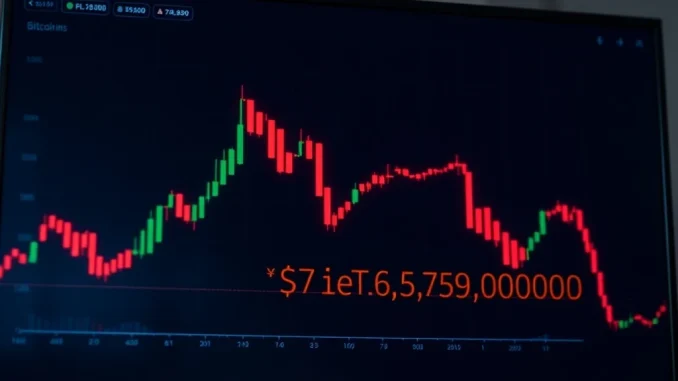
Bitcoin Price Plummets: BTC Falls Below $75,000 in Market Shift
Global Cryptocurrency Markets, April 2025: Bitcoin, the world’s leading digital asset, has experienced a significant price decline, falling below the key psychological threshold of $75,000. According to real-time data from CoinPulseHQ market monitoring, BTC is currently trading at $74,931.44 on the Binance USDT perpetual futures market. This movement marks a notable shift in recent market sentiment and prompts a closer examination of the underlying factors and broader context.
Bitcoin Price Drops Below Critical Support Level
The descent below $75,000 represents more than a simple numerical change. Market analysts often view round-number thresholds as significant support and resistance zones where trading activity intensifies. The breach of this level suggests a shift in the short-term balance between buyers and sellers. This price action follows a period of consolidation where Bitcoin struggled to maintain momentum above the $78,000 mark established earlier in the month. The immediate cause appears to be a combination of increased selling pressure from large holders, known as whales, and a broader cooling of risk appetite across global financial markets. Data from on-chain analytics firms indicates a rise in Bitcoin transfers to exchange wallets, a common precursor to selling activity.
Analyzing the Current Cryptocurrency Market Conditions
Bitcoin does not trade in a vacuum. Its price movement interacts with a complex ecosystem of macroeconomic indicators, regulatory news, and technical market structure. Several concurrent factors are contributing to the current environment.
- Macroeconomic Pressure: Recent statements from the U.S. Federal Reserve regarding persistent inflation have strengthened the U.S. dollar, which historically creates headwinds for risk-on assets like Bitcoin.
- Liquidity and Leverage: The cryptocurrency derivatives market has seen high levels of leverage in recent weeks. A price drop can trigger a cascade of liquidations, where leveraged positions are automatically closed, accelerating the downward move.
- Relative Market Performance: While Bitcoin has declined, its market dominance—the percentage of the total crypto market cap it represents—has remained relatively stable, suggesting this is not a flight from crypto to traditional assets, but a sector-wide correction.
Historical Context of Bitcoin Volatility
For long-term observers, a single-day price drop of this magnitude is not an anomaly but a characteristic feature of Bitcoin’s market behavior. Since its inception, Bitcoin has experienced numerous drawdowns exceeding 20% even within sustained bull markets. For instance, during the 2021 cycle, Bitcoin saw multiple corrections of 30% or more before reaching its all-time high. This volatility stems from its relatively young and evolving market structure, the absence of a central bank to provide stability, and the emotional trading patterns of its participant base. Understanding this history is crucial for separating short-term noise from long-term trend analysis.
Technical and On-Chain Data Perspectives
Beyond the spot price, a deeper look at blockchain data and technical indicators provides a more nuanced picture. The Net Unrealized Profit/Loss (NUPL) metric, which tracks the overall profit/loss state of the network, had recently entered the “belief” zone, indicating a large portion of holders were in profit. This often precedes profit-taking events. Meanwhile, key moving averages, such as the 50-day and 200-day, still reside significantly below the current price, suggesting the longer-term trend may not yet be threatened. The $72,000 to $73,000 range now emerges as the next critical support zone, based on previous consolidation areas and large volume profiles.
| Level | Price (USD) | Significance |
|---|---|---|
| Current Price | $74,931.44 | Real-time trading value on Binance USDT market |
| Key Resistance | $78,400 | Previous local high from early April |
| Immediate Support | $72,000 – $73,000 | High-volume node and previous consolidation zone |
| Major Support | $68,500 | 200-day simple moving average (approximate) |
Implications for Investors and the Ecosystem
The price drop has immediate consequences for different market participants. For short-term traders, it highlights the importance of risk management and stop-loss orders. For long-term holders, often referred to as “HODLers,” such dips are frequently viewed as potential accumulation opportunities, provided their fundamental thesis for Bitcoin remains unchanged. Within the broader ecosystem, mining profitability comes under slight pressure as the USD value of block rewards decreases, though this is often mitigated by adjustments in network difficulty. Furthermore, the decline tests the resilience of various decentralized finance (DeFi) protocols that use Bitcoin as collateral, though most are designed with significant safety buffers for exactly this scenario.
Conclusion
Bitcoin’s fall below the $75,000 mark to $74,931.44 is a significant market event that reflects a confluence of technical selling, macroeconomic sensitivity, and the asset’s inherent volatility. While the short-term price action captures headlines, the more important narrative lies in the underlying health of the network, which continues to operate without interruption, and the long-term adoption trends, which remain positive. Market participants are now closely watching the $72,000 support level and broader equity market correlations to gauge the next directional move for the premier cryptocurrency. As always, prudent investment in this space requires a focus on fundamentals, an understanding of volatility, and a time horizon measured in years, not hours.
FAQs
Q1: Why did Bitcoin fall below $75,000?
The drop is attributed to a combination of factors including profit-taking by large holders after a strong rally, a strengthening U.S. dollar due to macroeconomic policy expectations, and the triggering of leveraged long position liquidations in the derivatives market.
Q2: Is this a normal occurrence for Bitcoin?
Yes, significant intra-cycle volatility is a well-documented characteristic of Bitcoin. Corrections of 20-30% have been common even during historical bull markets, as the asset class matures and finds new price equilibriums.
Q3: What is the next important price level to watch?
Market analysts are focusing on the $72,000 to $73,000 range as the next major support zone. A hold above this level could suggest consolidation, while a break below might indicate a deeper correction toward the $68,500 area.
Q4: How does this affect Bitcoin miners?
A lower Bitcoin price in USD terms reduces the immediate fiat revenue from block rewards. However, mining difficulty adjusts periodically based on network hash rate, and many miners operate with hedging strategies to manage such volatility.
Q5: Should long-term investors be concerned about this price movement?
For investors with a long-term horizon focused on Bitcoin’s fundamental value proposition as a decentralized digital store of value, short-term price fluctuations are generally considered noise. Historical data shows that holding through such volatility has been a successful strategy, though it requires significant risk tolerance.
Related News
- Prediction Markets Shatter Records with Staggering $700M Daily Volume Milestone
- Historic: BlackRock's $180B BUIDL Token Launch on Uniswap Signals Major DeFi Pivot
- Gala Games Joins Forces with the White House for the Easter Egg Roll – A First for Crypto
Related: Crypto Presales February 2026: Analyzing Market Activity and Projects Like IPO Genie
Related: On-Chain Derivatives: How High-Performance Chains and Layer 3 Solutions Create a Scalable Future
Related: Solana Dominates: Unprecedented Network Transaction Lead Across All Blockchains in 2025