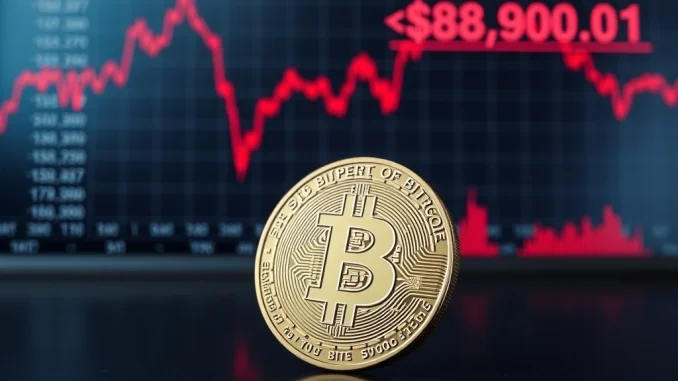
Global Cryptocurrency Markets, April 2025: Bitcoin, the world’s leading digital asset, has experienced a notable decline, with its price falling below the psychologically significant $89,000 level. According to real-time data from CoinPulseHQ market monitoring, BTC is currently trading at $88,950.01 on the Binance USDT perpetual futures market. This movement represents a key moment for traders and analysts observing the cryptocurrency’s volatile trajectory.
Bitcoin Price Dips Below a Critical Threshold
The descent of Bitcoin below $89,000 marks a shift from recent trading ranges observed over the preceding weeks. Market analysts routinely monitor such round-number levels, as they often act as support or resistance zones where trading activity intensifies. The breach of this level suggests a shift in short-term market sentiment, potentially driven by a confluence of macroeconomic factors and internal market dynamics. While daily volatility is a hallmark of the cryptocurrency asset class, movements of this magnitude against key levels warrant a closer examination of the underlying drivers.
Historical data shows that Bitcoin has experienced similar corrections throughout its history, often preceding periods of consolidation or renewed upward momentum. The current price action must be contextualized within the broader financial landscape, including traditional equity market performance, central bank policy announcements, and global liquidity conditions. This event underscores the inherent unpredictability and high-risk, high-reward nature of digital asset investment.
Analyzing the Cryptocurrency Market Context
To understand the significance of Bitcoin’s price movement, one must look beyond a single data point. The cryptocurrency market operates as a complex, 24/7 global network influenced by diverse factors. Several elements could be contributing to the current pressure on Bitcoin’s valuation.
- Macroeconomic Headwinds: Shifts in interest rate expectations or inflation data from major economies can impact investor appetite for risk assets, including cryptocurrencies.
- On-Chain Metrics: Analysts examine blockchain data, such as exchange inflows and outflows, to gauge whether coins are moving into storage (a bullish sign) or onto exchanges for potential sale.
- Derivatives Market Pressure: The Binance USDT perpetual market, where the reported price is sourced, is a derivatives platform. Large liquidations of leveraged long or short positions can exacerbate price movements in either direction.
- Regulatory Developments: News or speculation regarding digital asset regulation in key jurisdictions like the United States or the European Union can create immediate market uncertainty.
It is crucial to note that correlation does not imply causation. While these factors provide a framework for analysis, pinpointing a single catalyst for a price move in a decentralized market is often impossible.
Historical Perspective on Bitcoin Volatility
Bitcoin’s journey from a niche digital experiment to a multi-trillion-dollar asset class has been defined by extreme volatility. Periods of rapid appreciation, often called “bull runs,” have consistently been followed by sharp corrections, sometimes exceeding 50% or more. These cycles have historically served to shake out speculative excess and establish stronger foundational support levels for the next phase of growth. The current pullback, while significant in nominal terms, remains within the established historical pattern of Bitcoin’s market behavior. Long-term investors, often referred to as “HODLers,” have historically viewed such dips as potential accumulation opportunities, though this strategy carries substantial risk.
Implications for Traders and the Digital Asset Ecosystem
The immediate implication of Bitcoin falling below $89,000 is a test of market structure. Technical analysts will now watch to see if the price finds support at a lower level, such as $88,000 or $86,500, or if it attempts to reclaim the $89,000 level as new resistance. This price action will influence trading strategies across the board, from high-frequency algorithmic traders to retail investors.
Furthermore, Bitcoin’s performance often sets the tone for the broader altcoin market. A sustained downturn in BTC can lead to amplified losses in smaller-cap cryptocurrencies, a phenomenon known as “altseason contraction.” Conversely, a swift recovery in Bitcoin could restore confidence across the ecosystem. The event also highlights the importance of robust risk management practices for anyone involved in cryptocurrency markets, including the use of stop-loss orders and the avoidance of excessive leverage.
Conclusion
The Bitcoin price movement below $89,000 serves as a stark reminder of the digital asset market’s inherent volatility. While the specific price of $88,950.01 is a snapshot in time, the underlying market dynamics it reveals are of lasting importance. This event emphasizes the need for investors to conduct thorough research, understand the macroeconomic landscape, and maintain a disciplined approach to risk. The evolution of the Bitcoin price will continue to be a primary indicator of sentiment within the burgeoning digital economy, making its fluctuations a critical area of study for market participants worldwide.
FAQs
Q1: Why is the $89,000 level significant for Bitcoin?
Round-number price levels like $89,000 often act as psychological barriers in trading. They can become focal points for buy and sell orders, making them temporary support or resistance. A breach of such a level can signal a shift in short-term market momentum.
Q2: How does Bitcoin’s current volatility compare to its history?
While a drop below a key level is notable, Bitcoin has experienced far more severe drawdowns throughout its history. Its long-term chart is characterized by cycles of parabolic rises followed by deep corrections, often lasting months. The current move is within the established range of its volatile behavior.
Q3: What are perpetual futures contracts, like the Binance USDT market mentioned?
Perpetual futures are derivative contracts that allow traders to speculate on an asset’s future price without an expiry date. The Binance USDT market is one of the largest venues for trading BTC perpetuals, and its price is a key benchmark, though it can sometimes deviate slightly from the spot market price due to leverage and funding rates.
Q4: Should a price drop like this change a long-term investment strategy?
A long-term investment strategy should be based on fundamental beliefs about Bitcoin’s technology and adoption potential, not short-term price swings. Volatility is expected. Investors should only allocate capital they are willing to lose and avoid making impulsive decisions based on daily price action.
Q5: Where can I find reliable, real-time data on cryptocurrency prices?
Reputable data aggregators like CoinMarketCap, CoinGecko, and TradingView compile prices from multiple major exchanges. It is always best to cross-reference data from several sources, as prices can vary slightly between trading platforms due to liquidity differences.
Updated insights and analysis added for better clarity.
This article was produced with AI assistance and reviewed by our editorial team for accuracy and quality.