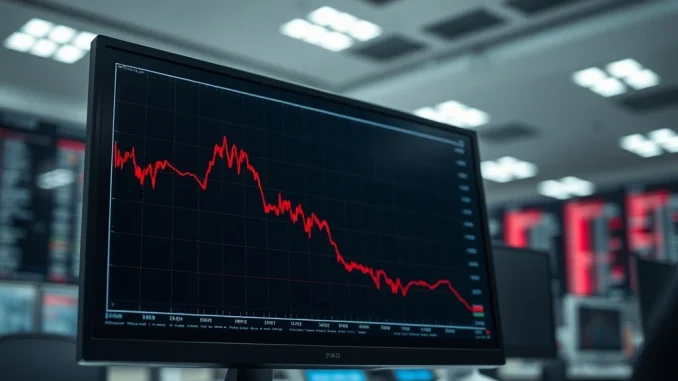
On Friday, March 7, 2026, Bitcoin’s price tumbled below the critical $70,000 support level, plunging to near $68,000 on major exchanges like Bitstamp. The sharp decline occurred during the Wall Street open, triggered by unexpectedly weak U.S. employment data that failed to provide the anticipated tailwind for risk assets. This Bitcoin price drop erased the cryptocurrency’s latest breakout attempt from the $74,000 level, continuing a pattern of failed rallies that has characterized its 2026 trading activity. Market analysts immediately pointed to stubbornly hawkish Federal Reserve policy expectations as the core driver, despite clear signals of labor market strain.
Bitcoin Price Drops Amid Surprising Labor Market Weakness
Data from TradingView confirmed a daily loss exceeding 3%, with Bitcoin (BTC) hitting a low of $68,176. The catalyst was a Bureau of Labor Statistics (BLS) report that shocked economists. Instead of the predicted gain of 58,000 jobs, the U.S. economy lost 92,000 positions in February. Consequently, the unemployment rate climbed to 4.4%. This marked only the second monthly job loss since the 2020 pandemic, a stark reversal from January’s surprisingly strong numbers. Trading resource The Kobeissi Letter noted on X, “The US labor market is clearly weakening.” Traditionally, such data would boost expectations for Federal Reserve interest rate cuts, providing fuel for speculative assets like crypto. However, the market reaction defied this historical pattern entirely.
Analysts quickly identified the divergence between the weak data and market expectations as the key story. The immediate sell-off in both crypto and equities suggested investors were interpreting the job losses not as a trigger for monetary policy easing, but as a signal of broader economic deterioration that could hurt corporate earnings and asset valuations. This nuanced reaction highlights a shift in how traders are processing macroeconomic signals in 2026, prioritizing immediate risk aversion over future policy speculation.
Federal Reserve Hawkish Stance Thwarts Crypto Bulls
The most critical factor behind the sell-off was the market’s perception of the Federal Reserve’s unwavering stance. Data from CME Group’s FedWatch Tool showed traders assigning a minimal probability of a rate cut at the Fed’s upcoming March 18 meeting. Furthermore, the market consensus priced in just one rate cut for the entirety of 2026. This hawkish outlook acted as a gravity well, pulling Bitcoin and other risk assets lower despite the ostensibly rate-cut-friendly jobs report. The failure of weak data to alter Fed expectations created a “no-win” scenario for bulls.
- Dashed Rate Cut Hopes: The jobs report did not meaningfully shift the needle on Fed policy odds, leaving crypto without a fundamental catalyst.
- Broad Risk-Off Sentiment: The S&P 500 and Nasdaq Composite fell 1.5% and 1.3% respectively, showing the sell-off was systemic, not crypto-specific.
- Safe-Haven Flow: Only gold gained significantly, up 1.5% to $5,155 per ounce, confirming a classic flight to safety among investors.
Expert Analysis on the Failed Breakout Pattern
Market commentators expressed frustration at Bitcoin’s repetitive price action. Maartunn, a contributor to CryptoQuant, identified a clear pattern. “Deviations above the Range High keep getting sold,” he noted, pointing to three similar failed breakouts in recent months. His analysis of perpetual contract charts suggested the $71,000 level had again acted as a “trap for late longs.” Keith Alan, co-founder of Material Indicators, echoed this sentiment, observing, “Looks like $BTC is round tripping the range…again.” This technical perspective confirms that the March 7 drop was not an isolated event but part of a consolidative trend where each rally attempt meets aggressive selling pressure, a dynamic that has defined Bitcoin’s struggle to establish new highs in 2026.
Broader Context: Crypto and Traditional Market Correlation
The synchronized decline of Bitcoin and U.S. equities underscores their continued high correlation in 2026. This relationship reinforces Bitcoin’s characterization by many institutional investors as a “risk-on” asset, highly sensitive to shifts in liquidity expectations and macroeconomic sentiment. The day’s events provided a clear case study: when hopes for increased liquidity (via rate cuts) evaporate, both tech stocks and crypto suffer simultaneously. This correlation challenges the narrative of Bitcoin as a digital gold or uncorrelated asset, at least in the short-term timeframe of macroeconomic shocks.
| Asset | Performance (March 7) | Key Driver |
|---|---|---|
| Bitcoin (BTC) | -3.2% (to ~$68.2K) | Hawkish Fed outlook despite weak jobs data |
| S&P 500 Index | -1.5% | Economic concern outweighing rate cut hopes |
| Gold (XAU) | +1.5% (to ~$5,155) | Flight to safety, traditional hedge |
| Nasdaq Composite | -1.3% | Pressure on growth/tech valuations |
What Happens Next: Watching Key Support and Fed Speech
The immediate focus for traders shifts to Bitcoin’s ability to hold above its 200-week exponential moving average (EMA) and the former 2021 all-time high zone, both critical long-term support levels. A sustained break below could trigger a deeper correction. Fundamentally, all eyes will be on Federal Reserve officials’ commentary in the coming days. Markets will scrutinize any speech for hints that the weak jobs data has altered the Fed’s internal model. The central bank’s next meeting on March 18 now carries even greater weight, though a policy change is considered highly unlikely. The path forward for Bitcoin appears contingent on a shift in the macro landscape, not just crypto-specific developments.
Trader Sentiment and On-Chain Activity
Following the price drop, on-chain analytics pointed to mixed signals. While some reports indicated large exchange outflows—often a sign of accumulation—the prevailing sentiment on trading desks was caution. The repeated failure to hold breakout levels has bred skepticism among short-term traders. This creates a environment where rallies are quickly sold into, perpetuating the consolidation range. The community reaction on social platforms reflected this fatigue, with many highlighting the disconnect between negative macro data and the lack of a positive market response.
Conclusion
The March 7 Bitcoin price drop to near $68,000 was a significant event driven by a complex macroeconomic interplay. Surprisingly weak U.S. jobs data failed to rescue crypto bulls because it did not change the market’s firmly hawkish outlook for the Federal Reserve. This highlights a mature market that is looking beyond surface-level data and focusing on the actual trajectory of monetary policy. Bitcoin’s repeated failure to sustain breakouts, noted by analysts like Maartunn and Keith Alan, confirms a period of extended consolidation. For investors, the key takeaway is that in the current regime, Bitcoin remains tightly coupled to traditional risk assets and Federal Reserve policy expectations. The next major move will likely require a definitive shift in the central bank’s rhetoric or a decoupling of crypto from equity market correlations.
Frequently Asked Questions
Q1: Why did Bitcoin price drop despite weak US jobs data?
The price dropped because the weak jobs data did not increase expectations for imminent Federal Reserve interest rate cuts. Markets still foresee a hawkish Fed with only one cut priced in for 2026, removing a key potential bullish catalyst for risk assets like Bitcoin.
Q2: What was the specific jobs data that triggered the sell-off?
The U.S. Bureau of Labor Statistics reported the economy lost 92,000 jobs in February 2026, far worse than the expected gain of 58,000. The unemployment rate also rose to 4.4%.
Q3: What are the key support levels for Bitcoin after this drop?
Traders are watching the 200-week exponential moving average (EMA) and the price zone around the old 2021 all-time high as critical long-term support levels that must hold to prevent a deeper correction.
Q4: How did other assets like stocks and gold perform?
The S&P 500 fell 1.5% and the Nasdaq fell 1.3%, showing a broad risk-asset sell-off. In contrast, gold rose 1.5%, demonstrating a classic flight to safety by investors.
Q5: What is the “round tripping” pattern analysts mentioned?
It refers to Bitcoin’s repeated pattern in 2026 of breaking above a resistance level (e.g., $71,000) only to quickly fall back into its previous trading range, frustrating bulls and trapping late buyers.
Q6: What should crypto investors watch next?
Investors should monitor commentary from Federal Reserve officials for any change in tone regarding rate cuts, and watch Bitcoin’s ability to hold above key support levels. The Fed’s meeting on March 18 is the next major scheduled event.