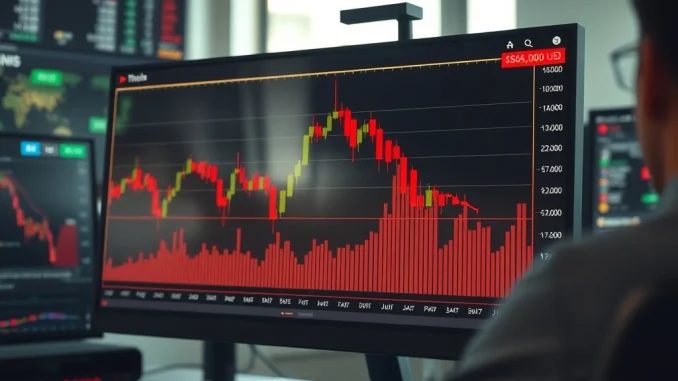
NEW YORK, March 6, 2026 — Bitcoin faces mounting pressure as simultaneous crises in private credit markets and escalating Middle East conflict trigger a broad risk-off sentiment across global financial markets. The cryptocurrency dropped 7% between Thursday and Friday, testing the critical $65,000 support level that traders now watch with heightened anxiety. This sharp correction follows Bitcoin’s failed attempt to reclaim the $74,000 level earlier in the week, coinciding with weak U.S. economic data and spiking oil prices as the U.S.-Israel-Iran war enters its seventh day. Market analysts point to redemption spikes in major private credit funds and deteriorating macroeconomic visibility as primary drivers behind the sudden Bitcoin price drop to $65K.
Geopolitical Tensions and Economic Data Weigh on Risk Assets
The simultaneous deterioration in both geopolitical and economic conditions created a perfect storm for risk assets this week. Typically, worsening economic data might signal impending monetary stimulus, boosting speculative assets in anticipation of increased liquidity. However, this cycle saw the S&P 500 retreat alongside Bitcoin as generalized risk-off sentiment erased all of Wednesday’s gains. U.S. retail sales fell 0.2% in January compared to the previous month, while the economy shed 92,000 jobs in February according to Labor Department data released Thursday.
Despite the cooling labor market, investors lack confidence that the Federal Reserve will cut interest rates further. Rising energy costs from the Middle East conflict typically generate inflationary pressure, limiting the central bank’s flexibility. U.S. Treasury markets currently price a 78% probability that interest rates will remain steady between 3.5% and 3.75% through late April, according to CME Group’s FedWatch Tool. This flight-to-safety pattern emerged clearly as gold surged while the Russell 2000 Small Capitalization index hit a two-month low.
Private Credit Market Stress Signals Retail Investor Anxiety
The current market weakness appears rooted in poor macroeconomic visibility rather than structural collapse, but stress signals from the private credit sector amplify concerns. BlackRock reportedly limited withdrawals from one of its largest credit funds following a spike in redemption requests, according to a Bloomberg report published Friday. Earlier this week, Blackstone’s flagship private credit fund fulfilled requests to tender a record 7.9% of shares, signaling rising retail anxiety about market stability.
- Credit Spread Indicators: The ICE Bank of America US high yield index option-adjusted spread currently hovers around 3%, within the normal range seen over the last six months. However, periods of significant economic turmoil typically push this indicator above 5.0%.
- Historical Context: The last time spreads exceeded 5.0% was March 2023, during the regional banking crisis. Current levels suggest concern but not panic.
- Market Implications: Private credit stress often precedes broader market corrections as it indicates institutional and retail investors are seeking liquidity.
Federal Reserve Officials Note Structural Labor Market Changes
Kansas City Fed President Jeff Schmid highlighted additional economic pressures during a Thursday address. “AI is increasingly filling roles that once required manual labor,” Schmid noted, adding that “older Americans are retiring,” causing real-time structural changes in the labor market. These comments, reported by Yahoo Finance, underscore concerns about a potential wave of corporate layoffs driven by artificial intelligence automation. Such structural shifts complicate the Federal Reserve’s policy decisions and contribute to market uncertainty.
War Impacts Extend Beyond Commodity Price Spikes
A prolonged Middle East conflict suggests increased U.S. government military spending, potentially reducing fiscal capacity for economic stimulus measures. Investors increasingly fear rising logistics costs beyond the commodities sector. Shipping giant Maersk announced Friday the temporary suspension of two critical routes connecting the Middle East to Asia and Europe, disrupting global supply chains.
Bitcoin’s retest of the $68,000 level on Friday indicates that technical resistance levels identified by analysts may be secondary to geopolitical events impacting the oil and energy industries. The cryptocurrency’s drop below $85,000 in late January already hindered its reputation as an uncorrelated asset, especially as silver rose to become the world’s second most valuable tradable asset by market capitalization according to 8marketcap data.
| Asset | Market Capitalization (USD) | Weekly Change |
|---|---|---|
| Gold | $16.2 trillion | +3.2% |
| Silver | $1.8 trillion | +5.7% |
| Bitcoin | $1.3 trillion | -7.1% |
| S&P 500 Index | $45.6 trillion | -2.3% |
Technical Analysis and Forward Market Outlook
Traders now question whether Bitcoin can maintain support above $65,000, a level that represents both psychological and technical significance. The current weakness in risk assets reflects multiple converging factors rather than a single catalyst. Market technicians note that Bitcoin has established strong support between $65,000 and $67,000 throughout February, but a sustained break below this range could trigger further selling pressure.
Institutional and Retail Response Patterns
The divergence between institutional and retail behavior provides additional market context. While retail investors appear anxious based on private credit fund redemption data, institutional positioning remains more measured. Major cryptocurrency investment products saw modest outflows this week, but nothing approaching panic levels. This suggests the current correction may represent healthy consolidation rather than the beginning of a bear market, provided geopolitical tensions don’t escalate further.
Conclusion
Bitcoin faces a critical test at the $65,000 support level as private credit market stress and Middle East conflict create unprecedented simultaneous pressures. The cryptocurrency’s 7% correction reflects broader risk-off sentiment rather than Bitcoin-specific concerns. While technical indicators suggest the $65,000-$67,000 range should provide substantial support, geopolitical developments could override technical factors. Traders should monitor private credit fund flows and oil price movements as leading indicators for Bitcoin’s next major move. The current environment underscores Bitcoin’s evolving role as both risk asset and potential hedge during periods of monetary uncertainty, though its short-term correlation with traditional markets remains elevated.
Frequently Asked Questions
Q1: What caused Bitcoin’s sudden drop toward $65,000?
Bitcoin dropped 7% between Thursday and Friday due to converging factors: escalating U.S.-Israel-Iran war tensions, spiking oil prices, weak U.S. economic data showing job losses and declining retail sales, and redemption pressures in private credit funds from BlackRock and Blackstone.
Q2: How does private credit market stress affect Bitcoin?
When investors request redemptions from private credit funds, it signals rising risk aversion and liquidity needs. This often precedes broader market corrections as money moves from risk assets to cash or safe havens, creating selling pressure across cryptocurrencies and equities.
Q3: What support levels are traders watching for Bitcoin?
Traders are closely monitoring the $65,000-$67,000 range, which provided strong support throughout February. A sustained break below $65,000 could trigger further technical selling, while holding above this level might signal consolidation before another upward move.
Q4: How does the Middle East conflict impact cryptocurrency markets?
The war affects markets through multiple channels: increased oil prices create inflationary pressure, limiting central bank flexibility; heightened geopolitical risk triggers flight-to-safety movements; and potential supply chain disruptions impact global growth expectations, reducing risk appetite.
Q5: What are the Federal Reserve’s likely next moves given current conditions?
FedWatch Tool data shows markets expect rates to remain steady between 3.5%-3.75% through April. The combination of weak economic data and war-induced inflation creates a policy dilemma, making near-term rate cuts unlikely despite employment concerns.
Q6: Should long-term Bitcoin investors be concerned about this correction?
Corrections of 7-10% are normal during bull markets. The fundamental Bitcoin thesis remains unchanged, though investors should monitor whether this represents healthy consolidation or the beginning of a deeper correction driven by macroeconomic deterioration.