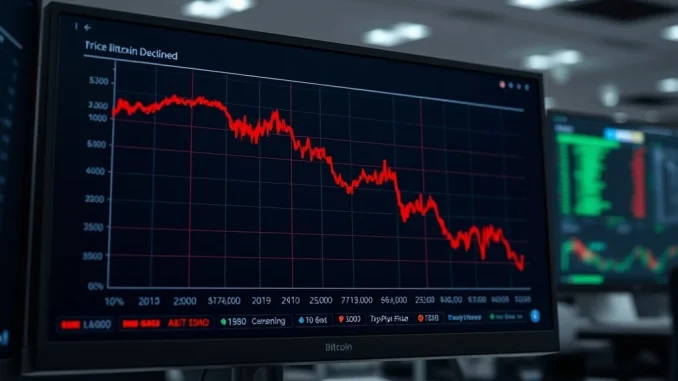
NEW YORK, March 7, 2026 — The Bitcoin price plunged below the critical $70,000 support level Friday, tumbling to near $68,000 despite surprisingly weak U.S. employment figures that traditionally boost risk assets. The flagship cryptocurrency erased its entire breakout attempt from earlier in the week, dropping over 8% from its monthly high near $74,000. This sharp decline occurred against a backdrop of broader market pessimism, as the S&P 500 and Nasdaq Composite also fell more than 1%. The market’s reaction highlights a significant shift in trader psychology, where bad economic news is no longer seen as a guaranteed catalyst for Federal Reserve intervention.
Bitcoin Price Drops Amidst Contradictory Economic Signals
Data from TradingView and major exchanges like Bitstamp showed BTC/USD hitting a daily low of $68,176 during the Wall Street open. This move represented a 3% single-day drop and continued a pattern of failed breakouts that has characterized Bitcoin’s price action throughout early 2026. The catalyst was the Bureau of Labor Statistics’ February jobs report, which delivered a shock to economists. Consequently, the U.S. economy lost 92,000 jobs last month, starkly contrasting with expectations for a 58,000 gain. Furthermore, the unemployment rate climbed to 4.4%, signaling mounting pressure on the labor market.
Historically, such weakness would increase expectations for Federal Reserve interest rate cuts, providing tailwinds for cryptocurrencies and growth stocks. However, the market’s reaction on Friday defied this traditional playbook. “The US labor market is clearly weakening,” noted trading resource The Kobeissi Letter in a post on X. “This marks just the 2nd monthly job loss since the 2020 pandemic.” Despite this clear signal, the anticipated monetary policy pivot failed to materialize in market pricing, leaving Bitcoin bulls without their expected catalyst.
Federal Reserve Hawkish Stance Deflates Market Hopes
The core reason for Bitcoin’s decline lies in the stubbornly hawkish outlook embedded in interest rate futures. Data from CME Group’s FedWatch Tool showed traders assigning a minimal probability of a rate cut at the Fed’s upcoming March 18 meeting. More significantly, the market currently prices in just one quarter-point rate cut for the entirety of 2026. This outlook has solidified over recent weeks, as Fed officials have communicated a “higher for longer” stance, prioritizing the battle against persistent service-sector inflation over reacting to labor market softness.
- Dashed Rate Cut Expectations: The market has moved from anticipating multiple cuts in late 2025 to pricing just one for 2026, removing a key support for asset prices.
- Liquidity Drain: The Fed’s ongoing quantitative tightening (QT) program continues to drain liquidity from the financial system, creating a headwind for all speculative assets.
- Risk-Off Sentiment: The simultaneous sell-off in stocks and crypto indicates a broad-based reduction in risk appetite, not an isolated crypto event.
Expert Analysis on Bitcoin’s Failed Breakout Pattern
Market analysts pointed to a frustrating technical pattern. “Deviations above the Range High keep getting sold,” observed Maartunn, a contributor to on-chain analytics platform CryptoQuant. He identified three similar failed breakouts in recent months, each resulting in a sharp rejection. “The latest deviation just occurred around $71K. If history repeats, this level may again act as a trap for late longs,” he warned. This pattern suggests that overhead resistance remains formidable, with institutional sellers or large holders (“whales”) consistently liquidating positions near local highs.
Keith Alan, co-founder of trading resource Material Indicators, echoed this technical frustration. “Looks like $BTC is round tripping the range…again,” he commented on X. The price has now returned to test key long-term technical levels, including the 200-week exponential moving average (EMA) and the psychological zone around the old 2021 all-time high. This retest will be critical for determining whether the bull market structure remains intact or if a deeper correction is underway.
Broader Market Context and Historical Precedents
Friday’s price action places Bitcoin’s 2026 performance in a clearer context. The cryptocurrency has struggled to establish sustained momentum above the $70,000 level despite several attempts. This contrasts with the explosive rallies seen in previous cycles and suggests a maturation of the market, where valuations are more tightly coupled to macro liquidity conditions and traditional risk metrics. The decoupling from gold is particularly notable; while Bitcoin fell, the precious metal rose 1.5% to $5,155 per ounce, potentially indicating a flight to a different type of safe-haven asset.
| Asset | Performance (March 7) | Key Driver |
|---|---|---|
| Bitcoin (BTC) | -3.2% | Hawkish Fed outlook outweighs weak jobs data |
| S&P 500 Index | -1.5% | Broad risk-off sentiment, rate concerns |
| Gold (XAU) | +1.5% | Traditional safe-haven demand |
| U.S. 10-Year Treasury Yield | Little Changed | Markets balance growth fears vs. inflation persistence |
What Happens Next for Bitcoin and Crypto Markets?
The immediate focus shifts to the $68,000 support level and the Federal Reserve’s March meeting. A sustained break below $68,000 could see Bitcoin test the next major support zone around $64,000. Conversely, a hold above this level, coupled with any dovish shift in Fed rhetoric, could fuel a relief rally. Market participants will also scrutinize upcoming Consumer Price Index (CPI) inflation data, as it remains the primary input for Fed policy decisions. The key question is whether labor market weakness will eventually force the Fed’s hand, or if inflation proves too sticky.
Trader Sentiment and On-Chain Data Signals
On-chain data provides mixed signals. The recent “anomalous” outflow of 32,000 BTC from exchanges in a single day, reported by Cointelegraph, could indicate accumulation by long-term holders, a potentially bullish sign. However, derivatives data shows funding rates remaining elevated, suggesting leveraged long positions are still prevalent and creating vulnerability to further liquidations. The overall sentiment has shifted from greedy to fearful based on common sentiment indices, which often precedes a local bottom, but the macro overhang remains substantial.
Conclusion
The Bitcoin price drop to $68,000 underscores a new market reality where bad economic news does not automatically translate to crypto gains. The failure of weak jobs data to rescue bulls reveals the market’s primary focus: the Federal Reserve’s unwavering commitment to fighting inflation, even at the cost of economic softening. Bitcoin’s repeated failure to hold breakouts above $71,000 confirms significant selling pressure at higher levels. For the trend to reverse, markets need either a confirmed shift in Fed policy or a surge in organic, institutional demand that can overcome macro headwinds. Until then, traders should prepare for continued volatility within a defined range, with key support at $68,000 and resistance near $74,000.
Frequently Asked Questions
Q1: Why did Bitcoin price drop after weak US jobs data?
The price dropped because the weak data failed to change the Federal Reserve’s hawkish interest rate outlook. Markets now expect only one rate cut in 2026, removing a key catalyst for risk assets like Bitcoin.
Q2: What is the significance of Bitcoin falling to $68,000?
The $68,000 level represents a critical technical and psychological support zone. A break below could lead to a test of $64,000, while holding above it is necessary to maintain the broader bull market structure.
Q3: When is the next Federal Reserve meeting, and why does it matter?
The next Federal Open Market Committee (FOMC) meeting is on March 18, 2026. It matters because the Fed’s statement and economic projections will provide crucial guidance on the path of interest rates, which is the dominant macro driver for crypto markets.
Q4: How are stock markets reacting compared to Bitcoin?
Major U.S. stock indices like the S&P 500 and Nasdaq also fell significantly (over 1%) on March 7, indicating a broad-based risk-off move, not a crypto-specific problem.
Q5: What does the decoupling from gold mean?
Gold rose while Bitcoin fell, suggesting investors may currently view gold as a more reliable safe-haven during economic uncertainty, while crypto is being treated as a risk-on growth asset.
Q6: How does this affect everyday cryptocurrency investors?
Investors should expect heightened volatility and ensure their portfolio risk is managed. The situation highlights the importance of understanding macroeconomics and not relying on simplistic narratives like “bad news is good news for crypto.”