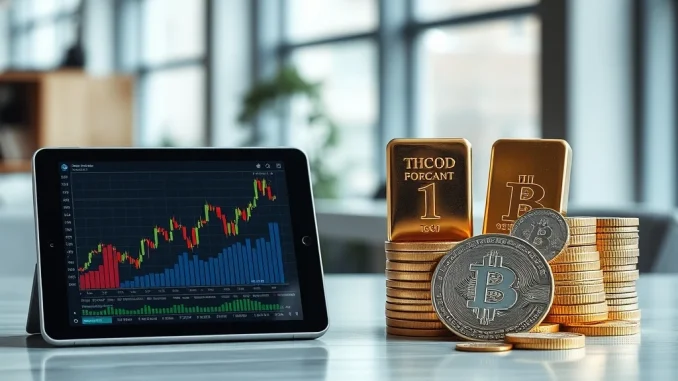
Global, March 2025: Prominent cryptocurrency analyst Benjamin Cowen presents a sobering assessment for Bitcoin investors, suggesting the digital asset may continue to underperform traditional stocks as the current market cycle matures. In a detailed analysis that challenges optimistic narratives, Cowen further argues that a significant capital rotation from established safe-haven assets like gold and silver into Bitcoin remains unlikely in the immediate future. This perspective, grounded in historical market behavior and macroeconomic indicators, provides a crucial counterpoint to prevailing bullish sentiment and underscores the complex, evolving relationship between digital and traditional stores of value.
Benjamin Cowen’s Analysis of Bitcoin’s Relative Performance
Benjamin Cowen, founder of the analytics platform IntoTheCryptoverse, built his recent argument on comparative performance metrics between Bitcoin and major stock indices. His analysis, shared via a detailed video presentation, examines the Bitcoin-to-Stocks (BTC/S&P) ratio, a key metric he has tracked for years. Cowen observes that this ratio has displayed persistent weakness throughout specific phases of past market cycles, particularly during periods of macroeconomic tightening or uncertainty. He notes that while Bitcoin often exhibits high volatility and independent price action, its performance relative to equities tends to follow broader liquidity and risk-appetite trends observable in traditional finance. This relationship suggests that Bitcoin, despite its decentralized nature, is not entirely decoupled from the fundamental forces driving capital allocation in global markets.
Historical data supports this interconnectedness. For instance, during the Federal Reserve’s rate-hiking cycle that began in 2022, both risk assets and cryptocurrencies faced significant pressure. Cowen’s framework suggests that as long as macroeconomic conditions favor a “risk-off” environment or even a neutral stance, capital may continue to favor the perceived stability and regulatory clarity of established public companies over the nascent crypto sector. This does not imply Bitcoin cannot appreciate in absolute terms, but rather that its growth rate may lag behind that of major stock indices, affecting its relative attractiveness for portfolio managers making comparative asset allocation decisions.
The Unlikely Short-Term Shift from Gold and Silver to Bitcoin
A central pillar of Cowen’s thesis addresses a popular narrative within the crypto community: that Bitcoin is “digital gold” and will inevitably attract capital from the multi-trillion-dollar precious metals market. Cowen cautions against expecting this transition to occur rapidly. He identifies several structural and behavioral barriers that prevent immediate, large-scale capital rotation. Firstly, the investor bases for these asset classes possess fundamentally different risk profiles and time horizons. Institutional and retail holders of physical gold and silver, including central banks, often prioritize capital preservation, inflation hedging, and portfolio diversification with low correlation to tech stocks—a profile that does not perfectly align with Bitcoin’s still-significant volatility.
Secondly, the mechanisms for investing differ drastically. Purchasing physical bullion, gold ETFs like GLD, or mining stocks involves established custodial, regulatory, and brokerage frameworks familiar to traditional investors. Transitioning a meaningful portion of these holdings into Bitcoin requires navigating cryptocurrency exchanges, digital wallets, and a different set of regulatory considerations—a friction point that slows institutional adoption. Cowen’s analysis suggests that while the long-term narrative of Bitcoin competing with gold as a store of value holds merit, the short-to-medium-term capital flows will likely remain within their respective silos, driven more by independent macro drivers than direct substitution.
- Investor Profile Mismatch: Precious metals attract conservative capital seeking stability; crypto attracts growth-oriented capital tolerating high volatility.
- Regulatory and Infrastructure Hurdles: Established pathways for gold investment lack direct, frictionless bridges to Bitcoin markets.
- Macro Drivers: Gold often rallies on fears of currency debasement and systemic risk; Bitcoin rallies can be driven by tech adoption narratives and liquidity cycles, which do not always coincide.
Contextualizing the Precious Metals and Crypto Relationship
The relationship between precious metals and cryptocurrencies is more nuanced than simple competition. Historical price charts reveal periods of correlation, decoupling, and even inverse correlation. For example, during the initial COVID-19 market crash in March 2020, both gold and Bitcoin sold off sharply as investors rushed to raise cash, demonstrating a temporary correlation during a liquidity crisis. Later, both assets rallied as central bank stimulus flooded the system. However, in 2022, as inflation surged and the Fed began raising rates, gold entered a prolonged consolidation phase while Bitcoin entered a bear market, highlighting how different assets respond to the same macroeconomic stimulus based on their unique properties.
This complex dynamic suggests that framing the debate as a direct capital “shift” may be overly simplistic. A more accurate model may involve overlapping but distinct Venn diagrams of investor interest. Some capital may indeed move between the assets, but larger, trend-defining flows are likely governed by broader factors like real interest rates, dollar strength, and global geopolitical stability for gold, versus network adoption, regulatory developments, and liquidity conditions for Bitcoin. Cowen’s caution against expecting an immediate rally in Bitcoin following a gold rally stems from this understanding—the catalysts are often different, and the capital pools, while adjacent, are not seamlessly connected.
Implications for Investor Strategy and Market Outlook
Cowen’s analysis carries significant implications for both retail and institutional investment strategies. For investors who view Bitcoin primarily as a high-growth tech bet, its potential underperformance against stocks in certain cycles is a critical risk management consideration. It argues for a disciplined, cycle-aware approach to accumulation rather than timing entries based on narratives about gold’s performance. For those viewing Bitcoin as a long-term store of value and hedge against monetary inflation, the analysis suggests patience is required. The “digital gold” thesis is a multi-decade transformation of finance, not an event that triggers immediate capital flight from traditional havens.
Furthermore, this perspective encourages a more holistic view of portfolio construction. Instead of pitting assets against each other, investors might consider the roles each plays. Physical precious metals can provide stability and non-correlation in a portfolio, while a strategic allocation to Bitcoin can offer asymmetric growth potential from technological adoption. Their performance drivers are not always in sync, which can, in fact, provide diversification benefits. Cowen’s work ultimately serves as a reminder that in mature financial markets, easy narratives of direct capital substitution rarely play out as expected. Deep, structural changes in capital allocation happen gradually, influenced by regulatory evolution, technological infrastructure development, and generational shifts in investor preference.
Conclusion
Benjamin Cowen’s measured analysis provides a necessary reality check for the cryptocurrency market, emphasizing that Bitcoin’s path remains intertwined with broader financial currents rather than operating in isolation. His view that a significant capital flow from precious metals to Bitcoin is unlikely in the near term is grounded in observable market structure, investor behavior, and historical precedent. This does not diminish Bitcoin’s long-term potential but frames its journey within the complex machinery of global finance. For market participants, understanding these dynamics is crucial for setting realistic expectations and building resilient investment theses that can withstand the nuanced and often counterintuitive flows of capital between different asset classes.
FAQs
Q1: What is Benjamin Cowen’s main argument about Bitcoin and stocks?
Benjamin Cowen argues that based on current cycle analysis, Bitcoin may continue to show relative weakness compared to major stock market indices like the S&P 500. He uses the BTC/Stocks ratio to suggest that macroeconomic conditions favoring traditional equities could persist, leading to Bitcoin underperformance on a relative basis.
Q2: Why does Cowen believe capital won’t quickly move from gold to Bitcoin?
Cowen cites differing investor bases, regulatory and infrastructure hurdles, and distinct primary price drivers. The institutions and individuals holding gold often seek stability and have different risk tolerances than typical crypto investors, and there is no frictionless mechanism for moving billions between these asset classes quickly.
Q3: Does this mean Bitcoin and gold are not correlated at all?
No, their correlation is variable. They can move together during broad market liquidity events (like central bank stimulus) but often decouple or move inversely based on factors like real interest rates (impacting gold) versus tech adoption narratives (impacting Bitcoin).
Q4: How should an investor interpret this analysis for their portfolio?
Investors should avoid assuming a direct substitution between gold and Bitcoin. A more prudent approach is to assess each asset’s unique role—gold for stability and non-correlation, Bitcoin for growth and adoption exposure—and allocate accordingly based on individual risk tolerance and time horizon, without expecting one to immediately follow the other’s price moves.
Q5: Is Cowen’s view bearish for Bitcoin long-term?
Not necessarily. Cowen’s analysis is focused on short-to-medium-term capital flow dynamics and relative performance. It is a cyclical observation rather than a condemnation of Bitcoin’s long-term value proposition as a decentralized digital asset and potential store of value.