LONDON, March 15, 2026 — For countless technology enthusiasts and aspiring cryptocurrency miners, a persistent question echoes through online forums and search engines: can you still mine Bitcoin on a PC in 2026? The short, definitive answer, according to network data and energy economists, is a resounding no for anyone seeking profit. However, the complete reality is a nuanced story of exponential network growth, insurmountable hardware economics, and the final chapter for casual, decentralized participation in Bitcoin’s creation. A decade ago, mining Bitcoin on a standard desktop was a viable hobby. Today, the landscape has transformed into an industrial-scale operation, rendering the personal computer functionally obsolete for Bitcoin’s proof-of-work algorithm.
The Insurmountable Rise of Bitcoin Network Difficulty
Bitcoin mining functions as a global computational lottery. Miners compete to solve complex cryptographic puzzles, and the winner adds a new block to the blockchain, earning the block reward. The network’s difficulty automatically adjusts every 2,016 blocks—approximately every two weeks—to ensure a new block is found roughly every ten minutes, regardless of the total computing power, or hash rate, dedicated to the network. Consequently, as more miners join with more powerful machines, the difficulty skyrockets. Data from Blockchain.com shows the network difficulty has increased by a factor of over 10 billion since the first GPU was used for mining. In January 2026, the difficulty reached a historic 150 trillion, a figure that underscores the sheer scale of the competition. Dr. Lena Chen, a cryptocurrency economist at the Cambridge Centre for Alternative Finance, states, “The exponential growth in network difficulty is the primary economic gatekeeper. The hashing power required to have even a statistical chance of earning a reward now resides firmly in the petahash per second (PH/s) range, which is orders of magnitude beyond any consumer PC.”
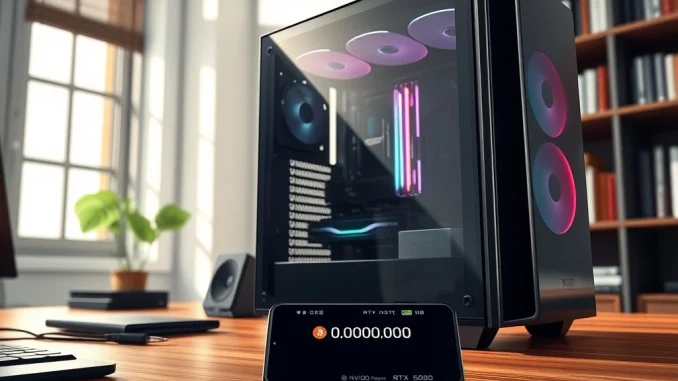
This difficulty trajectory creates a feedback loop. More efficient, specialized hardware is developed, which increases the network hash rate, which in turn increases the difficulty, which then makes older hardware—and certainly general-purpose PCs—completely non-competitive. The era where a gaming GPU could contribute meaningfully ended around 2013. The transition to Application-Specific Integrated Circuits (ASICs) designed solely for Bitcoin’s SHA-256 algorithm sealed the fate of PC mining. A modern Bitcoin ASIC miner, like the Bitmain Antminer S23, operates at over 300 TH/s while consuming 3,500 watts. A top-tier consumer graphics card, the NVIDIA RTX 5090, might achieve 3 GH/s on SHA-256 while consuming 500 watts—a performance difference of 100,000 times for a similar power envelope.
The Crushing Economics of Home PC Mining in 2026
Beyond raw hash rate, the profitability equation has become decisively negative for PC-based miners. The analysis hinges on three core variables: hardware efficiency, electricity cost, and Bitcoin’s market price. First, the efficiency metric—joules per terahash (J/TH)—is paramount. Industrial ASICs operate below 20 J/TH. A consumer GPU struggles to achieve 5,000,000 J/TH for the same work, making it profoundly energy-inefficient. Second, with global average electricity prices hovering near $0.15 per kWh in 2026, the cost to run a high-end PC for mining quickly eclipses any potential reward. Finally, while Bitcoin’s price has stabilized in the $90,000-$110,000 range, the block reward has halved multiple times, now sitting at 3.125 BTC per block. “Running a PC to mine Bitcoin in 2026 is economically analogous to using a garden hose to fill an Olympic swimming pool,” explains Michael Rostov, lead analyst at CoinMetrics. “The operational cost—electricity—will always exceed the microscopic value of the water you contribute.”
- Hardware Cost vs. Reward: A $2,000 gaming PC would take centuries to mine a single satoshi (0.00000001 BTC) at current difficulty, effectively generating zero revenue.
- Energy Consumption: A mining-optimized PC can draw 700+ watts. At $0.15/kWh, it costs over $2.50 per day to operate, generating theoretical revenue of less than $0.01.
- Hardware Depreciation: The intense 24/7 workload would degrade a PC’s components—especially the GPU—within months, leading to premature failure and total capital loss.
Expert Consensus and Institutional Data
The academic and industry perspective is unanimous. A 2025 report by the International Energy Agency (IEA) on cryptocurrency energy use explicitly categorized “consumer PC-based Bitcoin mining” as a historically insignificant and currently non-existent contributor to global mining activity. The report’s data shows that over 99.9% of the Bitcoin network hash rate originates from professional mining facilities utilizing ASIC hardware, often located near renewable energy sources or stranded power. Furthermore, statements from hardware manufacturers like NVIDIA and AMD have evolved. While they once marketed gaming GPUs for mining versatility, their 2025–2026 driver suites and public communications now actively discourage Bitcoin mining, focusing instead on AI workload optimization and next-generation gaming. An AMD spokesperson recently noted, “Our RDNA architecture is engineered for graphics parallelism and AI acceleration. Using it for SHA-256 hashing is an extreme misuse of its capabilities and is not supported for long-term operation.”
What Can You Mine on a PC in 2026? The Alternative Landscape
While the door to Bitcoin mining on PCs is closed and locked, the broader cryptocurrency mining ecosystem offers narrow alternatives. The reality for PC enthusiasts in 2026 is a pivot to mining other, less dominant cryptocurrencies that use different, ASIC-resistant algorithms. These algorithms, like RandomX (used by Monero) or Ethash (formerly used by Ethereum), are designed to be efficiently mined by general-purpose CPUs and GPUs to preserve decentralization. However, profitability remains precarious and is highly sensitive to coin price and network difficulty. For instance, mining Monero (XMR) on a high-end CPU might yield a few dollars per month before electricity costs, making it a break-even endeavor at best in most regions. The activity persists largely as an ideological project or a technical learning exercise rather than a revenue stream.
| Cryptocurrency | Algorithm | 2026 Viability on High-End PC | Estimated Monthly Net Profit (at $0.15/kWh) |
|---|---|---|---|
| Bitcoin (BTC) | SHA-256 | None (Massive Loss) | -$75+ |
| Monero (XMR) | RandomX | Low (CPU-only, near break-even) | $0 – $5 |
| Ravencoin (RVN) | KAWPOW | Very Low (GPU, likely loss) | -$10 – $0 |
| Ergo (ERG) | Autolykos2 | Low (GPU, sensitive to price) | -$5 – $5 |
The Future: Cloud Mining, Staking, and the End of an Era
For individuals determined to participate in cryptocurrency creation, the path forward in 2026 does not involve purchasing hardware but allocating capital. Cloud mining contracts, where users rent hash power from industrial facilities, present one option, though they are fraught with risk from fraudulent providers and often offer poor returns. The more significant trend is the shift from proof-of-work (mining) to proof-of-stake (staking) consensus mechanisms. Ethereum’s successful transition to proof-of-stake in 2022 set a precedent. In proof-of-stake, validators are chosen to create new blocks based on the amount of cryptocurrency they “stake” or lock up as collateral, not on computational work. This eliminates the energy-intensive mining race entirely. Consequently, the relevant question for PC owners in 2026 is not “Can I mine?” but “Can I run a node or stake?” Running a full node for Bitcoin or a validator node for a proof-of-stake chain like Cardano or Solana is a valuable, PC-friendly contribution to network security and decentralization that requires bandwidth and storage, not exahashes of power.
The Persistent Cultural Myth and Educational Challenge
Despite the clear technical and economic reality, the myth of PC-based Bitcoin mining persists in popular culture, fueled by outdated online tutorials and nostalgic stories of the “early days.” This creates an ongoing educational challenge for the crypto community. Newcomers often invest in expensive PC hardware under false pretenses, only to discover the operational loss. Industry advocates like the Bitcoin Mining Council now include explicit disclaimers in their public materials, steering interested parties toward accurate information about network participation. The narrative has fundamentally shifted from individual mining to collective security and the macroeconomic role of industrial-scale mining in energy grid stabilization and renewable development.
Conclusion
The definitive answer to whether you can mine Bitcoin on a PC in 2026 is a technical yes but a practical and economic no. The astronomical network difficulty, the catastrophic inefficiency of general-purpose hardware, and the relentless mathematics of energy cost versus reward have collectively ended the era of profitable home Bitcoin mining. The activity now exists solely as a historical footnote or an extremely costly demonstration. The real opportunity for PC-owning individuals in the current cryptocurrency landscape lies in supporting networks through staking, running nodes, or contributing to decentralized applications—activities that align with modern consensus mechanisms and offer a sustainable path for participation. The story of Bitcoin mining is now one of hyperspecialization and industrial scale, a testament to the network’s security but also a clear demarcation from its decentralized, hobbyist origins.
Frequently Asked Questions
Q1: Is it technically possible to run Bitcoin mining software on a PC in 2026?
Yes, you can technically run mining software like CGMiner or NiceHash on a modern PC. However, the hash rate contribution will be so infinitesimally small—measured in gigahashes (GH/s) versus the network’s exahashes (EH/s)—that you have a statistically zero chance of ever earning a block reward, making it a pointless exercise beyond pure academic curiosity.
Q2: What is the single biggest reason PC Bitcoin mining is not profitable?
The exponential increase in Bitcoin network difficulty is the primary reason. It automatically adjusts to the total mining power, ensuring blocks are found every ~10 minutes. With industrial ASIC farms contributing immense power, the difficulty has risen to a level where even thousands of high-end PCs combined would not find a block for centuries.
Q3: Could a future change in Bitcoin’s code make PC mining viable again?
Extremely unlikely. Changing Bitcoin’s core proof-of-work algorithm would require near-unanimous consensus from the global developer and miner community, effectively creating a new cryptocurrency (a hard fork). The economic incentives for the existing industrial mining ecosystem are aligned against such a change, which would render their billion-dollar ASIC investments obsolete.
Q4: I see online calculators showing potential profit. Why are they misleading?
Most public mining calculators use simplified models that fail to account for the continuous and rapid increase in network difficulty. They provide a static snapshot based on current difficulty, but by the time you set up your hardware, the difficulty will have increased, instantly eroding any projected profit. They also often ignore pool fees, hardware degradation, and real-world electricity rate variations.
Q5: What should I do with a powerful PC if I want to earn cryptocurrency?
Consider alternatives like staking proof-of-stake coins (e.g., ETH, ADA, SOL) by purchasing and holding them in a wallet, which requires no computational work. You can also provide processing power for decentralized computing networks like Render Network or participate in “mineable” but ASIC-resistant coins like Monero, though profits are minimal and not guaranteed.
Q6: How does the energy consumption of a mining PC compare to just buying Bitcoin?
The comparison is stark. The electricity cost of running a high-end PC 24/7 for one month to attempt Bitcoin mining could directly purchase a more substantial amount of Bitcoin on an exchange than you could ever hope to mine in several lifetimes. From a purely financial perspective, direct purchase is astronomically more efficient.