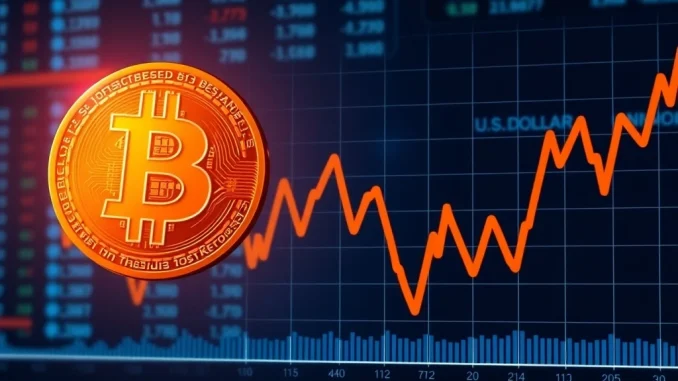
Global Markets, May 2025: The outlook for Bitcoin has shifted notably this week as a key macroeconomic indicator, the U.S. Dollar Index (DXY), fell below the 96 level for the first time since early 2022. This movement has captured the attention of cryptocurrency analysts and traditional finance observers alike, as historical patterns suggest a weaker dollar often coincides with stronger performance for alternative assets like Bitcoin. The development introduces a fresh layer of analysis for investors monitoring the complex interplay between fiat currencies and digital assets.
Bitcoin Outlook Improves Amid Dollar Weakness
The U.S. Dollar Index, which measures the value of the dollar against a basket of six major world currencies, experienced a notable decline in recent trading sessions. Data from financial terminals showed the index briefly trading below 96.00, a threshold not seen in over three years. This decline represents a continuation of a broader trend observed throughout the first quarter of 2025, influenced by shifting expectations regarding Federal Reserve monetary policy and relative economic strength abroad. For Bitcoin, a non-sovereign digital asset often viewed as a hedge against traditional financial systems, dollar weakness has historically been a constructive backdrop.
Market analysts point to a clear, though not absolute, inverse correlation between the DXY and Bitcoin’s price over multi-year timeframes. When the dollar weakens, assets priced in dollars—including Bitcoin—can become relatively cheaper for international buyers using other currencies. Furthermore, a falling dollar can sometimes reflect broader market sentiment seeking alternatives to traditional stores of value. It is critical to note that correlation does not imply causation, and Bitcoin’s price is influenced by a multitude of factors including its own adoption cycle, regulatory developments, and network-specific metrics. However, the macro environment set by currency markets provides a significant contextual layer.
Historical Context of the DXY and Bitcoin Performance
Examining past periods when the DXY traded at or below current levels reveals instructive patterns for the current Bitcoin outlook. The last sustained period below 96 occurred between mid-2021 and early 2022. During that window, Bitcoin experienced significant volatility but also reached its all-time high near $69,000 in November 2021. Prior to that, the DXY’s decline in 2020 coincided with Bitcoin’s recovery from its COVID-19 crash and the beginning of a major bull market.
The relationship is not perfectly mechanical. Other forces were at play during those periods, such as unprecedented fiscal stimulus and a surge in retail investment. The table below outlines key historical DXY levels and concurrent Bitcoin price action, illustrating the general environment rather than a direct trigger.
| Period | Average DXY Level | Bitcoin Price Context | Key Macro Drivers |
|---|---|---|---|
| 2020-2021 | ~91-93 | Bull market from $10k to $69k | Global stimulus, low rates |
| Early 2022 | Rising above 96 | Bear market initiation | Fed rate hikes begin |
| 2023-2024 | 100-105 | Recovery and consolidation | Higher for longer rates |
| Q2 2025 | Falling below 96 | Current environment | Policy pivot expectations |
This historical perspective underscores why the current DXY move is garnering attention. It signals a potential regime shift in the macro landscape that has been dominated by a strong dollar for several years. For asset allocators, such shifts prompt portfolio re-evaluations.
The Mechanics of Currency Markets and Crypto Flows
The connection between the dollar and Bitcoin operates through several channels. Firstly, a weaker dollar improves the purchasing power of foreign investors. A European or Japanese investor, for instance, finds dollar-denominated assets less expensive when their home currency strengthens against the dollar. This can increase buy-side demand for Bitcoin on global exchanges. Secondly, the DXY’s decline often reflects market expectations for lower U.S. interest rates or relatively stronger growth overseas. This environment typically supports risk assets, a category that includes, though controversially, cryptocurrencies.
Thirdly, there is a psychological and narrative-driven component. Financial media and analysts frequently frame Bitcoin as “digital gold” or an inflation hedge. When the dollar weakens, narratives around currency debasement and the search for alternative stores of value gain traction, potentially drawing new attention and capital to the crypto market. It is essential to maintain a balanced view, recognizing that these flows are one part of a complex equation that also includes Bitcoin ETF inflows, on-chain activity, and broader technology adoption trends.
Current Market Structure and Analyst Perspectives
Beyond the DXY, the current Bitcoin market structure shows several characteristics that analysts consider when assessing the improved outlook. On-chain data indicates that long-term holders continue to accumulate, a sign of conviction. Exchange reserves remain at multi-year lows, suggesting a lack of immediate selling pressure. The approval and subsequent flows into U.S.-listed spot Bitcoin ETFs have created a new, institutional demand channel that did not exist during previous DXY lows.
Several key factors differentiate the present moment from 2021:
- Regulatory Clarity: Major markets have more defined, though evolving, regulatory frameworks.
- Institutional Infrastructure: The existence of regulated ETFs and custody solutions lowers barriers for traditional capital.
- Network Maturity: Bitcoin’s underlying network has processed more transactions and demonstrated resilience through another market cycle.
- Macro Divergence: Global central bank policies are not as synchronized as during the 2020-2021 period.
This mature structure means that while a falling DXY may provide a favorable tailwind, Bitcoin is less reliant on any single macro factor than in its earlier years. Its market is deeper and more nuanced.
Risks and Considerations for the Improved Outlook
While the correlation with a weaker dollar is a positive signal, a prudent analysis must account for countervailing risks. The Federal Reserve’s future policy path remains data-dependent. Stronger-than-expected U.S. economic data or persistent inflation could halt or reverse the dollar’s decline, removing this supportive factor. Geopolitical tensions can cause sudden flights to safety, boosting the dollar and pressuring risk assets.
Furthermore, the cryptocurrency market faces its own unique challenges. Regulatory actions in key jurisdictions, technological vulnerabilities, or shifts in investor sentiment driven by crypto-specific news can easily overshadow broader macro trends. Therefore, viewing the DXY move as one indicator among many is a more accurate and trustworthy approach than presenting it as a definitive predictor.
Conclusion
The Bitcoin outlook has demonstrably improved with the U.S. Dollar Index’s descent to its lowest level since early 2022. This development reactivates a historical pattern where dollar weakness has coincided with periods of strength for the pioneering cryptocurrency. The current environment combines this macro shift with a more mature and institutionalized Bitcoin market, featuring ETF access and clearer regulatory perimeters. However, investors should interpret this signal within a broader context, acknowledging the multitude of fundamental, technical, and regulatory factors that ultimately drive Bitcoin’s price. The falling DXY removes a significant headwind and provides a potentially favorable backdrop, but the future trajectory will depend on the complex interplay of all these forces. Monitoring this relationship offers valuable insight into the evolving role of digital assets within the global financial system.
FAQs
Q1: What is the U.S. Dollar Index (DXY)?
The U.S. Dollar Index (DXY) is a measure of the value of the United States dollar relative to a basket of six foreign currencies: the Euro, Japanese Yen, British Pound, Canadian Dollar, Swedish Krona, and Swiss Franc. It is a key benchmark for the dollar’s international strength.
Q2: Why does a falling DXY potentially help Bitcoin?
A weaker dollar makes dollar-denominated assets like Bitcoin cheaper for investors using other currencies, potentially increasing international demand. It can also reflect a macroeconomic environment of lower interest rates or a search for alternative stores of value, which has historically been supportive for Bitcoin.
Q3: Is the relationship between the DXY and Bitcoin’s price guaranteed?
No, the relationship is a historical correlation, not a guarantee. While an inverse correlation has been observed over long periods, Bitcoin’s price is influenced by many factors, including its own adoption, regulation, and technological developments, which can sometimes override macro trends.
Q4: What were other key factors when the DXY was last this low in 2021?
In 2021, the low DXY environment coincided with massive global fiscal stimulus, near-zero interest rates, and a surge in retail investor participation driven by pandemic-era markets and easy monetary policy. The current macro backdrop in 2025 has distinct differences.
Q5: Should investors buy Bitcoin solely based on a falling DXY?
No. The DXY is one useful macroeconomic indicator among many. Sound investment decisions for an asset as volatile as Bitcoin should be based on a comprehensive analysis including personal risk tolerance, portfolio strategy, and an understanding of both crypto-specific and broad financial market fundamentals.