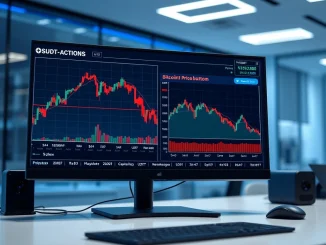
In a surprising twist for the world’s premier cryptocurrency, Bitcoin online searches and social media mentions experienced a significant and sustained decline throughout 2025. This trend unfolded against a backdrop of dramatic price action, including a new all-time high and a subsequent major correction, creating a complex puzzle for market analysts and investors alike. Data from Google Trends and social media analytics platforms, reported by outlets including Cointelegraph, paints a clear picture of waning public curiosity even as the asset itself commanded headlines for its price swings.
Analyzing the 2025 Bitcoin Search Decline
The data reveals a stark contradiction. While Bitcoin’s price chart showed extreme volatility, public search behavior told a different story. According to aggregated reports, Google searches for the term “Bitcoin” saw a sharp, event-driven spike immediately following the U.S. presidential election in November 2024. However, this surge proved ephemeral. Throughout the following year, search interest entered a pronounced and steady downward trajectory. This decline in Bitcoin online searches suggests a potential decoupling between short-term news events and sustained public investigation. Market analysts often correlate search volume with retail investor interest and mainstream awareness. Consequently, this 2025 trend may indicate a maturation phase or a shift in how the public engages with cryptocurrency information, potentially seeking it through more specialized channels rather than broad web searches.
The Social Media Conversation Cools
Parallel to the search data, the conversation on major social platforms also diminished. Specifically, the number of posts on X (formerly Twitter) containing the keyword ‘Bitcoin’ fell by a substantial 32% year-over-year. This drop brought the total to approximately 96 million mentions for the year. Social media chatter frequently acts as a real-time sentiment gauge and a driver of viral attention. A decline of this magnitude points to a cooling of the speculative frenzy and meme-driven hype that has periodically characterized crypto discourse. It may also reflect broader platform algorithm changes or user fatigue with repetitive market commentary. This dual decline—in both search and social mentions—forms a coherent narrative of reduced top-of-mind awareness among the general online populace during 2025.
Contextualizing the Data Within Crypto Market Cycles
To understand this trend, one must place it within the historical context of cryptocurrency adoption waves. Previous bull markets, such as those in 2017 and 2021, were strongly correlated with parabolic increases in Google search volume and social media activity. The 2025 scenario presents a notable deviation. The market experienced significant price volatility, including a rally to a new record high, yet failed to ignite the same level of public digital curiosity. Experts point to several potential factors for this shift:
- Institutional Dominance: As Bitcoin’s market structure evolves, price movements may be increasingly driven by institutional flows (ETFs, corporate treasuries) rather than retail sentiment, which is more closely tied to search and social trends.
- Information Saturation: After over a decade in the public eye, Bitcoin may have reached a baseline level of awareness where only truly paradigm-shifting news generates widespread search interest, not just price changes.
- Regulatory Clarity (or Lack Thereof): The prolonged regulatory landscape in major economies like the U.S. may have pushed continual discussion into more niche, professional forums rather than general public platforms.
| Metric | 2024 | 2025 | Change |
|---|---|---|---|
| Google Search Interest (Avg. Index) | High (Post-Election Spike) | Declining Trend | Significant Decrease |
| X (Twitter) Mentions | ~141 Million | ~96 Million | -32% |
| Market Context | Election-Driven Volatility | ATH & Correction | High Volatility Persisted |
Expert Perspectives on Decoupling Sentiment from Price
Financial sociologists and data analysts offer nuanced interpretations. Dr. Anya Petrova, a researcher specializing in digital asset ecosystems, notes, “The decoupling of search volume from price volatility could signal a normalization. In traditional finance, people don’t Google ‘S&P 500’ daily unless a major crash occurs. Bitcoin may be transitioning from a speculative novelty to a recognized, if volatile, asset class.” This perspective frames the decline in Bitcoin online searches not necessarily as a loss of interest, but as a change in the nature of engagement. The data may reflect a consolidation of interest among a more dedicated cohort of holders, developers, and institutions, while casual observers tune out the noise of ordinary market fluctuations. Furthermore, the maturation of dedicated crypto news platforms and analytics services means enthusiasts have less need to rely on general search engines for basic information.
The Impact of Macro-Economic and Political Events
The 2024 U.S. presidential election serves as a critical reference point. The immediate search spike following the result underscores Bitcoin’s continued sensitivity to macro-political shocks, particularly those related to monetary policy and fiscal spending expectations. The failure of that spike to sustain itself through 2025’s price peaks, however, is telling. It suggests that the initial “fear of missing out” (FOMO) reaction was not replenished by new entrants during the subsequent rally. This pattern could indicate that the market rally was fueled more by existing capital reallocation and institutional participation than by a new wave of retail investors—a dynamic that would naturally produce fewer first-time searches.
Conclusion
The decline in Bitcoin online searches and social media mentions throughout 5 presents a fascinating case study in the evolution of cryptocurrency markets. It challenges the long-held assumption that extreme price volatility automatically translates to heightened public curiosity. This trend may reflect Bitcoin’s gradual integration into the broader financial landscape, where it garners sustained, deeper analysis from a dedicated base rather than fleeting attention from the masses. While the dip in mentions does not directly dictate price direction, it offers crucial insight into market psychology and participant structure. Moving forward, monitoring these engagement metrics will remain essential for distinguishing between hype-driven cycles and periods of organic, fundamentals-based growth for the world’s first and most prominent cryptocurrency.
FAQs
Q1: What does a decline in Bitcoin online searches mean for the price?
There is no direct causal relationship. Historically, high search volume often coincided with market tops driven by retail FOMO. A decline could indicate less speculative froth, but price is influenced by many other factors like institutional adoption, macroeconomics, and liquidity.
Q2: Did interest in all cryptocurrencies decline in 2025, or just Bitcoin?
The reported data specifically tracks Bitcoin. However, as the market leader, Bitcoin’s trends often set the tone. It is plausible that interest in major altcoins followed a similar pattern, though niche projects might have seen independent trends based on development news.
Q3: Could the decline be due to people using different search terms?
This is a valid consideration. As knowledge deepens, users may search for more specific terms like “Bitcoin ETF flows,” “Lightning Network,” or “hash rate” instead of the generic “Bitcoin.” Overall ecosystem interest might be steadier than the top-level keyword data suggests.
Q4: How reliable are Google Trends and social mentions as metrics?
They are reliable as indicators of broad, public-facing interest and sentiment, not as precise measures of total market activity. They are best used in conjunction with on-chain data, trading volumes, and institutional flow reports for a complete picture.
Q5: Has this kind of search-volume and price decoupling happened before with Bitcoin?
Not to this extent in previous major cycles. The 2017 and 2021 bull runs saw search interest rise almost in lockstep with price. The 2025 dynamic is somewhat novel, potentially reflecting the market’s changing participant mix and maturation.
Updated insights and analysis added for better clarity.
This article was produced with AI assistance and reviewed by our editorial team for accuracy and quality.