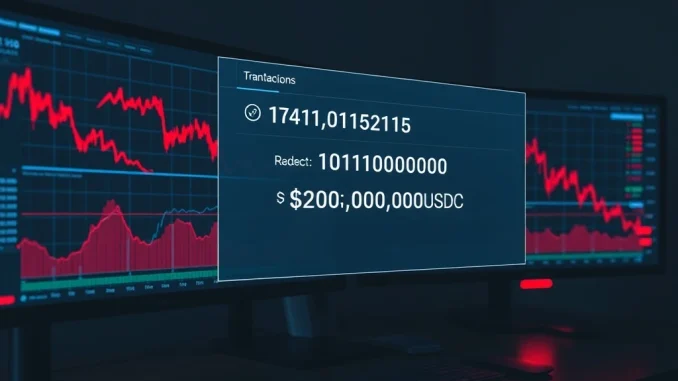
Global, April 2025: A prominent long-term Bitcoin holder, identified only by the cryptic on-chain address ‘1011short’, has executed a critical $20 million USDC deposit to stave off imminent liquidation on the Hyperliquid derivatives platform. This defensive maneuver, captured by the on-chain analytics firm Onchain-Lenz, reveals a high-stakes financial drama unfolding in real-time. The entity now contends with a staggering $83.4 million in unrealized losses, a situation that underscores the extreme volatility and profound risks inherent in leveraged cryptocurrency trading.
Bitcoin OG Faces Mounting Pressure on Hyperliquid
The recent $20 million USDC infusion represents a desperate bid to maintain collateral ratios for several enormous leveraged long positions. Data indicates the anonymous trader’s cumulative realized profits have evaporated dramatically, plummeting from a peak of $142.5 million to just $9.7 million. This precipitous decline highlights how quickly market reversals can erase gains, especially when employing high leverage. The core positions, which the deposit aims to protect, are monumental in scale. They include a $630 million notional value position on Ethereum (ETH) leveraged 5x, an $86.98 million position on Bitcoin (BTC) also at 5x leverage, and a particularly aggressive $61.10 million position on Solana (SOL) leveraged 20x. The concentration and size of these bets are exceptional, even within the professional crypto trading sphere.
Anatomy of a High-Stakes Leveraged Portfolio
To understand the gravity of the situation, one must examine the mechanics of perpetual futures contracts and liquidation engines like Hyperliquid’s. Leverage amplifies both gains and losses. A 5x long position means a 20% adverse price move triggers liquidation, while a 20x position requires only a 5% move against the trader. The portfolio’s composition reveals a calculated but risky strategy.
- Ethereum Dominance: The $630M ETH position is the cornerstone, suggesting strong conviction in ETH’s medium-term trajectory but creating massive exposure to its price swings.
- Bitcoin Foundation: The BTC position, while smaller, likely acts as a relatively stable core holding within the leveraged framework.
- Solana Speculation: The 20x SOL position is the portfolio’s riskiest element, a high-volatility bet that demands constant monitoring and precise risk management.
The need for a $20 million top-up signals that market movements have pushed these positions dangerously close to their liquidation thresholds. This is not merely a paper loss; it is an active margin call requiring immediate, liquid capital to resolve.
The Critical Role of On-Chain Transparency
This event is visible only because of the transparent nature of public blockchains. Analytics platforms like Onchain-Lenz track the flow of funds from known “whale” wallets to centralized and decentralized finance (DeFi) protocols. The address ‘1011short’ is likely tagged due to its historical activity, allowing analysts to monitor its financial state. This transparency provides a real-time case study in risk management—or the lack thereof. It offers the broader market and regulators an unfiltered view of the systemic pressures that can build when large entities employ excessive leverage during periods of market stress.
Historical Context and Market Implications
The saga of ‘1011short’ echoes past crypto market crises where over-leveraged positions triggered cascading liquidations. Events like the May 2021 market crash and the LUNA/UST collapse in May 2022 were exacerbated by similar forced selling from liquidated positions. While this single event may not be systemic, it serves as a canary in the coal mine. If multiple large holders face simultaneous margin calls, it can create a self-reinforcing cycle of selling pressure: liquidations force asset sales, driving prices down further and triggering more liquidations. This dynamic is a primary concern for market stability analysts.
Expert Insight on Risk Management Failures
Professional risk managers point to several potential failures evident in this scenario. First is a lack of position sizing relative to total capital; the positions are so large that defending them requires extraordinary reserves. Second is the mismatch between asset volatility and leverage applied; employing 20x leverage on an asset like Solana, known for sharp intraday swings, is exceptionally perilous. Third is the apparent absence of a clear de-risking plan as profits began to unwind. The $20 million deposit, while saving the positions for now, represents a classic “good money after bad” dilemma if the market continues to trend unfavorably.
Conclusion
The Bitcoin OG liquidation scare, involving a $20 million USDC rescue deposit on Hyperliquid, is a stark reminder of the double-edged sword of leverage in cryptocurrency markets. It demonstrates how even experienced, well-capitalized holders can face existential threats from rapid price movements. This public on-chain drama provides invaluable, real-world data on market leverage, risk concentration, and the psychological pressures of high-stakes trading. For the broader ecosystem, it underscores the perpetual need for robust risk management protocols, both at the individual trader level and within the lending and derivatives platforms that enable such high-leverage strategies.
FAQs
Q1: What does “OG” mean in this context?
A1: In cryptocurrency circles, “OG” stands for “Original Gangster” and is a term of respect for an early adopter or long-term participant in the space, implying significant experience and historical holdings.
Q2: What is Hyperliquid?
A2: Hyperliquid is a decentralized perpetual futures exchange. It allows traders to take leveraged long or short positions on cryptocurrencies without an expiry date, using collateral deposited in assets like USDC.
Q3: How does on-chain data reveal this information?
A3: Public blockchains record all transactions. Analytics firms track deposits from known wallet addresses to exchange or DeFi protocol addresses. By analyzing these flows and the subsequent trading activity on the platform’s smart contracts, they can infer position sizes and health.
Q4: What happens if a position is liquidated?
A4: If the value of the collateral falls below the required maintenance margin, the exchange’s liquidation engine automatically closes the position. The remaining collateral is used to cover the loss, and any leftover funds (if any) are returned to the trader. This process often results in a total loss of the initial margin.
Q5: Why is a 20x leverage position on Solana considered so risky?
A5: Leverage multiplies the effect of price movements. At 20x, a mere 5% price drop wipes out 100% of the margin. Cryptocurrencies like Solana can easily experience 5% volatility within an hour, making such a position extremely vulnerable to rapid liquidation during normal market fluctuations.