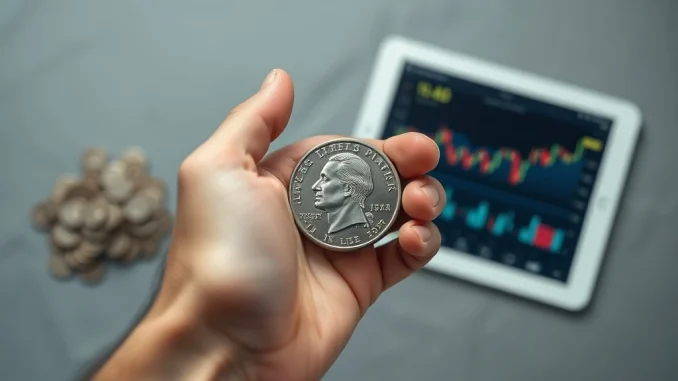
February 5, 2026 — A viral financial theory circulating on social media platforms claims investors can achieve guaranteed 43% profits by melting down US five-cent coins for their metal content. The posts specifically suggest selling Bitcoin holdings to accumulate physical nickels, creating a surprising intersection between cryptocurrency markets and base metal commodities. We investigated the mathematical claims, practical logistics, and legal implications of this unconventional investment strategy as metal prices reach multi-year highs.
The Viral Nickel Melt Theory Explained
Social media posts from accounts like Bitcoin Teddy on X have gained traction by claiming that melting American nickels represents a superior inflation hedge to Bitcoin. The theory hinges on the cupronickel composition of modern five-cent coins, which contain 3.75 grams of copper and 1.25 grams of nickel. At current commodity prices, the raw metal value exceeds the coin’s face value by approximately 43%. Proponents argue this creates an arbitrage opportunity where investors can theoretically buy nickels at face value, extract the metals, sell them as scrap, and reinvest the proceeds into more nickels. However, financial analysts note this ignores significant practical barriers.
The meme appears to have originated from an October 2025 post by Kyle Mitchell, who later admitted his claim of hoarding $250,000 in nickels was a hoax. Despite its dubious origins, the theory continues circulating during periods of metal price volatility. Copper currently trades at $13,247 per tonne, representing a 33% annual increase, while nickel sits at $17,330 per tonne with an 11.4% yearly gain. These price movements make the mathematical proposition superficially compelling to retail investors seeking alternatives to cryptocurrency volatility.
Mathematical Analysis Versus Practical Reality
Coinapp’s calculator demonstrates that $10,000 worth of nickels contains $4,265 worth of nickel and $10,068 worth of copper, totaling $14,333 in theoretical metal value. This represents a 43.3% premium over face value, compared to Bitcoin’s 26.3% decline over the same period. However, converting this theoretical profit into actual returns requires overcoming substantial physical and chemical challenges. Melting cupronickel requires temperatures exceeding 1,984°F for copper and 2,651°F for nickel, necessitating industrial-grade equipment beyond typical household capabilities.
- Energy and Equipment Costs: Specialized furnaces capable of reaching these temperatures cost thousands of dollars, while chemical separation processes require expensive acids and safety equipment
- Storage and Transportation: $10,000 in nickels weighs approximately one metric ton, equivalent to a small car, creating massive logistical challenges
- Market Access: Scrap metal buyers typically offer below-market rates for non-industrial quantities, while finding buyers specifically seeking 75-25 copper-nickel alloy presents additional difficulty
- Time Investment: Processing thousands of coins represents hundreds of hours of labor, dramatically reducing effective hourly returns
Legal Restrictions on Currency Modification
United States Code Section 5111(d) of title 31 explicitly prohibits melting or exporting one-cent and five-cent coins. The legislation, originally passed to prevent coin shortages during periods of high metal prices, carries penalties of up to $10,000 in fines and five years imprisonment. While casual modification like penny pressing or creating coin jewelry remains legal, systematic destruction for profit violates federal law. This legal framework fundamentally undermines the viral theory’s feasibility for US residents.
Historical Context of Metal Arbitrage Attempts
Similar schemes have emerged periodically throughout modern financial history whenever metal prices experience significant rallies. In May 2007, nickel prices peaked above $51,000 per tonne, prompting widespread discussion of coin melting before prices collapsed during the global financial crisis. The 2022 “nickel crisis” caused by Russian supply concerns sparked another wave of similar speculation. However, historical data shows these commodity spikes prove temporary compared to Bitcoin’s long-term appreciation of approximately 18,500% since 2016.
| Asset | 10-Year Return | Storage Requirements | Liquidity |
|---|---|---|---|
| Bitcoin | ~18,500% | Digital wallet | Global, 24/7 markets |
| Nickel Commodity | 48.2% | Warehouse space | Industrial markets only |
| Copper Commodity | 67.8% | Warehouse space | Industrial markets only |
| Physical Nickels | Face value only | Massive physical space | Bank deposits only |
Bitcoin’s Structural Advantages in Comparison
While the nickel melt theory captures attention through its novelty, Bitcoin offers structural advantages that explain its continued adoption as a digital store of value. Cryptocurrency exchanges facilitate global transactions within minutes, contrasting sharply with the physical limitations of transporting and processing tons of metal coins. Bitcoin’s daily trading volume regularly exceeds $20 billion, providing liquidity impossible for physical commodity arbitrage schemes. Furthermore, Bitcoin’s programmable nature enables integration with decentralized finance applications, smart contracts, and cross-border payment systems.
Industry analysts note that viral investment theories often gain traction during periods of market uncertainty. Bitcoin’s 26.3% decline over the past year has prompted some investors to explore unconventional alternatives. However, historical patterns suggest these fringe strategies typically fail to deliver sustainable returns compared to established asset classes. The nickel melt discussion primarily functions as social media engagement bait rather than serious financial advice.
Expert Perspectives on Alternative Inflation Hedges
Financial advisors consistently emphasize diversification over chasing viral trends. “While creative, these schemes ignore transaction costs, regulatory barriers, and practical realities,” explains commodities analyst Mark Johnson of Financial Insights Group. “Investors seeking inflation protection have better options through regulated commodity ETFs or Treasury Inflation-Protected Securities.” Johnson notes that even successful metal speculation requires proper market timing, as nickel prices have demonstrated extreme volatility, dropping 40% within months during the 2022 crisis.
Conclusion
The viral nickel melt theory represents mathematically intriguing but practically flawed financial speculation. While the 43% premium between face value and metal content appears compelling, legal restrictions, processing costs, storage requirements, and market realities render the strategy unworkable for most investors. Bitcoin, despite recent price declines, maintains structural advantages in liquidity, transferability, and global market access that physical commodity schemes cannot match. Investors should approach viral financial theories with skepticism, recognizing that sustainable wealth building typically involves conventional diversification rather than social media trends. As metal prices continue fluctuating, regulatory authorities will likely monitor potential coin shortages, while cryptocurrency markets evolve toward greater institutional adoption.
Frequently Asked Questions
Q1: Is it actually profitable to melt nickels for their metal content?
While the raw metal value exceeds face value by 43%, processing costs, equipment expenses, and below-market scrap prices eliminate most potential profits. The theoretical gain ignores practical implementation barriers.
Q2: What are the legal consequences of melting US coins?
United States Code Section 5111(d) prohibits melting pennies and nickels, with violations carrying fines up to $10,000 and potential five-year prison sentences. The law aims to prevent coin shortages during metal price spikes.
Q3: How does Bitcoin compare to physical commodities as an inflation hedge?
Bitcoin offers superior liquidity, transferability, and storage efficiency but experiences higher volatility. Physical commodities provide industrial utility but require substantial storage and have less developed retail investment markets.
Q4: Have similar coin melting schemes occurred historically?
Yes, discussions about melting coins for profit emerge whenever copper, nickel, or silver prices rise significantly. Previous instances occurred in 2007 and 2022, but no widespread implementation developed due to practical and legal barriers.
Q5: What makes the current nickel price environment unusual?
Nickel prices have risen 11.4% annually amid supply concerns and industrial demand, while copper has increased 33% yearly. However, both metals remain below their all-time highs and exhibit typical commodity cycle volatility.
Q6: Should cryptocurrency investors consider physical commodities?
Diversification into commodities can reduce portfolio volatility, but most financial advisors recommend regulated ETFs or futures contracts rather than physical storage schemes. Professional storage and insurance costs typically outweigh potential gains for retail investors.