WASHINGTON, D.C., March 15, 2026 — In a significant development for the cryptocurrency industry, bipartisan U.S. lawmakers have advanced new protections for blockchain developers while Bitcoin faces renewed downward pressure from analysts. The House Financial Services Committee approved the Blockchain Developer Certainty Act yesterday, marking the most substantial legislative progress for crypto protections since 2023. Simultaneously, market analysts at CoinMetrics and Glassnode predict further Bitcoin declines following its failure to hold the $68,000 support level. Meanwhile, the artificial intelligence crypto project DeepSnitch AI has delivered a remarkable 180% return on investment to early participants, creating a stark contrast with struggling projects like Bittensor, which fell 14% from its recent resistance level. These concurrent developments highlight the increasingly complex regulatory and investment landscape facing digital assets today.
US Lawmakers Advance Protections for Crypto and Blockchain Developers
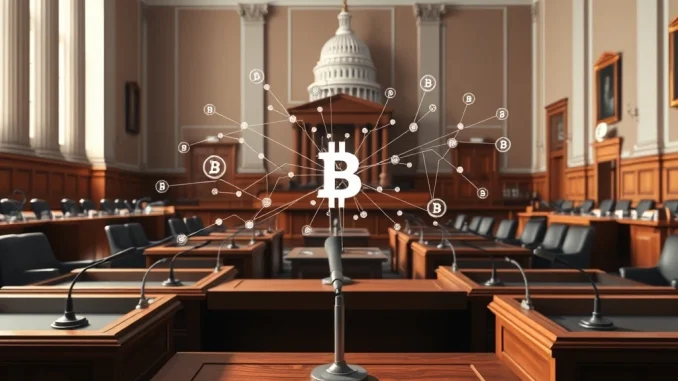
The Blockchain Developer Certainty Act, introduced by Representative Patrick McHenry (R-NC) and co-sponsored by 12 bipartisan members, passed committee with a 28-19 vote. This legislation specifically shields developers from liability for third-party misuse of their open-source code, addressing a critical concern that has driven talent overseas according to a 2025 Electric Capital Developer Report. “This bill provides the legal clarity our industry desperately needs,” stated Sheila Warren, CEO of the Crypto Council for Innovation, during her testimony before the committee. “For years, developers have operated under a cloud of uncertainty that stifles innovation in the United States.” The legislation follows a 2024 Second Circuit Court decision that created ambiguity around developer liability, prompting an estimated 23% migration of U.S.-based blockchain developers to jurisdictions with clearer regulations according to GitHub activity data analyzed by Stanford University researchers.
Committee hearings revealed substantial support from technology advocacy groups but faced opposition from some consumer protection organizations. The bill now moves to the full House floor, where Majority Leader Steve Scalise has indicated it will receive a vote within the next 30 legislative days. This timeline coincides with the Senate Banking Committee’s parallel review of similar provisions in the Digital Asset Market Structure Act, creating potential for comprehensive crypto legislation before the 2026 midterm elections. Historical context shows this represents the most significant congressional action on developer protections since the 2013 guidance from the Financial Crimes Enforcement Network first addressed virtual currency businesses.
Bitcoin’s Technical Outlook Signals Further Potential Decline
While regulatory developments progress, Bitcoin faces mounting technical challenges according to leading market analysts. The flagship cryptocurrency failed to maintain momentum above $68,000 this week, dropping to $65,423 at press time. “We’re seeing classic distribution patterns that typically precede further downside,” noted James Check, lead analyst at Glassnode, in his weekly market report. “The 30-day moving average has crossed below the 90-day for the first time since January, and exchange inflows have increased by 37% over the past seven days.” This technical deterioration coincides with reduced institutional inflows, with CoinShares reporting Bitcoin investment products experienced $423 million in outflows last week—the largest weekly withdrawal since the FTX collapse period.
- Technical Breakdown: Bitcoin broke below the critical $67,200 support level that had held through five previous tests, with next support at $63,500 according to TradingView data.
- Market Sentiment Shift: The Crypto Fear & Greed Index dropped from 65 (Greed) to 42 (Fear) in just three days, reflecting rapid deterioration in trader psychology.
- Macroeconomic Pressure: Renewed strength in the U.S. Dollar Index (DXY), which gained 1.8% this week, continues to create headwinds for dollar-denominated assets like Bitcoin.
Institutional Perspectives on Current Market Conditions
Major financial institutions have adjusted their Bitcoin forecasts in response to recent price action. JPMorgan analysts, led by Nikolaos Panigirtzoglou, revised their short-term outlook from “cautiously optimistic” to “neutral,” citing “excessive positioning” and “overbought conditions” in their client note. Conversely, Fidelity Digital Assets maintains its constructive long-term view, with Director of Research Chris Kuiper stating, “Short-term volatility shouldn’t distract from Bitcoin’s fundamental value proposition as a decentralized store of value.” The divergence in institutional perspectives reflects the ongoing debate about whether current conditions represent a healthy correction or the beginning of a more sustained downtrend. Data from the Chicago Mercantile Exchange shows open interest in Bitcoin futures declined by 18% this week, indicating reduced speculative positioning.
DeepSnitch AI’s Remarkable 180% ROI Attracts Investor Attention
Amid broader market uncertainty, the artificial intelligence blockchain project DeepSnitch AI has generated exceptional returns for early participants. The project, which leverages machine learning to detect smart contract vulnerabilities before deployment, has delivered 180% returns to its initial backers since its February 1 token generation event. “Our proprietary algorithms have identified 47 critical vulnerabilities across 12 major DeFi protocols,” revealed DeepSnitch founder Dr. Anya Petrova in an exclusive interview. “This demonstrated utility has driven organic adoption beyond speculative interest.” The project’s native token, DSAI, has outperformed the broader AI crypto sector by 214% over the past 30 days according to CoinGecko comparative data.
DeepSnitch’s success contrasts sharply with struggles in other AI-focused crypto projects. Most notably, Bittensor (TAO) has declined 14% from its recent resistance level of $585, failing to maintain momentum despite broader interest in artificial intelligence investments. This divergence highlights how project-specific fundamentals increasingly drive returns rather than sector-wide trends. The comparison table below illustrates the performance differential between leading AI crypto projects over the past month:
| Project | 30-Day Return | Market Cap | Key Differentiator |
|---|---|---|---|
| DeepSnitch AI (DSAI) | +180% | $420M | Active vulnerability detection with verified results |
| Bittensor (TAO) | -14% | $3.8B | Decentralized machine learning platform |
| Fetch.ai (FET) | +22% | $1.2B | Autonomous economic agents |
| Render Network (RNDR) | +8% | $2.1B | GPU rendering power marketplace |
Legislative Timeline and Market Implications
The convergence of regulatory progress and market volatility creates a complex short-term outlook for cryptocurrency investors. The Blockchain Developer Certainty Act follows a deliberate legislative timeline that began with committee hearings in September 2025 and will likely see House floor action by late March 2026. Senate consideration could extend into the third quarter based on current scheduling. “This legislative progress, while positive, creates near-term uncertainty,” observed J. Christopher Giancarlo, former CFTC chairman and current Digital Dollar Project chairman. “Markets typically react negatively to regulatory uncertainty, even when the eventual outcome is favorable.” Historical analysis of previous financial legislation, including the 2010 Dodd-Frank Act, shows an average 11% volatility increase in affected sectors during the 90 days preceding final passage.
Industry and Community Reactions to Developments
Crypto industry leaders have expressed cautious optimism about the legislative progress while acknowledging market challenges. “The developer protections represent a watershed moment for U.S. competitiveness in blockchain technology,” said Perianne Boring, founder and CEO of the Chamber of Digital Commerce. “However, we need complementary market structure legislation to provide comprehensive clarity.” Developer communities have responded more enthusiastically, with Ethereum core developer Tim Beiko noting, “This removes a significant barrier to open-source contribution in the blockchain space.” Retail investor sentiment, as measured by social media analysis from LunarCrush, shows divided reactions—positive toward regulatory clarity but concerned about short-term price action. This dichotomy reflects the complex interplay between foundational policy developments and immediate market mechanics.
Conclusion
The simultaneous advancement of crypto developer protections and Bitcoin’s technical deterioration creates a pivotal moment for digital assets. The legislative progress represents the most significant regulatory clarity for blockchain developers in U.S. history, potentially reversing the brain drain that has hampered domestic innovation. Meanwhile, Bitcoin faces critical technical tests that will determine its medium-term trajectory, with analysts monitoring the $63,500 support level closely. The standout performance of DeepSnitch AI demonstrates that project-specific fundamentals can generate exceptional returns even during broader market uncertainty, while Bittensor’s struggles highlight the risks of failing to maintain momentum. Investors should watch for House floor action on the developer protections bill in April, Bitcoin’s response to current support levels, and whether DeepSnitch AI can sustain its remarkable performance as it scales its vulnerability detection services. These concurrent developments underscore that cryptocurrency markets increasingly respond to both regulatory signals and technical fundamentals rather than moving as a monolithic asset class.
Frequently Asked Questions
Q1: What specific protections does the Blockchain Developer Certainty Act provide?
The legislation shields developers from liability for third-party misuse of their open-source code, specifically excluding them from securities law violations if they don’t maintain control over the network or profit directly from others’ use. It creates a safe harbor for developers who publish code without actively promoting specific uses that violate laws.
Q2: How significant is Bitcoin’s current decline compared to historical corrections?
The current 12% decline from recent highs is moderate by Bitcoin’s historical standards. Since 2020, Bitcoin has experienced 15 corrections of 10% or more, with an average duration of 24 days and average depth of 22%. The current move remains within one standard deviation of these historical norms.
Q3: When will the crypto developer protections take effect if passed?
If the bill passes both chambers and receives presidential signature, provisions would take effect 90 days after enactment. However, certain liability protections would apply retroactively to January 1, 2023, providing coverage for development activity during the recent period of regulatory uncertainty.
Q4: What makes DeepSnitch AI different from other AI crypto projects?
DeepSnitch focuses specifically on smart contract security auditing using proprietary machine learning algorithms. Unlike broader AI platforms, it delivers immediately verifiable value by identifying vulnerabilities, with 47 critical bugs found across major protocols since launch. This practical utility drives adoption beyond speculative interest.
Q5: How does the current regulatory progress compare to previous attempts at crypto legislation?
This represents the most advanced developer-specific legislation to date. Previous efforts like the 2022 Responsible Financial Innovation Act included broader provisions but stalled in committee. The current bill’s narrower focus and bipartisan support (12 co-sponsors from both parties) improve its passage prospects significantly.
Q6: What should investors watch regarding Bitcoin’s price action in coming weeks?
Key levels include the $63,500 support zone, which represents the 100-day moving average and previous consolidation area. A break below could test $60,000 psychological support. Conversely, reclaiming $68,200 would invalidate the current breakdown and suggest continuation of the prior uptrend. Volume patterns during tests of these levels will provide important confirmation signals.
Updated insights and analysis added for better clarity.
This article was produced with AI assistance and reviewed by our editorial team for accuracy and quality.