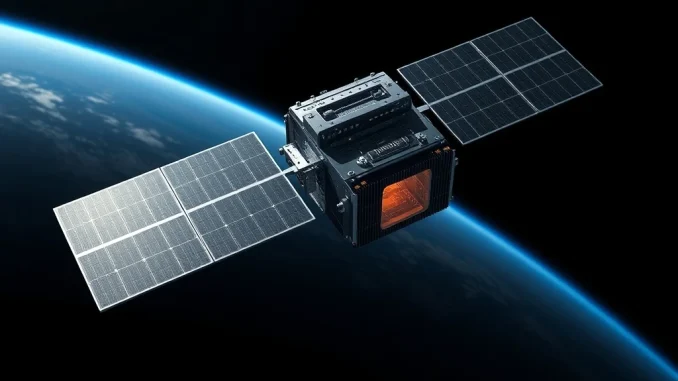
LOS ANGELES, March 10, 2026 — In a move that redefines the frontiers of both finance and technology, Starcloud, an Nvidia-backed orbital data center startup, will become the first company to mine Bitcoin in space later this year. CEO Philip Johnston confirmed the ambitious plan in a March 8 announcement, revealing that the venture will commence with the launch of the company’s second spacecraft. The initiative capitalizes on a radical economic advantage: Johnston states that running Bitcoin-specific ASIC miners in orbit is approximately 30 times cheaper per kilowatt-hour than using GPUs, positioning off-planet compute as a potentially transformative force for the energy-intensive cryptocurrency industry.
Starcloud’s Plan for the First Off-Planet Bitcoin Mine
Starcloud’s roadmap to extraterrestrial Bitcoin mining hinges on the successful deployment of its second orbital data center, scheduled for launch in the fourth quarter of 2026. The company, founded in early 2024 to address the soaring energy demands of artificial intelligence, made history in November 2025 by launching a satellite equipped with a powerful NVIDIA H100 GPU—the first of its kind to operate in space. Its broader vision involves a constellation of roughly 88,000 satellites, primarily powered by solar energy, creating a distributed computational network in low Earth orbit.
In a detailed interview with HyperChange, CEO Philip Johnston laid out the compelling financial logic. “GPUs are about 30 times more expensive per kilowatt or per watt than ASICs,” Johnston explained, providing concrete figures. “A 1-kilowatt B200 chip might cost $30,000. A 1-kilowatt ASIC is like $1,000.” This stark cost differential makes Bitcoin ASIC miners, which are designed solely for the hashing algorithms that secure the Bitcoin network, the ideal initial application for the company’s space-based compute infrastructure. Johnston argues that the economics are so persuasive that space-based mining could eventually absorb a significant portion of the industry’s global power draw, which he estimates at a continuous 20 gigawatts.
The Economic and Environmental Impact of Space-Based Compute
The potential shift of Bitcoin mining infrastructure to orbit carries profound implications for the industry’s economics and its contentious environmental footprint. Mining on Earth faces escalating challenges, including volatile energy costs, regulatory pressures, and localized strain on power grids. A space-based model, powered by consistent solar energy and operating in a thermally efficient vacuum, presents a paradigm shift.
- Radical Cost Reduction: The primary driver is the 30x cost efficiency of ASICs over GPUs for this specific task in the space environment, fundamentally altering profitability margins.
- Decoupling from Terrestrial Grids: Operations would no longer compete with residential or industrial energy demands, potentially mitigating a major source of public and regulatory criticism.
- Thermal Management Advantage: The cold vacuum of space offers near-ideal conditions for dissipating the immense heat generated by high-density computing, reducing the need for complex and energy-intensive cooling systems.
Expert Analysis on Viability and Scale
While the concept is groundbreaking, space industry analysts urge measured perspective. Dr. Anya Sharma, a senior fellow at the Center for Space Commerce at MIT, provided context. “The launch cost per kilogram remains the single largest barrier to large-scale orbital industry,” Dr. Sharma noted. “Starcloud’s model depends on achieving unprecedented satellite longevity and reliability to amortize those initial costs. Their success with the H100 satellite is a promising proof-of-concept for the hardware’s survivability.” She also pointed to the need for robust, automated systems for maintenance and upgrades in orbit. The startup’s backing from Nvidia, a leader in AI and compute hardware, lends significant credibility to its technical ambitions, as reported in their 2025 investment disclosures.
Broader Context: Bitcoin’s Interplanetary Future
Starcloud’s announcement is part of a growing discourse about cryptocurrency’s role in space exploration and future off-world economies. Just last year, tech entrepreneurs Jose E. Puente and Carlos Puente published a theoretical framework for sending Bitcoin transactions to Mars in as little as three minutes, leveraging existing optical links from agencies like NASA or satellite networks like Starlink. Their proposed interplanetary timestamping system would route transactions through space stations or lunar relays.
| Initiative | Primary Goal | Key Challenge | Timeline |
|---|---|---|---|
| Starcloud Bitcoin Mining | Profitably mine Bitcoin using orbital solar-powered data centers | Launch costs, hardware reliability in space | Operational launch planned for late 2026 |
| Puente Interplanetary Protocol | Enable Bitcoin transactions between Earth and Mars | Network latency and consensus across planets | Theoretical framework published 2025 |
| Traditional Earth Mining | Maintain network security and earn block rewards | Energy costs, regulation, environmental impact | Ongoing since 2009 |
However, as the Puentes clarified, mining Bitcoin on Mars itself remains impractical due to the prohibitive communication latency between the planets, which would disrupt the synchronized consensus mechanism of the Bitcoin network. This distinction highlights that while value transfer across planets may be feasible, the compute-intensive process of mining likely must remain relatively close to Earth, making low Earth orbit a strategically viable middle ground.
The Road Ahead for Starcloud and Orbital Industry
The immediate next step for Starcloud is the launch and commissioning of its second spacecraft, which will carry the specialized ASIC miners. Success would validate the core economic thesis and likely trigger a wave of investment and competition in the nascent field of orbital compute. The company’s longer-term vision extends beyond cryptocurrency; it aims to provide general-purpose, solar-powered high-performance computing (HPC) services from space, serving AI training, scientific simulation, and other data-intensive tasks unconstrained by terrestrial energy limitations.
Industry and Market Reactions
Initial reactions from the cryptocurrency mining sector have been a mix of skepticism and keen interest. “The numbers are eye-catching if they hold up in practice,” said Michael Carter, a veteran mining pool operator. “But for most miners, the capital required to even experiment with a space-based rig is currently prohibitive. We’ll be watching Starcloud’s operational data very closely.” Meanwhile, the news has sparked discussions among policymakers about the future of space resource utilization and the need for clear regulatory frameworks for commercial orbital activities, including data processing and financial transactions.
Conclusion
Starcloud’s plan to initiate Bitcoin mining in space in late 2026 represents a bold convergence of the cryptocurrency and new space industries. Driven by a 30-fold cost advantage for ASICs in orbit and the limitless solar energy available in space, the venture seeks to address the core economic and environmental pressures facing Earth-based mining. While significant technical and financial hurdles remain, the successful launch of its first GPU satellite provides a foundational proof of concept. This development marks a pivotal moment, suggesting that the future of extreme-scale computing—for Bitcoin, AI, and beyond—may increasingly look to the stars for sustainable and economically viable solutions. The industry’s focus will now shift to the upcoming launch, which will serve as the first real-world test of off-planet cryptocurrency production.
Frequently Asked Questions
Q1: When will Starcloud actually start mining Bitcoin in space?
The company plans to launch its second spacecraft, equipped with Bitcoin ASIC miners, in the fourth quarter of 2026. Mining operations would commence shortly after successful deployment and testing in orbit.
Q2: Why is mining Bitcoin in space considered cheaper?
According to Starcloud CEO Philip Johnston, it is 30 times cheaper per kilowatt-hour to run purpose-built Bitcoin ASIC miners in space compared to using general-purpose GPUs for the same task, primarily due to the lower hardware cost of ASICs and the use of free solar power.
Q3: What are the biggest challenges facing space-based Bitcoin mining?
The primary challenges are the high cost of launching hardware into orbit, ensuring the long-term reliability and maintenance of computing equipment in the harsh space environment, and building a business model that can overcome these initial capital expenses.
Q4: Could this solve Bitcoin’s environmental impact problems?
Potentially, by using solar power in space, it decouples mining from fossil-fuel-based terrestrial grids. However, the environmental impact of manufacturing and launching thousands of satellites must also be factored into the total lifecycle assessment.
Q5: How does this relate to sending Bitcoin to other planets?
While Starcloud focuses on mining in Earth orbit, other researchers have proposed protocols for transmitting Bitcoin transactions to Mars. Mining on Mars itself is not currently feasible due to network latency, but value transfer might be.
Q6: How will this affect individual Bitcoin miners on Earth?
In the short term, impact will be minimal due to the small scale of the initial space operation. If the model proves massively scalable and economical, it could over the long term increase the global hash rate and mining difficulty, favoring operations with the lowest marginal energy cost.