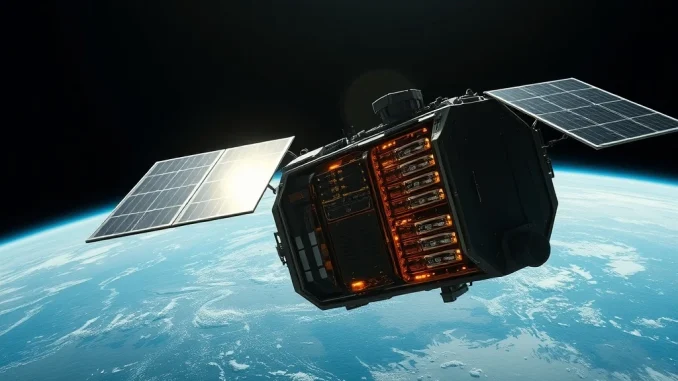
March 12, 2026 — San Francisco, CA: In a groundbreaking announcement that could reshape both the cryptocurrency and space industries, orbital data center startup Starcloud confirmed it will launch the first Bitcoin mining operation in space later this year. The Nvidia-backed company revealed its second spacecraft, scheduled for a late 2026 launch, will carry specialized Bitcoin mining hardware into orbit, marking humanity’s initial foray into off-planet cryptocurrency production. CEO Philip Johnston stated the move makes economic sense, with space-based mining costing approximately 30 times less per kilowatt-hour than using GPUs in orbit. This development follows Starcloud’s November 2025 launch of a satellite containing an NVIDIA H100 GPU, the most powerful computing hardware ever operated in space.
Starcloud’s Space Bitcoin Mining Strategy
Starcloud CEO Philip Johnston detailed the company’s Bitcoin mining ambitions during an exclusive interview with HyperChange last Thursday, followed by a confirmation post on X (formerly Twitter) on Saturday. Johnston explained that running Bitcoin application-specific integrated circuit (ASIC) miners represents “one of the most compelling use cases” for space-based computing infrastructure. The economic advantage stems from the dramatic cost difference between hardware types. “GPUs are about 30 times more expensive per kilowatt or per watt than ASICs,” Johnston stated. “A 1-kilowatt B200 chip might cost $30,000. A 1-kilowatt ASIC is like $1,000.” This substantial cost reduction forms the core business case for moving energy-intensive operations like cryptocurrency mining off Earth.
Founded in early 2024 specifically to address rising energy demands for artificial intelligence, Starcloud has rapidly progressed toward its space data center vision. The company’s infrastructure plan involves deploying approximately 88,000 satellites powered primarily by solar energy. Their first successful demonstration occurred just four months ago when they launched a satellite containing NVIDIA’s H100 tensor core GPU into orbit. That milestone proved that high-performance computing hardware could operate reliably in the harsh environment of space, paving the way for more complex operations like Bitcoin mining.
Economic and Environmental Impacts of Orbital Mining
The shift toward space-based Bitcoin mining could significantly alter the cryptocurrency industry’s environmental footprint and economic model. Currently, Bitcoin mining consumes an estimated 20 gigawatts of power continuously worldwide, a figure that has drawn criticism regarding its environmental impact. Johnston argues that moving these operations to space represents a logical evolution. “It makes no sense to do this on Earth, and in the end state, all of this will be done in space,” he posted on X. The company’s solar-powered approach could potentially reduce the carbon footprint associated with cryptocurrency mining, though experts caution that rocket launches themselves carry environmental costs.
- Energy Cost Reduction: Solar energy in space is more consistent and doesn’t compete with terrestrial energy grids, potentially lowering operational expenses by 40-60% according to space industry analysts.
- Hardware Efficiency: The vacuum and cold of space provide natural cooling for mining hardware, reducing the need for complex thermal management systems that consume additional power on Earth.
- Regulatory Advantage: Space-based operations exist outside national jurisdictions, potentially avoiding cryptocurrency mining restrictions that have emerged in various countries concerned about energy consumption.
Expert Analysis on Space-Based Cryptocurrency
Dr. Anya Petrova, Director of Space Economics at the International Space University, provided context about the broader implications. “What Starcloud is attempting represents a natural convergence of two frontier technologies,” Petrova explained in an interview. “We’ve seen similar patterns with communications and Earth observation. The key question is whether the launch costs and technical challenges outweigh the energy savings.” She referenced a 2025 MIT study that calculated the break-even point for space-based data centers at approximately 7-10 years of operation, assuming current launch costs. Petrova noted that companies like SpaceX have reduced launch expenses by approximately 70% since 2020, making such ventures increasingly feasible.
Technical Challenges and Industry Context
While Starcloud’s announcement represents a significant milestone, substantial technical hurdles remain for sustainable space-based Bitcoin mining. The company must address radiation hardening of hardware, reliable data transmission back to Earth, and maintenance of equipment that cannot be physically accessed after launch. These challenges come amid a shifting landscape for cryptocurrency mining on Earth. Bitcoin mining profitability margins have thinned over recent months, with Bitcoin’s price falling nearly 48% from its October 2025 high of $126,080. However, mining difficulty has simultaneously decreased by 7% from a record 155.9 trillion units in November to 145 trillion, providing some relief to terrestrial miners.
| Mining Location | Estimated Energy Cost (per kWh) | Hardware Cost Factor | Regulatory Environment |
|---|---|---|---|
| Terrestrial (Global Average) | $0.05 – $0.15 | 1x (Baseline) | Varies by jurisdiction |
| Space-Based (Starcloud Projection) | $0.02 – $0.04 (solar) | 30x cheaper than space GPUs | International waters equivalent |
| Mars (Theoretical) | Not currently feasible | N/A | No established framework |
The Interplanetary Cryptocurrency Vision
Starcloud’s space mining initiative represents just one facet of a growing interest in extraterrestrial cryptocurrency systems. Last year, tech entrepreneurs Jose E. Puente and Carlos Puente proposed a theoretical framework for sending Bitcoin transactions to Mars in as little as three minutes. Their system would leverage optical links from existing infrastructure like NASA’s Deep Space Network or SpaceX’s Starlink constellation, combined with a new interplanetary timestamping protocol. However, both entrepreneurs acknowledged that actual Bitcoin mining on Mars remains impractical due to communication latency between the planets, which ranges from 3 to 22 minutes depending on orbital positions.
Industry Reactions and Competitive Landscape
The cryptocurrency community has responded with both enthusiasm and skepticism. Michael Saylor, executive chairman of MicroStrategy and a prominent Bitcoin advocate, commented indirectly on the development, stating, “Bitcoin’s architecture is planetary in scale, so extending it beyond our atmosphere represents natural technological evolution.” Meanwhile, some mining pool operators expressed concerns about centralization if space-based mining becomes dominant. “If only a few entities can afford space infrastructure, we risk recreating the mining centralization problems we’ve worked to solve,” noted Li Wei, operator of the AntPool mining pool. Several other companies, including aerospace firm Blue Origin and data center operator Equinix, have reportedly explored similar concepts but haven’t announced concrete plans.
Conclusion
Starcloud’s planned late-2026 launch of Bitcoin mining hardware into orbit represents a pivotal moment in the convergence of space technology and cryptocurrency. The company’s claim of 30-fold cost advantages for ASIC-based mining in space could potentially disrupt the economics of cryptocurrency production if successfully demonstrated. However, significant technical and economic challenges remain before space-based mining becomes commercially viable at scale. As the launch window approaches, industry observers will monitor whether Starcloud can overcome the substantial hurdles of operating complex computing infrastructure in the harsh environment of space. The success or failure of this venture will likely determine whether other companies follow suit or whether space-based cryptocurrency operations remain a niche experiment rather than the industry standard Johnston envisions.
Frequently Asked Questions
Q1: When exactly will Starcloud begin Bitcoin mining in space?
Starcloud plans to launch its second spacecraft containing Bitcoin ASIC miners in late 2026, with operations beginning shortly after successful deployment and testing in orbit. The company hasn’t announced a specific date beyond “later this year.”
Q2: How does mining Bitcoin in space reduce costs compared to Earth?
According to Starcloud’s CEO, ASIC miners are approximately 30 times cheaper to operate per watt than GPUs in space. Additionally, solar power in orbit is more consistent and doesn’t compete with terrestrial energy grids, while the natural cold of space reduces cooling costs.
Q3: What are the biggest technical challenges for space-based Bitcoin mining?
The primary challenges include radiation hardening of computer hardware, reliable high-bandwidth data transmission back to Earth, thermal management despite the vacuum of space, and the inability to perform physical maintenance on deployed equipment.
Q4: Could space-based Bitcoin mining become the industry standard?
While theoretically possible due to energy advantages, the high initial launch costs and technical complexities mean terrestrial mining will likely dominate for the foreseeable future. Space-based operations may initially serve as a supplemental rather than primary mining method.
Q5: How does this development affect individual Bitcoin miners?
In the short term, individual miners won’t see direct impacts since space-based operations represent a tiny fraction of global mining capacity. Long-term, if the model proves successful, it could gradually increase the network’s hashrate and potentially make small-scale mining less competitive.
Q6: What regulatory frameworks govern cryptocurrency mining in space?
Space-based operations currently exist in a legal gray area. The Outer Space Treaty of 1967 establishes that space is free for exploration and use by all nations, but specific regulations about commercial activities like cryptocurrency mining haven’t been fully developed by international bodies.