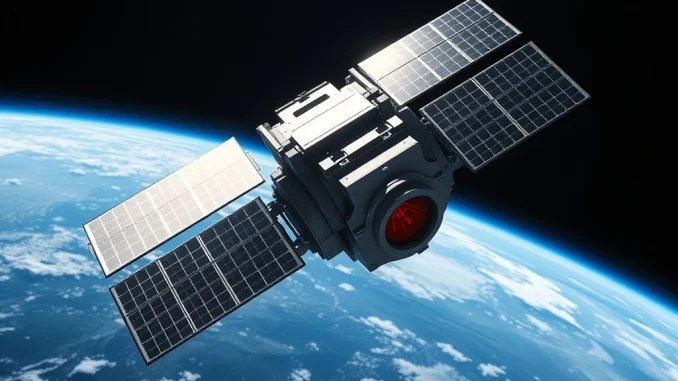
In a landmark announcement for both the cryptocurrency and aerospace industries, orbital data center startup Starcloud has confirmed it will begin mining Bitcoin from space later this year. CEO Philip Johnston revealed the plan in an interview on March 8, 2026, positioning the Nvidia-backed company to become the first entity to mine cryptocurrency off-planet. The initiative hinges on launching a second spacecraft equipped with Bitcoin ASIC miners, leveraging the company’s existing orbital data center infrastructure to capitalize on what Johnston calls a “massive” economic advantage over terrestrial mining.
Starcloud’s Plan for Off-World Bitcoin Mining
Starcloud CEO Philip Johnston provided concrete technical and economic reasoning for the unprecedented move. The core advantage, he stated, lies in the radical cost difference between hardware. “GPUs are about 30 times more expensive per kilowatt or per watt than ASICs,” Johnston explained in his interview with HyperChange. He provided a stark comparison: a 1-kilowatt Nvidia B200 AI chip costs approximately $30,000, while a 1-kilowatt Bitcoin ASIC miner is roughly $1,000. Consequently, running Bitcoin application-specific integrated circuit (ASIC) miners represents “one of the most compelling use cases” for the company’s space-based compute platform. The startup’s existing satellite, launched in November 2025 with a powerful NVIDIA H100 GPU, proved the viability of operating high-performance computing hardware in orbit. Starcloud’s ultimate vision involves a constellation of around 88,000 satellites, primarily powered by solar energy, creating a decentralized orbital data center network.
Johnston’s vision extends beyond a single satellite. He argues that the fundamental economics of Bitcoin’s energy consumption make space an inevitable destination. “Bitcoin mining consumes about 20 GW of power continuously. It makes no sense to do this on Earth, and in the end state, all of this will be done in space,” he posted on social media platform X. This statement frames the 2026 mission not as a stunt, but as a critical first step toward relocating a significant portion of global compute-intensive, energy-hungry processes into space. The company was founded in early 2024 specifically to address the soaring energy demands of artificial intelligence, with Bitcoin mining emerging as a parallel and immediately viable application.
The Economic and Environmental Impact of Space-Based Mining
The potential impacts of successful space-based Bitcoin mining are profound, affecting industry economics, environmental debates, and even space law. If Starcloud demonstrates significantly lower operational costs, it could trigger a competitive rush to orbit, fundamentally altering the geographic and economic landscape of cryptocurrency mining. This shift could alleviate political and social pressures related to the energy consumption of mining on Earth, moving the contentious activity literally out of sight and into a domain powered by abundant solar energy. However, it also raises new questions about space debris, orbital congestion, and the equitable use of space resources.
- Industry Disruption: A proven 30x hardware cost advantage could render many terrestrial mining operations non-competitive, forcing a rapid technological and locational pivot for the entire sector.
- Environmental Narrative: Moving megawatt-scale consumption to solar-powered platforms could partially decouple Bitcoin from the fossil fuel debate, though the environmental cost of rocket launches remains a factor.
- New Space Economy: This venture provides a clear, revenue-generating use case for commercial space infrastructure, potentially accelerating investment in space-based power, logistics, and manufacturing.
Expert Analysis on Technical Viability
Dr. Amanda Chen, a space systems engineer at the Secure World Foundation, provided context on the technical hurdles. “While the principle of operating compute hardware in space is proven, mining Bitcoin introduces unique challenges,” Chen noted in a statement to our publication. “Thermal management is paramount. ASICs generate immense heat, and dissipating it in the vacuum of space requires sophisticated, reliable radiator systems. A single-point failure could be mission-ending.” She also highlighted latency. “For mining, a few seconds of communication delay to Earth is negligible. This makes it more feasible than latency-sensitive applications, which is why the Puente proposal for transactions to Mars is more complex than the mining concept.” Chen’s analysis underscores that Starcloud’s November GPU satellite launch was a critical pathfinder mission for the thermal and power systems needed for the more demanding ASIC payload.
Broader Context: Bitcoin in the Final Frontier
Starcloud’s announcement is part of a growing discourse about cryptocurrency’s role in space exploration and settlement. In September 2025, tech entrepreneurs Jose E. Puente and Carlos Puente published a theoretical framework for sending Bitcoin transactions to Mars in as little as three minutes using optical links and a new interplanetary timestamping system. Their work, while distinct from mining, illustrates the broader industry’s forward-looking stance. However, they concluded that mining Bitcoin on Mars itself would be impractical due to the prohibitive latency between the planets, which would prevent miners from competing effectively in solving blocks. This delineation is crucial: Starcloud focuses on mining in Earth orbit with minimal latency, while interplanetary transactions remain a separate, longer-term challenge.
The news also arrives during a period of adjustment for the Bitcoin mining industry on Earth. Following Bitcoin’s price decline of nearly 48% from its October 2026 high of $126,080, profitability margins have tightened. However, the Bitcoin network’s mining difficulty has concurrently fallen by 7% from a record 155.9 trillion in November to 145 trillion, offering some relief to miners. Starcloud’s proposition suggests a future where mining economics are less tied to Bitcoin’s volatile price and more to the fixed, lower cost of space-based solar energy and hardware.
| Mining Location | Primary Energy Source | Key Hardware Cost (per kW) | Major Challenge |
|---|---|---|---|
| Terrestrial Data Center | Grid (Mixed Fossil/Renewable) | ~$30,000 (High-end GPU) | Energy Cost & Political Scrutiny |
| Orbital Data Center (Starcloud) | Solar | ~$1,000 (ASIC) | Launch Cost & Thermal Management |
| Theoretical Mars Base | Solar/Nuclear | Extremely High | Latency & Extreme Environment |
What Happens Next: The 2026 Launch and Beyond
The immediate next step is the launch of Starcloud’s second spacecraft, scheduled for the fourth quarter of 2026. This mission will carry the Bitcoin ASIC payload into low Earth orbit. Success will be measured not just by the satellite’s operational status, but by its demonstrated hash rate and the actual Bitcoin it mines. The industry will closely watch the operational data on power generation, heat dissipation, and compute stability. A successful proof-of-concept could trigger a wave of investment and competitive entries. Regulatory bodies, including the Federal Communications Commission (FCC) and the United Nations Office for Outer Space Affairs (UNOOSA), may also begin developing more concrete frameworks for commercial compute activities in space, especially those with significant energy footprints.
Industry and Community Reaction
Reactions from the cryptocurrency community have been polarized. Proponents hail it as a visionary leap that solves Bitcoin’s ESG problem. Critics, however, question the opportunity cost. “This is a spectacular solution in search of a problem,” tweeted a prominent mining analyst. “The capital spent developing and launching this could deploy gigawatts of renewable energy on Earth with immediate impact.” Others point to the risk of creating a new frontier for centralization if only a few well-capitalized entities can afford the astronomical upfront costs of space access. The debate highlights the tension between Bitcoin’s decentralized ethos and the inherently centralized nature of spaceflight infrastructure.
Conclusion
Starcloud’s 2026 mission to mine Bitcoin in space represents a pivotal test for the convergence of frontier technologies. It challenges assumptions about where and how critical digital infrastructure can operate. The core promise is a dramatic reduction in operational costs through specialized hardware and abundant solar power. If successful, it could initiate a slow migration of energy-intensive compute workloads off-planet, reshaping the economics of Bitcoin and potentially other industries. While significant technical and regulatory hurdles remain, the announcement marks a definitive moment. The world will be watching the launch later this year to see if the final frontier becomes the next battleground for cryptographic hash rate.
Frequently Asked Questions
Q1: How can mining Bitcoin in space be cheaper than on Earth?
Starcloud’s CEO claims a 30x cost advantage primarily due to hardware. Bitcoin ASIC miners are far less expensive per kilowatt than the high-end GPUs used for AI in space. Furthermore, the primary energy source in orbit is solar power, which is abundant and free after the initial infrastructure cost, unlike variable terrestrial electricity prices.
Q2: What are the biggest technical challenges for mining Bitcoin in space?
The two foremost challenges are thermal management and reliability. ASIC miners generate extreme heat that must be radiated into the vacuum of space using complex systems. Any mechanical failure in these cooling systems or in the satellite itself is irreparable, making durability and redundancy critical design factors.
Q3: When exactly will Starcloud launch its Bitcoin mining satellite?
The company has scheduled the launch for the fourth quarter of 2026. This will be its second spacecraft launch, following its first satellite carrying an NVIDIA H100 GPU, which was successfully deployed in November 2025.
Q4: Could this make Bitcoin mining truly environmentally friendly?
It could significantly reduce the carbon footprint associated with the electricity used for mining by leveraging solar power. However, a full lifecycle analysis must include the environmental impact of manufacturing and launching the satellites, which currently relies on carbon-intensive rocket launches.
Q5: How does this relate to proposals for using Bitcoin on Mars?
They are related but distinct concepts. Starcloud focuses on mining Bitcoin in Earth orbit. Other proposals, like the Puente system, focus on transmitting Bitcoin transactions between planets. Mining on Mars is considered unfeasible due to communication latency, but transactions could work with new protocols.
Q6: How will this affect everyday Bitcoin investors or users?
In the short term, likely very little. If space-based mining scales successfully, it could increase the network’s overall hash rate and security while potentially lowering the energy cost per mined Bitcoin. This could contribute to long-term network stability but is unlikely to cause immediate changes for users sending transactions.