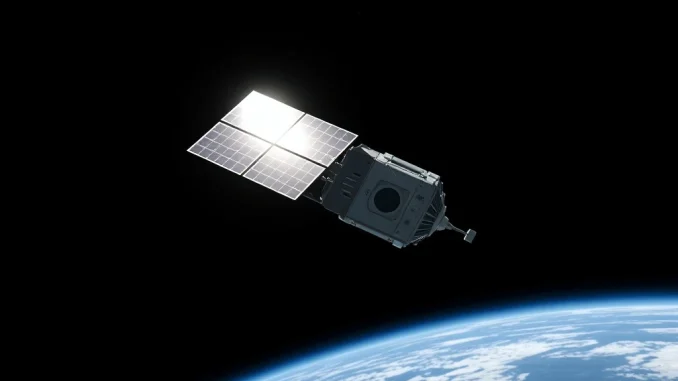
LOS ANGELES, March 10, 2026 — In a landmark move for both the cryptocurrency and aerospace industries, orbital data center startup Starcloud will initiate the first-ever Bitcoin mining in space operation later this year. The company, which counts tech giant Nvidia among its backers, confirmed the ambitious plan over the weekend, targeting a launch window for its second specialized spacecraft. CEO Philip Johnston stated the venture capitalizes on a staggering economic advantage, asserting that running application-specific integrated circuit (ASIC) miners in orbit is approximately thirty times more cost-effective per kilowatt-hour than using graphics processing units (GPUs) on Earth. This development signals a radical shift in the infrastructure of global cryptocurrency networks, moving critical operations beyond our planet’s atmosphere.
Starcloud’s Off-World Bitcoin Mining Ambition
Starcloud CEO Philip Johnston publicly detailed the company’s Bitcoin mining roadmap in a March 8 post on social media platform X, following an earlier interview. “Starcloud will be the first to mine Bitcoin in space,” Johnston declared, positioning the startup at the forefront of a nascent industry. The operational plan hinges on the launch of the company’s second spacecraft, scheduled for the latter half of 2026. Founded in early 2024 to address the soaring energy demands of artificial intelligence with space-based data centers, Starcloud achieved a significant milestone in November 2025 by launching a satellite equipped with a powerful NVIDIA H100 GPU into orbit. The orbital data center architecture, ultimately comprising a constellation of roughly 88,000 satellites, primarily draws power from solar energy, creating a potentially limitless and clean power source for energy-intensive computing.
Johnston’s rationale centers on brutal economics. In his interview with HyperChange, he presented a direct cost comparison that makes a compelling case for space-based ASIC operations. “GPUs are about 30 times more expensive per kilowatt or per watt than ASICs,” Johnston explained. “A 1-kilowatt B200 chip might cost $30,000. A 1-kilowatt ASIC is like $1,000.” This fundamental cost disparity, when combined with the abundant solar power available in orbit, creates a profitability margin that terrestrial miners, grappling with volatile energy prices and localized regulations, cannot match. He envisions this model scaling to absorb a significant portion of the global Bitcoin network’s estimated 20-gigawatt continuous power draw.
Economic and Environmental Impact of Space-Based Mining
The potential impacts of successful space compute mining are profound and multi-faceted. First, it could dramatically alter the geographic and economic landscape of cryptocurrency mining. Currently concentrated in regions with cheap electricity—often tied to fossil fuels or specific hydroelectric conditions—mining could become unmoored from terrestrial energy grids. Consequently, this shift may alleviate political and regulatory pressures in various countries while simultaneously raising new questions about space law and orbital resource use. Second, the environmental narrative around Bitcoin could change. Mining powered by space-based solar energy presents a path to a near-zero operational carbon footprint, directly addressing a major criticism of the industry.
- Profitability Reshuffle: Established mining companies with large Earth-based facilities may face disruptive competition from lower-cost orbital operations, potentially consolidating the industry.
- Energy Market Effects: A migration of mining demand to space could reduce pressure on local energy infrastructures in mining hubs, possibly freeing up electricity for other uses.
- New Space Economy: This venture validates space-based data centers as a viable commercial service, likely accelerating investment and innovation in orbital infrastructure and launch technologies.
Expert Analysis on Technical and Market Viability
Dr. Anya Sharma, a space systems engineer and senior fellow at the Center for Space Commerce, provided context on the technical hurdles. “The principle is sound—solar power is abundant and consistent in low Earth orbit, and heat dissipation in a vacuum is a different, but manageable, engineering challenge,” Sharma noted. “The real test for Starcloud will be achieving the necessary reliability and data throughput for mining pool connectivity. Latency is low for LEO, but any interruption in the communication link means lost revenue.” She referenced the successful demonstration of the H100 GPU in orbit as a positive precedent for hardware resilience. From a market perspective, David Chen, lead analyst at CryptoTech Insights, pointed to the current state of Bitcoin mining. “Profitability margins have been thin lately with BTC’s price down from its October high,” Chen said, referencing Cointelegraph’s market data. “However, the recent 7% drop in mining difficulty offers some relief. A player that can slash energy costs by an order of magnitude through a space-based model could be profitable at almost any Bitcoin price, fundamentally changing the game.”
Broader Context: Cryptocurrency’s Final Frontier
Starcloud’s announcement is not the only proposal linking Bitcoin to the cosmos. In September 2025, tech entrepreneurs Jose E. Puente and Carlos Puente theorized a system for sending Bitcoin transactions to Mars in as little as three minutes using optical links and an interplanetary timestamping system. Their concept, while distinct from mining, highlights the growing intersection of cryptographic networks and space infrastructure. However, they concurrently argued that mining Bitcoin on Mars would be impractical due to the prohibitive communication latency between the planets. This delineates a clear boundary: while transaction relay across the solar system may be feasible, the synchronized, competitive nature of proof-of-work mining requires proximity. Therefore, near-Earth operations like Starcloud’s represent the logical first step for off-world cryptocurrency infrastructure.
| Initiative | Primary Goal | Key Challenge | Timeline |
|---|---|---|---|
| Starcloud Mining | Operate Bitcoin ASIC miners in LEO | Hardware reliability & continuous connectivity | Launch slated for late 2026 |
| Puente Interplanetary System | Enable BTC transactions between planets | Building latency-tolerant protocol & infrastructure | Theoretical proposal, no launch date |
| Terrestrial Mega-Mining | Scale mining on Earth with renewable energy | Securing reliable, low-cost power & social license | Ongoing, facing regulatory headwinds |
The Road Ahead for Orbital Cryptocurrency Operations
The immediate next step for Starcloud is the successful launch and deployment of its second mining-equipped spacecraft. The company must demonstrate not only that the hardware functions in the space environment but also that it can maintain a stable, low-latency connection to Bitcoin mining pools on Earth to validate blocks and earn rewards. Industry observers will closely monitor the hash rate contribution of the satellite to gauge its impact. Success could trigger a wave of investment and competitive entries into the orbital data center sector. Conversely, failure might slow investment but likely won’t extinguish the long-term thesis, given the compelling economics. Regulatory bodies, including the Federal Communications Commission (FCC) and the Office of Space Commerce, are expected to scrutinize these activities, particularly regarding spectrum use and orbital debris mitigation plans.
Industry and Community Reactions
Reactions from the cryptocurrency mining community have been mixed, blending skepticism with intrigue. A spokesperson for a major North American mining consortium, who requested anonymity, commented, “The capital and complexity are enormous. We’ll believe it when we see a satellite consistently contributing hashes to a public pool.” However, many on social media and crypto forums have expressed excitement about the potential for “clean” Bitcoin mined with solar power, seeing it as a powerful counter-argument to environmental critics. The aerospace community views it as a promising validation of commercial space infrastructure beyond communications and Earth observation. Environmental groups remain cautiously observant, noting that while the operational energy may be green, the environmental cost of manufacturing and launching thousands of satellites remains a significant concern.
Conclusion
Starcloud’s plan to commence Bitcoin mining in space in late 2026 represents a bold convergence of frontier technologies. Driven by a thirty-fold cost advantage for ASIC operations in orbit and the promise of abundant solar energy, this venture could redefine the economic and environmental parameters of the entire cryptocurrency mining industry. While substantial technical and operational hurdles remain, the move has already shifted the conversation about the future of decentralized network infrastructure. If successful, it will prove that for Bitcoin, the final frontier is not just a destination for transactions, but a new home for its foundational process. The launch later this year will be a critical watchpoint for the finance, technology, and aerospace sectors alike.
Frequently Asked Questions
Q1: When exactly will Starcloud start mining Bitcoin in space?
Starcloud plans to begin its Bitcoin mining operation in space following the launch of its second specialized spacecraft, which is scheduled for the latter half of 2026. An exact date depends on launch vehicle readiness and final testing.
Q2: Why is mining Bitcoin in space potentially cheaper?
CEO Philip Johnston states it is about 30 times cheaper per kilowatt-hour to run ASIC miners in space. This is due to the lower hardware cost of ASICs compared to GPUs and the use of abundant, free solar power in orbit, avoiding terrestrial electricity costs and grid dependencies.
Q3: What are the biggest technical challenges for space-based Bitcoin mining?
The primary challenges include ensuring computing hardware can survive and operate reliably in the radiation and vacuum of space, managing heat dissipation without an atmosphere, and maintaining a continuous, low-latency data link to Earth-based Bitcoin mining pools to submit work.
Q4: Could this make Bitcoin more environmentally friendly?
Potentially, yes. If the mining satellites are powered primarily by solar panels and succeed at scale, the operational carbon footprint could be near zero. However, the full lifecycle impact—including manufacturing and launching the satellites—must be considered for a complete environmental assessment.
Q5: How does this relate to ideas about sending Bitcoin to Mars?
They are related but separate concepts. Starcloud focuses on the *production* (mining) of Bitcoin in near-Earth space. Other proposals involve the *transmission* of Bitcoin transactions across interplanetary distances. Mining on distant planets like Mars is currently seen as infeasible due to high latency.
Q6: How will this affect individual Bitcoin miners on Earth?
If space-based mining scales significantly, it could increase the global network’s hash rate and mining difficulty. This would pressure individual and small-scale miners on Earth who cannot compete with the lower energy costs of orbital operations, potentially leading to further centralization among large, well-capitalized entities both on and off the planet.