
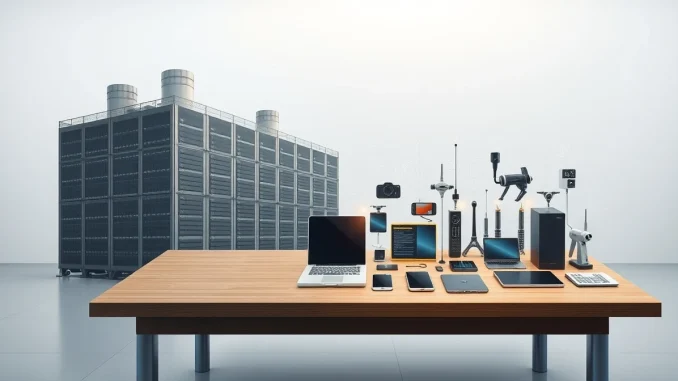
A new analysis suggests the foundational technologies of Bitcoin and artificial intelligence are moving in opposite structural directions. According to Galaxy Research, Bitcoin’s mining operations risk greater centralization, while AI is expected to become more distributed through edge computing. This divergence touches the core promise of blockchain technology and could reshape the future of digital infrastructure.
Galaxy Research Highlights a Structural Split
Alex Thorn, head of research at Galaxy, outlined this counter-trend in recent commentary. He noted that Bitcoin mining began with individuals using personal computers. Today, it demands specialized, industrial-scale operations. “AI may follow the opposite path,” Thorn stated. He explained that AI started in massive, centralized data clusters. However, challenges like data scarcity and memory limits for large models are creating an opening. “Open-source models could close the gap,” he added. The implication is a shift toward personal, on-device AI that doesn’t rely on corporate clouds.
Also read: Bitcoin Miners Brace for a Brutal 2028 Halving as Margins Shrink and Costs Soar
This isn’t just theoretical. What this means for investors and technologists is a potential re-drawing of the power map in tech. One sector consolidates control; the other may diffuse it. Industry watchers note this could signal different investment theses for blockchain versus AI infrastructure.
The Rapid Ascent of Edge AI Computing
Edge AI refers to processing data directly on devices like phones, sensors, or local servers, not in distant data centers. This approach reduces latency, enhances privacy, and cuts bandwidth costs. Data from Grand View Research shows the global edge AI market was valued at approximately $25 billion in 2025. The firm projects it will reach $119 billion by 2033. That represents growth of nearly 300%.
Also read: Push Notification Privacy: Durov's Stark Warning on a Hidden Surveillance Risk
GVR analysts link this surge to the expansion of the Internet of Things and connected devices. Demand for real-time processing and a growing focus on data privacy are also key drivers. This suggests a tangible, market-backed move toward decentralized AI. The growth isn’t speculative; it’s supported by hard numbers.
Why Edge AI Matters for Decentralization
Centralized AI models require users to send sensitive data to remote servers. Edge computing keeps that data local. This shift could reduce the dominance of a few large tech companies that control cloud infrastructure. Furthermore, smaller, more efficient models are becoming capable. They can run on consumer hardware without constant internet connections. This trend could democratize access to powerful AI tools.
Bitcoin Mining’s Centralization Pressure
Bitcoin’s design is decentralized, but its mining reality is complex. Early miners used CPUs and GPUs. The introduction of Application-Specific Integrated Circuit (ASIC) miners changed everything. These devices are expensive and quickly become obsolete. This creates high barriers to entry. Mining is now dominated by large firms and pooled resources. According to recent data from the Cambridge Centre for Alternative Finance, the top three mining pools often control over 50% of the network’s total hash rate.
This concentration raises concerns. A highly centralized mining ecosystem could, in theory, be more vulnerable to coercion or coordinated attack. It challenges the network’s antifragile nature. The security model of Bitcoin relies on no single entity having excessive control. Persistent centralization pressures could undermine this principle over the long term.
A Geographic Shift for Bitcoin Mining
There is a countervailing trend in mining: geographic decentralization. A report from crypto exchange KuCoin highlighted this shift. Soaring energy costs in the United States have made mining less profitable there. In some regions, the cost to mine one Bitcoin exceeded $100,000. This is pushing mining activity to new locations.
Countries like Paraguay and Ethiopia are becoming destinations. They offer surplus hydroelectric power at lower costs. This geographic dispersal has a security benefit. It makes the Bitcoin network less vulnerable to a single country’s regulatory or environmental changes. The network becomes more resilient. However, industry watchers note this is different from operational decentralization. A few large firms could still control operations across multiple countries.
The Energy Equation Remains Key
Mining’s move is fundamentally an energy arbitrage. Access to cheap, reliable power is the primary determinant of profitability. This relentless search for low-cost energy will continue to dictate where mining pools establish operations. It’s a powerful economic force that shapes the network’s physical footprint.
Implications for the Future of Tech
The opposing paths of Bitcoin mining and AI present a fascinating paradox. Both are transformative technologies. One emerged from a decentralized ethos but faces centralizing economics. The other was born in centralized corporate labs but is spreading outward. This suggests that the initial structure of a technology does not dictate its final form. Market forces, hardware evolution, and user demand play decisive roles.
For Bitcoin, the community continues to debate solutions. These include alternative consensus mechanisms and improvements to mining hardware accessibility. For AI, the success of open-source models and efficient chip design will determine how decentralized it becomes. The next five years will be critical for both trajectories.
Conclusion
The analysis from Galaxy Research highlights a critical divergence between Bitcoin mining and artificial intelligence. Bitcoin grapples with centralizing forces driven by economies of scale in hardware and energy. Meanwhile, AI is finding a path toward greater distribution through edge computing and efficient models. This split has profound implications for security, privacy, and control in the digital age. The evolution of both sectors will test the resilience of decentralized ideals against powerful economic and technical realities.
FAQs
Q1: What did Alex Thorn of Galaxy Research say about Bitcoin and AI?
Alex Thorn stated that Bitcoin mining, which started decentralized, has become more centralized over time. Conversely, he argued that AI, which began centralized, is moving toward a more decentralized future through edge and on-device computing.
Q2: What is edge AI computing?
Edge AI computing involves running artificial intelligence algorithms directly on local devices (like phones, cars, or IoT sensors) instead of sending data to remote cloud servers. This allows for faster processing, improved data privacy, and reduced reliance on internet connectivity.
Q3: How large is the edge AI market expected to grow?
According to Grand View Research, the global edge AI market was valued at about $25 billion in 2025. It is projected to grow to $119 billion by 2033, representing an increase of roughly 300%.
Q4: Why is Bitcoin mining becoming more centralized?
Bitcoin mining centralization is primarily driven by the need for specialized, expensive ASIC miners and access to cheap, industrial-scale energy sources. This creates high financial barriers to entry, favoring large corporations and mining pools over individual participants.
Q5: Is Bitcoin mining decentralizing in any way?
Yes, geographically. Due to rising energy costs in traditional hubs like the United States, mining operations are migrating to countries with cheaper power, such as Paraguay and Ethiopia. This geographic spread enhances network resilience against regional shocks, though operational control may remain concentrated.
Q6: What are the risks of centralized Bitcoin mining?
Excessive centralization of mining power could, in theory, make the Bitcoin network more vulnerable to coordinated attacks, censorship, or regulatory pressure targeted at a few large entities. It conflicts with the decentralized security model that is foundational to Bitcoin’s value proposition.

This article was produced with AI assistance and reviewed by our editorial team for accuracy and quality.





Be the first to comment