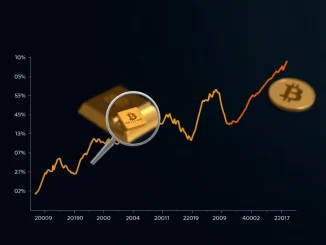
NEW YORK, March 15, 2026 — Bitcoin requires just one-sixth of the global store-of-value market to achieve a $1 million valuation per coin, according to a new analysis from cryptocurrency asset manager Bitwise. Chief Investment Officer Matt Hougan published research on Tuesday challenging conventional assumptions about Bitcoin’s growth trajectory relative to gold. His analysis reveals that most observers overestimate the market share Bitcoin needs by focusing solely on gold’s current $38 trillion valuation while ignoring the entire store-of-value market’s historical expansion. This perspective arrives during a period of notable divergence between Bitcoin and gold prices, raising fundamental questions about Bitcoin’s evolving role in global portfolios.
Bitcoin’s $1 Million Threshold: A 17% Market Share Target
Matt Hougan’s analysis centers on a crucial recalculation of Bitcoin’s path to a seven-figure valuation. Most analysts dismiss the $1 million Bitcoin forecast as unrealistic, believing it would require the cryptocurrency to capture half of gold’s entire market value. However, Hougan identifies a critical oversight in this thinking. The global store-of-value market has grown consistently for decades, driven by multiple macroeconomic factors. Gold’s market capitalization alone has expanded from $2.5 trillion in 2004 to approximately $38 trillion today, representing a compound annual growth rate of 13%. This growth stems from rising government debt levels, geopolitical uncertainty, expansive monetary policies, and increasing institutional allocation to hard assets.
Hougan projects this growth trajectory forward using historical data from the World Gold Council and Federal Reserve economic reports. If the store-of-value market continues growing at its 20-year average rate, it will reach approximately $121 trillion within the next decade. At that future market size, Bitcoin would need only a 17% share—about $20.6 trillion in market capitalization—to justify a $1 million per coin valuation. This represents a fundamentally different growth narrative than the 50% of today’s gold market that many critics reference. The analysis incorporates demographic shifts, particularly wealth transfer to younger generations with higher cryptocurrency adoption rates, as a supporting factor for Bitcoin’s market share growth.
The Store-of-Value Market Expansion: Beyond Gold’s Dominance
Bitwise’s research reframes the conversation around what constitutes the “store of value” market. While gold dominates current discussions, the broader category includes multiple asset classes that preserve wealth across economic cycles. This market has demonstrated remarkable resilience and growth through various financial crises, including the 2008 global financial crisis and the 2020 pandemic-induced market volatility. Institutional investors have increasingly allocated to store-of-value assets as portfolio hedges, particularly following the inflation surges of the early 2020s. Central bank gold purchases hit record levels in 2023-2024, adding further momentum to market expansion.
- Market Composition: The store-of-value universe includes physical gold, gold ETFs, sovereign wealth fund allocations to hard assets, collectibles, and increasingly, digital assets with scarcity properties.
- Growth Drivers: Monetary debasement concerns, currency volatility in emerging markets, and geopolitical tensions have accelerated capital flows into value preservation assets.
- Demographic Shift: Younger investors show stronger preference for digital stores of value, with surveys indicating 40% of millennials and Gen Z view cryptocurrency as a primary wealth preservation tool.
Institutional Catalysts for Bitcoin Adoption
Hougan cites specific institutional developments that could accelerate Bitcoin’s capture of store-of-value market share. The approval of spot Bitcoin exchange-traded funds in the United States in January 2024 created a regulated pathway for traditional capital allocation. Major asset managers including BlackRock, Fidelity, and Bitwise itself have collectively gathered over $50 billion in assets under management across these products as of early 2026. Sovereign wealth funds from countries including Norway, Saudi Arabia, and Singapore have begun exploratory allocations to digital assets, though most remain below 1% of total portfolios. Additionally, corporate treasury adoption continues with companies like MicroStrategy maintaining aggressive Bitcoin accumulation strategies despite price volatility.
Bitcoin-Gold Divergence: Challenging the “Digital Gold” Narrative
The last twelve months have presented a significant challenge to Bitcoin’s “digital gold” thesis. While gold prices reached an all-time high of $5,327 per ounce in late January 2026 and remain within 2.2% of that peak, Bitcoin has traded 44% below its October 2025 high of $98,000. This divergence has prompted renewed scrutiny from traditional finance leaders. Billionaire investor Ray Dalio reiterated his skepticism in early March, stating that central banks continue buying physical gold while showing minimal interest in Bitcoin reserves. Dalio argues that Bitcoin behaves more like a technology growth stock than a monetary hedge, citing its higher correlation with the Nasdaq than with inflation expectations.
| Asset | 2026 Year-to-Date Performance | Correlation with Inflation Expectations |
|---|---|---|
| Gold | +8.3% | 0.42 |
| Bitcoin | -12.7% | 0.18 |
| S&P 500 | +5.1% | -0.05 |
Greg Cipolaro, Global Head of Research at NYDIG, noted in a March 6 research report that Bitcoin appears “not currently being priced as a macro hedge, a sovereign risk hedge, or a real-rate or inflation trade.” This observation helps explain ongoing frustration among investors expecting Bitcoin to mirror gold’s price action during periods of geopolitical tension or currency weakness. The divergence became particularly pronounced following the October 2025 cryptocurrency market correction, which saw Bitcoin decline alongside technology stocks while gold maintained its upward trajectory.
The Road to 17%: Realistic Pathways and Potential Obstacles
Achieving 17% of a $121 trillion store-of-value market represents a formidable but plausible challenge for Bitcoin. The cryptocurrency’s current market capitalization of approximately $1.2 trillion represents just 3% of gold’s market value and less than 1% of the projected future store-of-value market. Hougan identifies several potential pathways to increased adoption. Regulatory clarity in major economies could unlock additional institutional participation, particularly from pension funds and insurance companies currently restricted by compliance guidelines. Technological improvements to Bitcoin’s scalability and privacy features might enhance its utility as a settlement layer for large-value transactions. Perhaps most significantly, continued monetary expansion by central banks could drive renewed interest in hard-capped alternative assets.
Competitive Responses and Market Evolution
The traditional store-of-value market continues evolving in response to digital competition. Gold industry participants have launched digital gold products with blockchain settlement, including tokenized gold certificates and physically-backed ETFs with enhanced liquidity features. Central bank digital currency developments in China, the European Union, and the United States incorporate programmable money features that could compete with cryptocurrency’s technological advantages. Meanwhile, alternative cryptocurrencies with different monetary policies continue claiming portions of the digital store-of-value narrative, though Bitcoin maintains approximately 52% dominance in the overall cryptocurrency market capitalization as of March 2026.
Conclusion
Bitwise’s analysis reframes the $1 million Bitcoin debate around market dynamics rather than static comparisons. The crucial insight recognizes that the store-of-value market expands alongside global wealth and monetary base growth. Bitcoin capturing 17% of this expanding market represents a significantly different proposition than capturing 50% of today’s gold market. However, recent price divergence from gold highlights ongoing questions about Bitcoin’s correlation properties and institutional adoption timeline. The pathway to $1 million depends on continued store-of-value market growth at historical rates alongside Bitcoin maintaining its current trajectory of increasing institutional allocation. Investors should monitor quarterly ETF flow data, regulatory developments in major economies, and Bitcoin’s correlation with traditional risk assets as key indicators of progress toward this ambitious valuation target.
Frequently Asked Questions
Q1: What exactly does “17% of the store-of-value market” mean for Bitcoin?
It means Bitcoin would need to capture $20.6 trillion of a projected $121 trillion global store-of-value market in 2036 to reach a $1 million per coin valuation. This contrasts with the common misconception that Bitcoin needs 50% of today’s $38 trillion gold market.
Q2: Why has Bitcoin been diverging from gold prices recently?
Bitcoin has shown stronger correlation with technology stocks than with inflation hedges since late 2025. Institutional positioning, regulatory uncertainty, and changing risk appetite have contributed to this divergence from gold’s traditional safe-haven behavior.
Q3: What growth rate is Bitwise assuming for the store-of-value market?
The analysis assumes 13% annual growth, matching gold’s market cap expansion from $2.5 trillion in 2004 to $38 trillion today. This growth is driven by monetary expansion, geopolitical uncertainty, and increasing institutional allocation to hard assets.
Q4: How realistic is Bitcoin capturing 17% market share in ten years?
It represents significant growth from Bitcoin’s current position but aligns with historical adoption curves of transformative technologies. Success depends on continued institutional adoption, regulatory clarity, and Bitcoin maintaining its scarcity advantage amid competing digital assets.
Q5: What are the main obstacles to Bitcoin reaching this target?
Key obstacles include regulatory challenges in major economies, competition from other store-of-value assets (including improved gold products), technological limitations of the Bitcoin network, and potential macroeconomic scenarios that reduce risk appetite for volatile assets.
Q6: How should investors interpret this analysis for portfolio decisions?
As a long-term framework rather than short-term price prediction. The analysis highlights Bitcoin’s potential in an expanding store-of-value universe but doesn’t address timing or volatility. Investors should consider their risk tolerance, time horizon, and Bitcoin’s evolving correlation properties when making allocation decisions.