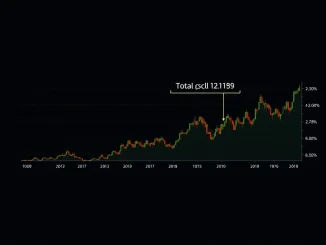
Global, May 2025: A significant shift in Bitcoin’s foundational investor base is unfolding. On-chain data reveals the supply held by long-term holders (LTHs) has rebounded to approximately 14.3 million BTC, halting a multi-month distribution phase. This reversal in accumulation behavior is a critical on-chain signal that analysts are scrutinizing for clues about the broader market cycle’s structure.
Bitcoin Long-Term Holder Supply Reaches 14.3 Million BTC
The metric for Bitcoin long-term holder supply tracks the number of coins that have remained unmoved in wallets for at least 155 days. This cohort is widely considered the most conviction-driven segment of the Bitcoin investor base, often composed of early adopters, institutional entities, and staunch believers in the digital asset’s long-term value proposition. After a period where these holders were net sellers, contributing to market supply, the trend has demonstrably reversed. Data from several blockchain analytics firms confirms the aggregate LTH supply has climbed back to the 14.3 million BTC level, a zone last seen before the previous distribution phase began. This accumulation represents coins being withdrawn from exchange liquidity and transferred into cold storage, a classic sign of bullish, long-term intent.
Analyzing the Shift from Distribution to Accumulation
The recent behavior of long-term holders marks a stark contrast to the preceding months. During that period, the LTH supply metric consistently declined, indicating these seasoned investors were taking profits or rebalancing portfolios. This distribution phase often coincides with market tops or periods of high volatility and speculative fervor, where older coins are spent into the market. The current rebound suggests this profit-taking has subsided. Several factors may be driving this renewed accumulation:
- Price Consolidation: Bitcoin has experienced a prolonged period of range-bound trading, shaking out short-term speculators and creating what long-term investors perceive as a favorable accumulation zone.
- Macroeconomic Hedge: Amidst persistent global economic uncertainty, some institutions and high-net-worth individuals may be increasing Bitcoin allocations as a non-correlated asset.
- Reduced Exchange Balances: The net flow of Bitcoin off exchanges, a closely watched metric, has been positive, directly contributing to the growth in the long-term holder cohort.
This shift is not merely a numerical change but reflects a fundamental change in market participant psychology from short-term profit-taking to long-term holding.
Historical Context and Cycle Comparisons
Historical on-chain analysis provides crucial context for the current long-term holder supply rebound. In previous Bitcoin market cycles, similar resumptions of LTH accumulation have often occurred during what analysts term a “mid-cycle reset.” This phase typically follows a period of intense speculation and a significant price correction. It is characterized by a cooling of sentiment, a decline in leverage across derivatives markets, and the transfer of assets from weak hands to strong hands. The 155-day threshold for defining a long-term holder is itself derived from historical cycle analysis, representing a period after which the statistical likelihood of a coin being spent drops dramatically. Comparing the current LTH supply curve to those of 2016-2017 and 2019-2021 reveals structural similarities that support the mid-cycle reset thesis, though each cycle exhibits unique macro and regulatory drivers.
The Mechanics and Implications of On-Chain Data
On-chain data offers a transparent, real-time ledger of Bitcoin network activity, free from the sentiment often found on social media or in price charts alone. The long-term holder supply is a derived metric, calculated by analyzing the age of unspent transaction outputs (UTXOs). When the aggregate volume of UTXOs older than 155 days increases, the LTH supply metric rises. The implications of this rebound are multifaceted for the broader market ecosystem:
- Reduced Liquid Supply: As more Bitcoin is effectively locked away in long-term storage, the liquid supply available for daily trading decreases. This can create a supply shock if demand suddenly increases.
- Increased Holder Conviction: The act of holding through volatility signals strong underlying belief in Bitcoin’s future value, potentially stabilizing the asset during future downturns.
- Foundation for Future Phases: A robust base of long-term holders is often a prerequisite for a sustainable bull market, as it indicates a healthy transfer of ownership from speculators to believers.
It is critical to note that on-chain metrics are descriptive, not predictive. They provide a high-fidelity picture of current network state and investor behavior, which must be interpreted alongside other data points.
Distinguishing Between Long-Term Holders and Other Cohorts
To fully understand the market dynamic, one must contrast long-term holder behavior with that of other key cohorts. Short-term holders (STHs), defined as wallets holding coins for less than 155 days, are typically more reactive to price movements and news cycles. Their supply often increases near market tops as new buyers enter. Meanwhile, the entity often described as “the market”—comprising exchanges, ETFs, and large custodial services—holds Bitcoin for its users, making its behavior a function of aggregate user action. The recent rebound in LTH supply, occurring alongside stable or declining exchange balances, suggests coins are moving from the transient, trading-focused segments of the market into the permanent, conviction-driven segment. This maturation is a hallmark of an asset class transitioning from a speculative novelty to a store-of-value asset.
Conclusion
The rebound in Bitcoin long-term holder supply to 14.3 million BTC represents a pivotal development in the current market cycle. This data point signals a potential mid-cycle reset, where early profit-taking has concluded and a new phase of accumulation by conviction-driven investors has begun. While no single metric guarantees future price action, the behavior of long-term holders provides a powerful, on-chain signal of underlying market structure and investor sentiment. This shift toward holding reduces immediate selling pressure and builds a more stable foundation for the network, underscoring the evolving maturity of Bitcoin as a global monetary asset. Monitoring the trajectory of the long-term holder supply will remain essential for understanding the market’s next phase.
FAQs
Q1: What is the Bitcoin long-term holder (LTH) supply?
The Bitcoin long-term holder supply is an on-chain metric that tracks the total number of bitcoins held in wallets where the coins have not been moved for at least 155 days. It is used to gauge the behavior of the most committed segment of the investor base.
Q2: Why is the rebound to 14.3 million BTC significant?
This rebound is significant because it follows a period of distribution, where long-term holders were net sellers. The reversal to accumulation suggests profit-taking has subsided and a new phase of conviction-based buying and holding may be underway, often associated with a mid-cycle market reset.
Q3: How does long-term holder behavior affect Bitcoin’s price?
Long-term holders affect price indirectly. By withdrawing coins from exchanges into long-term storage, they reduce the immediately available liquid supply. This can decrease selling pressure and, if coupled with rising demand, contribute to upward price momentum due to a potential supply shock.
Q4: What is a “mid-cycle reset” in Bitcoin markets?
A mid-cycle reset refers to a period within a broader Bitcoin market cycle characterized by a significant price correction, a cooling of speculative sentiment, and a transfer of coins from short-term, weak-handed investors to long-term, strong-handed investors. It often sets the stage for the next leg of a bull market.
Q5: Where can I find data on Bitcoin’s long-term holder supply?
Public blockchain analytics platforms like Glassnode, CryptoQuant, and IntoTheBlock provide data and charts tracking the long-term holder supply and other key on-chain metrics. These platforms analyze the public Bitcoin ledger to derive these insights.
Updated insights and analysis added for better clarity.
This article was produced with AI assistance and reviewed by our editorial team for accuracy and quality.