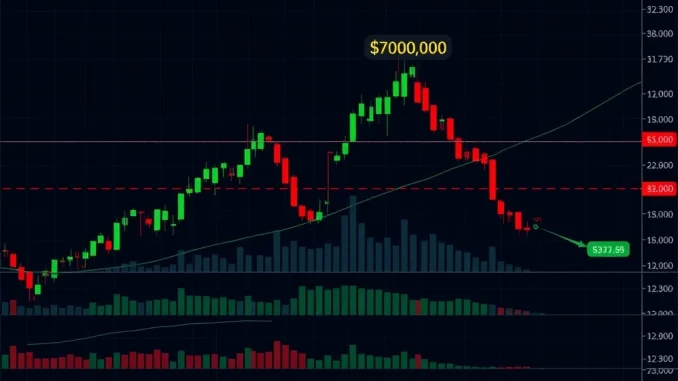
Global Markets, May 2025: The Bitcoin price continues to face significant resistance below the $70,000 threshold, a critical psychological and technical barrier that has defined market sentiment for weeks. According to a recent analysis from leading algorithmic trading firm Wintermute, this stagnation stems not from a simple lack of bullish momentum, but from a complex interplay of low investor conviction, weak spot market demand, and a market structure increasingly dominated by leverage. The resulting environment fosters choppy and unstable price discovery, where futures contracts and derivatives exert more influence on short-term swings than fundamental buying or selling pressure.
Bitcoin Price Analysis: The $70,000 Ceiling and Market Mechanics
Bitcoin’s struggle to reclaim and hold ground above $70,000 represents a pivotal moment in its current market cycle. This level has acted as a formidable ceiling since the significant wave of long liquidations that swept through derivatives markets approximately two weeks ago. That event, often described as a deleveraging shock, wiped out over-leveraged bullish positions and instilled a climate of caution. Price action since then has been characterized by sharp, intraday reversals and a noticeable lack of sustained directional momentum. Analysts point to a decoupling between the spot market—where physical Bitcoin is bought and sold—and the futures market, where traders speculate on future prices using leverage. When futures trading volume and open interest disproportionately drive price moves, the market becomes susceptible to exaggerated swings based on margin calls and positioning rather than organic supply and demand.
The Dominance of Leverage in Current Price Discovery
The term ‘price discovery’ refers to the market process of determining the price of an asset through the interactions of buyers and sellers. In a healthy market, this process reflects genuine valuation based on information, utility, and investment thesis. However, Wintermute’s assessment highlights that Bitcoin’s current price discovery is becoming ‘choppy’ or unstable due to the outsized role of leverage. Futures markets allow traders to control large positions with a relatively small amount of capital, amplifying both gains and losses. This creates a feedback loop:
- Increased Volatility: Large leveraged positions can force rapid buying or selling to meet margin requirements, creating sharp price spikes or drops unrelated to broader sentiment.
- Whiplash Patterns: The market experiences rapid rallies followed by equally swift pullbacks as leveraged positions are quickly opened and closed.
- Suppressed Trend Formation: Sustained trends struggle to develop because leverage-induced moves often lack the foundational support of spot market accumulation.
This environment makes it exceptionally difficult for Bitcoin to achieve a clean, decisive breakout above key resistance levels like $70,000.
Macroeconomic Shifts and Weak Spot Demand
Beyond internal market structure, external macroeconomic factors contribute to the ‘low conviction’ environment. Shifts in monetary policy expectations, inflation data, and geopolitical tensions have introduced a layer of uncertainty that affects all risk assets, including cryptocurrencies. Traditional investors and large institutions, often seen as sources of robust spot demand, may adopt a wait-and-see approach during such periods of macro uncertainty. This hesitancy results in weaker spot buying pressure, leaving the market more vulnerable to being pushed around by the more reactive and highly leveraged futures sector. The absence of strong, consistent demand from spot exchange-traded funds (ETFs) or sustained corporate treasury buying further exacerbates this dynamic, removing a key stabilizing force that helped propel previous rallies.
Historical Context: Lessons from Past Leverage Cycles
This is not the first time leverage has dictated Bitcoin’s short-term trajectory. Historical analysis reveals clear patterns. The bull run of late 2020 and early 2021 was punctuated by several major deleveraging events where excessive long leverage was rapidly unwound, leading to corrections of 20-30%. Similarly, the bear market of 2022 was accelerated by cascading liquidations across leveraged positions. The current market structure echoes these precedents, albeit at a different phase of the cycle. The key lesson is that markets dominated by leverage are inherently fragile. Sustainable advances are typically built on a foundation of spot market accumulation—often referred to as ‘coins moving from weak hands to strong hands’—rather than speculative futures bets. Until spot market activity picks up meaningfully, the path of least resistance may continue to be sideways or choppy action below major resistance.
Implications for Traders and Long-Term Investors
The current environment demands distinct strategies for different market participants. For short-term traders, the heightened volatility presents both opportunity and significant risk. Strategies must account for sudden, leverage-driven moves and employ rigorous risk management to avoid being caught in liquidation squeezes. For long-term investors, the choppy price discovery may be less relevant on a multi-year horizon, but it underscores the importance of understanding market mechanics. It also highlights potential entry points during periods of leverage washouts, when prices may temporarily disconnect from longer-term fundamentals. Furthermore, this situation tests the resilience of the broader cryptocurrency ecosystem, including lending protocols and exchanges, which must manage their own risk exposure to volatile, leverage-influenced markets.
Conclusion: Navigating a Leverage-Driven Market Phase
In conclusion, the Bitcoin price remains capped below $70,000 due to a confluence of factors expertly identified by Wintermute: low conviction, weak spot demand, and macro uncertainty, all set against a backdrop of leverage-driven price discovery. This creates a choppy and unstable trading environment where futures market dynamics often override fundamental buying and selling. For the market to stage a convincing and sustainable breakout, a shift is likely required—either a flush of excessive leverage from the system or a resurgence of strong, organic demand from the spot market. Until then, participants should prepare for continued volatility and recognize that true price discovery may remain elusive until the market’s structural balance is restored.
FAQs
Q1: What does ‘choppy price discovery’ mean?
Choppy price discovery refers to a market condition where an asset’s price moves in sharp, irregular, and unstable swings without establishing a clear, sustained trend. It often occurs when short-term factors like leveraged trading override longer-term fundamental valuation.
Q2: How does leverage in futures markets affect Bitcoin’s price?
Leverage allows traders to control large positions with little capital. When many traders use high leverage, even small price moves can trigger mass margin calls or liquidations, forcing rapid buying or selling that creates exaggerated price volatility unrelated to core market sentiment.
Q3: What is the difference between spot demand and futures trading?
Spot demand involves buying and selling the actual Bitcoin asset for immediate delivery. Futures trading involves contracts to buy or sell Bitcoin at a future date. Futures are often traded with leverage and can influence the spot price, but they represent a derivative bet, not direct ownership.
Q4: Why is the $70,000 level psychologically important for Bitcoin?
$70,000 is a key round-number resistance level that Bitcoin has tested and failed to hold multiple times. It represents a significant all-time high region from the previous cycle, making it a major technical and psychological barrier for bulls to overcome.
Q5: What could lead to a sustainable Bitcoin breakout above $70,000?
A sustainable breakout would likely require a combination of reduced leverage in the system, a surge in organic spot market buying from institutions or ETFs, and a supportive macroeconomic backdrop that boosts investor conviction for holding the asset long-term.