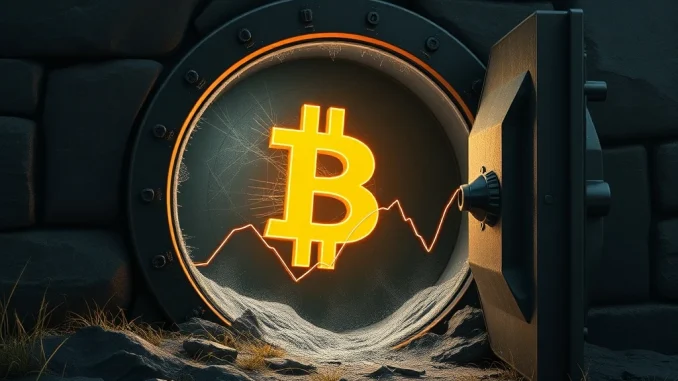
Global, December 2025: Bitcoin is having a rough stretch. Since the fourth quarter of 2025, the premier cryptocurrency has underperformed relative to broader expectations and select altcoins, prompting a fundamental reassessment of market drivers. The core issue emerging from on-chain data and trading patterns is not merely short-term volatility but a structural repricing of a long-overshadowed risk: the potential future circulation of dormant Bitcoin supply. This analysis explores the tangible market mechanics behind Bitcoin lagging as investors and algorithms grapple with the implications of vast, aging coin reserves suddenly becoming active.
Bitcoin Is Lagging Due to a Fundamental Market Repricing
The recent underperformance of Bitcoin signals a shift in market psychology. For years, the narrative of ‘digital gold’ and a fixed supply cap of 21 million coins supported valuations. However, the fixed total supply does not equate to a fixed active supply. Markets are now intently focused on the portion of Bitcoin that has not moved in years—coins held in wallets untouched for five, seven, or even ten years. Analysts are recalculating models to account for the probability of these coins re-entering circulation, acting as a latent overhang on price. This repricing reflects a maturation of market analysis, moving beyond simple scarcity to assess the fluidity and behavioral patterns of the existing supply.
Decoding Dormant Bitcoin Supply and Its Market Impact
Dormant supply refers to Bitcoin held in addresses with no outgoing transactions for an extended period. This cohort is often romanticized as ‘diamond hands’ or ‘lost coins,’ but its market impact is purely mathematical. A sudden movement of even a small percentage of this supply can drastically increase sell-side pressure.
- Volume vs. Velocity: While trading volume may remain stable, the velocity of the total supply—how quickly coins change hands—has stagnated. This indicates coins are being held, not transacted, reducing network economic energy.
- The Aging Coin Metric: Data from blockchain analytics firms shows a multi-year high in the percentage of supply last active over five years ago. This creates a binary risk: continued dormancy supports price stability, while activation introduces unpredictable selling.
- Historical Precedents: Previous bull market peaks in 2017 and 2021 were preceded by significant spikes in dormant coin movement, as long-term holders took profits. The market is now preemptively discounting this possibility.
The Psychology of Stagnant Engagement and Investor Fatigue
Beyond the raw data, a palpable sense of emotional fatigue is evident. The frenetic retail engagement of past cycles has given way to a cautious, wait-and-see approach. This fatigue manifests in reduced activity on retail exchanges, lower search trend volumes for ‘Bitcoin,’ and a decline in social media sentiment metrics. The market participant base appears to be holding, but not enthusiastically accumulating. This emotional stagnation directly contributes to Bitcoin lagging, as it lacks the speculative fervor that often drives rapid price appreciation. The market is in a state of equilibrium, waiting for a catalyst to shift the dormant supply dynamic one way or the other.
Short-Term Holder Pain and the Avoidance of Structural Crash
Current price action is inflicting historic losses on short-term holders (STHs)—entities holding coins for less than 155 days. Their aggregate cost basis now sits significantly above the spot price, creating a zone of realized loss. Typically, such widespread STH loss is a precursor to capitulation and a deeper crash. However, a full structural market crash has so far been avoided. The reason lies in redistribution. Analysis shows that coins sold at a loss by STHs are being absorbed not by other weak hands, but by entities with longer-term holding patterns and larger balances. This transfer, while painful in the short term, prevents a cascading liquidation spiral and consolidates supply into potentially more resilient hands, setting a firmer, if lower, floor for the price.
The Role of Large Holders and Institutional Custody
The behavior of large holders, often called ‘whales,’ is crucial. On-chain data indicates that while some whale entities have distributed portions of their holdings, a significant cohort has used the period of Bitcoin lagging to accumulate or hold steady. Furthermore, the rise of regulated institutional custody solutions has effectively ‘institutionalized’ a portion of the dormant supply. Coins held in these vaults are subject to different governance and release schedules than individual wallets, adding a new layer of predictability—and complexity—to the dormant supply equation. This institutional layer may act as a dampener on volatile, emotion-driven sell-offs from this cohort.
Comparative Analysis: Bitcoin vs. Broader Crypto Asset Performance
The phenomenon of Bitcoin lagging is particularly notable when set against the performance of other major crypto assets. While Bitcoin has struggled, select sectors like decentralized finance (DeFi) tokens and layer-1 alternatives have seen relative strength. This divergence suggests capital is not exiting the digital asset space entirely but is rotating within it. Investors may be seeking higher beta opportunities or yields not available in a stagnant Bitcoin market. This rotation further pressures Bitcoin’s dominance ratio and underscores that the repricing of dormant supply risk is a Bitcoin-specific headwind, not a blanket crypto-industry problem.
| Asset Class | Price Performance | Key Driver | Supply Risk Profile |
|---|---|---|---|
| Bitcoin (BTC) | Lagging / Negative | Dormant Supply Repricing | High (Latent Overhang) |
| Major Layer-1s (e.g., ETH, SOL) | Mixed / Neutral | Network Utility & Staking Yield | Medium (Controlled Emission) |
| DeFi Governance Tokens | Positive / Outperforming | Protocol Revenue & Incentives | Variable (Often Inflationary) |
Conclusion: Navigating a Market Defined by Latent Supply
The current period of Bitcoin lagging is not a story of broken technology or failed adoption. It is a story of market maturation. Participants are soberly assessing a risk that was always present but often ignored: the behavioral economics of a decentralized holder base. The repricing of dormant supply risk represents a more nuanced, and arguably healthier, phase of valuation. Price discovery now incorporates not just future demand but also the probabilistic models of existing supply movement. For Bitcoin to break out of this lagging phase, it will require a catalyst that either permanently alters the dormancy calculus—such as widespread institutional adoption locking supply further—or a controlled, non-disruptive activation of old coins that the market can absorb without panic. The path forward hinges on this balance between dormant potential and active circulation.
FAQs
Q1: What exactly is ‘dormant Bitcoin supply’?
Dormant Bitcoin supply refers to coins that have not been moved from their wallet addresses for a significantly long period, commonly defined as two, five, or seven years. These coins are considered inactive, and their potential future movement creates uncertainty for market pricing.
Q2: Why does dormant supply risk cause Bitcoin to be lagging in price?
Markets discount future risks. The possibility that a large amount of previously inactive Bitcoin could suddenly be sold increases the perceived future selling pressure. This leads traders and algorithms to value Bitcoin lower in the present, resulting in underperformance or lagging prices until the uncertainty is resolved.
Q3: How is ‘investor fatigue’ measured in cryptocurrency markets?
Investor fatigue is gauged through indirect metrics like declining active address growth, reduced retail exchange deposit volumes, lower social media engagement and sentiment scores, and a drop in online search interest for terms like ‘Bitcoin buy.’ It reflects a lack of new, enthusiastic participants.
Q4: If short-term holders are at a loss, why hasn’t the Bitcoin market crashed?
A full crash has been avoided due to redistribution. Coins sold at a loss by short-term holders are being purchased by entities with longer-term holding horizons and stronger balance sheets. This transfer consolidates supply and prevents a panic-driven liquidation cascade, establishing a new, more resilient price floor.
Q5: Could a large movement of dormant coins ever be a positive signal?
Yes, context matters. If dormant coins move into long-term cold storage or regulated institutional custody, it signals consolidation by committed holders. Conversely, movement to exchanges typically signals an intent to sell. The market impact depends entirely on the destination and volume of the moved coins.