
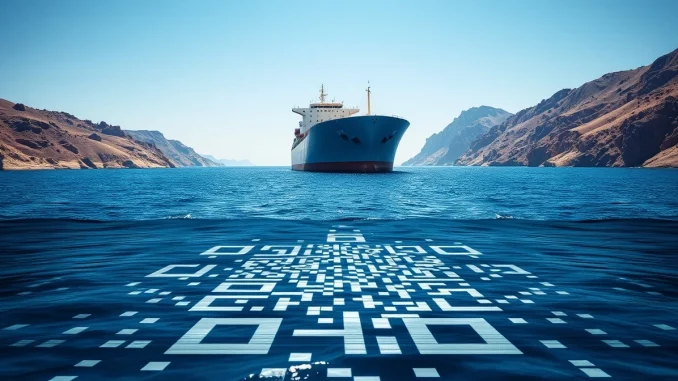
Reports that Iran may accept Bitcoin for oil tanker tolls have ignited a fierce debate about cryptocurrency’s role in global finance and sanctions evasion. The discussion, centered on the strategic Strait of Hormuz, examines whether digital assets can function as a neutral settlement layer for multi-million dollar international transactions.
Conflicting Reports on Iran’s Proposed Payment Method
According to a Financial Times report published in late March 2026, Iranian authorities are considering accepting Bitcoin payments from oil tankers crossing the Strait of Hormuz. This vital waterway sees about 20% of the world’s oil supply pass through it. The stated aim is to circumvent U.S. sanctions that restrict Iran’s access to the global financial system.
Also read: Sanctions Warning: Paying Iran in Crypto Puts Global Shippers at Severe Legal Risk
But subsequent reporting has created confusion. Alex Thorn, head of firmwide research at Galaxy, a crypto investment firm, noted that other sources suggest payments might be made in stablecoins or Chinese yuan. “We are monitoring onchain activity for signs of an oil tanker fee paid in BTC,” Thorn stated. This discrepancy highlights the opaque nature of the proposal and the challenges in verifying its details.
The Technical and Practical Hurdles
The initial Financial Times report cited an Iranian official saying ships would have “a few seconds” to complete payment. This detail points directly to the Bitcoin Lightning Network, a layer-2 protocol designed for fast, low-cost transactions. However, Thorn pointed out a significant limitation. “The largest known transaction over the Lightning network to date has been for $1 million,” he said. Estimates for the toll itself range from $200,000 to $2 million per tanker.
Also read: CFTC Innovation Task Force Appoints Key Members in Urgent Crypto Clarity Drive
This creates a potential technical bottleneck. A more likely scenario, according to Thorn, involves Iranian authorities providing a QR code or a standard Bitcoin address to ships for payment upon approval. This method would use Bitcoin’s base layer, which has slower confirmation times but higher capacity for large transfers.
Why Bitcoin Over Stablecoins?
Advocates argue that Bitcoin’s structure makes it uniquely suited for a nation under sanctions. Justin Bechler, a Bitcoin advocate, explained the critical difference. “USDT and USDC include built-in blacklist functions at the smart contract level. When an address is flagged, the issuer can freeze the tokens, rendering them completely illiquid,” he said.
Bechler referenced compliance controls in frameworks like the GENIUS stablecoin regulatory framework as a reason Iran would avoid dollar-pegged stablecoins. “Bitcoin has no issuer, no compliance officer to pressure, and no freeze function. Iran’s pivot toward Bitcoin follows directly from this structural reality,” he added. For a government facing asset freezes, this censorship-resistant quality is a primary attraction.
Implications for Bitcoin and Global Finance
If implemented, this move would represent one of the most significant state-level adoptions of Bitcoin for international trade. Industry watchers note that it could boost Bitcoin’s credibility as a tool for settling large-scale, cross-border transactions outside traditional banking channels. The implication is a potential shift in how sanctioned states engage with the global economy.
Data from blockchain analytics firms shows no unusual large-volume transfers to wallets identifiable as Iranian state entities as of early April 2026. This suggests the policy is either not yet active, being conducted with extreme opacity, or may not materialize at all. What this means for investors is heightened attention on Bitcoin’s use case beyond a speculative asset.
Geopolitical Context and Sanctions Evasion
Iran has explored digital assets for years to mitigate the impact of stringent U.S. sanctions. In 2022, the country authorized the use of cryptocurrency for international settlements. This latest report about the Strait of Hormuz tolls represents a more direct and high-value application. The Strait is a geopolitical flashpoint, and controlling transit there is a key source of utilize and revenue for Iran.
Analysts suggest that adopting Bitcoin for this purpose would test the limits of U.S. sanctions enforcement. While the U.S. Treasury can sanction cryptocurrency exchanges and wallet addresses, tracking and interdicting peer-to-peer Bitcoin transactions on a sovereign level is more complex. This could signal a new phase in the technological arms race between sanctioning powers and targeted states.
Market and Community Reaction
The Bitcoin community’s reaction has been mixed. Some view it as validation of the asset’s “hard money” properties. Others express concern about the association with a sanctioned regime, fearing it could prompt stricter regulatory crackdowns in Western nations. The price of Bitcoin showed minor volatility following the initial report, but no sustained trend, indicating the market is treating the news with caution.
According to analysts at Chainalysis, while public blockchain ledgers are transparent, attributing activity to specific nation-states remains challenging. Without confirmed on-chain evidence, the reports remain when it comes to geopolitical speculation. However, the mere discussion changes the narrative around Bitcoin’s utility.
Conclusion
The debate over Iran’s potential use of Bitcoin for oil tanker tolls underscores digital currency’s growing intersection with high-stakes geopolitics. While practical and technical questions remain, the proposal highlights Bitcoin’s perceived value as a sanctions-resistant payment rail. Whether this specific plan moves forward or not, it reinforces a trend of states exploring cryptocurrencies to address financial isolation. The outcome will be closely watched by governments, regulators, and the crypto industry alike.
FAQs
Q1: What did the Financial Times report say about Iran and Bitcoin?
The Financial Times reported in March 2026 that Iranian authorities were considering requiring oil tankers to pay transit tolls for the Strait of Hormuz in Bitcoin to avoid U.S. sanctions.
Q2: Why would Iran choose Bitcoin over stablecoins like USDT?
Bitcoin advocates argue that centralized stablecoins have “freeze functions” allowing issuers to blacklist addresses. Bitcoin, being decentralized, has no central authority that can seize or freeze funds, making it more resistant to external pressure.
Q3: How would ships pay a Bitcoin toll so quickly?
The reported “few seconds” payment window suggests the Bitcoin Lightning Network, a layer-2 for fast payments. However, experts note capacity limits, making a QR code for a base-layer transaction a more likely method.
Q4: How much is the toll for an oil tanker?
Estimates from Galaxy research head Alex Thorn place the toll between $200,000 and $2 million per vessel, depending on size and cargo.
Q5: Has Iran used cryptocurrency before?
Yes. Iran formally authorized the use of cryptocurrencies for international trade settlements in 2022 and has explored mining and other crypto-related activities to generate revenue under sanctions.
Q6: What is the strategic importance of the Strait of Hormuz?
Approximately 20% of global oil shipments pass through the Strait of Hormuz, making it one of the world’s most critical maritime chokepoints. Control over this transit provides Iran with significant geopolitical and economic employ.

This article was produced with AI assistance and reviewed by our editorial team for accuracy and quality.



Be the first to comment