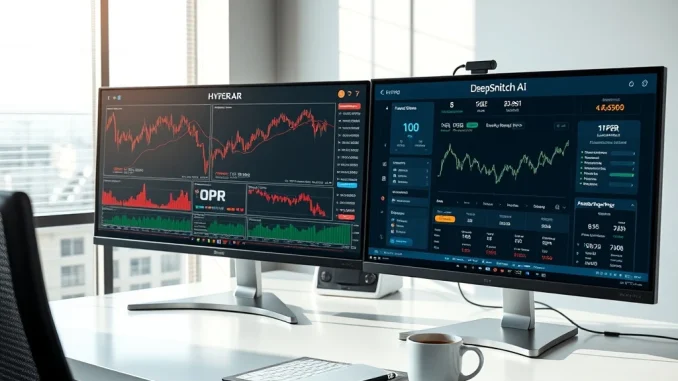
Global, May 2025: The cryptocurrency market continues to evolve with new projects and technologies emerging regularly. Recent attention has focused on Bitcoin Hyper price predictions and the substantial $1.66 million funding secured by DeepSnitch AI, a platform developing real AI trading agents. These developments occur within a broader context of increasing institutional interest in blockchain technologies and artificial intelligence applications within financial markets.
Understanding Bitcoin Hyper and Current Market Position
Bitcoin Hyper (HYPER) represents a cryptocurrency project operating within the broader digital asset ecosystem. As of May 2025, market data indicates HYPER trading at approximately $0.013675. The project exists alongside thousands of other cryptocurrencies, each with distinct technological approaches and market positioning strategies. Historical analysis shows that cryptocurrency valuations typically respond to multiple factors including technological development milestones, market adoption rates, regulatory developments, and broader economic conditions affecting investor sentiment toward risk assets.
The cryptocurrency market has demonstrated significant volatility since Bitcoin’s creation in 2009. Major price movements often correlate with technological breakthroughs, regulatory announcements, macroeconomic shifts, and changes in institutional adoption patterns. Projects like Bitcoin Hyper operate within this complex environment where fundamental technological utility must be evaluated alongside market dynamics and investor behavior patterns.
DeepSnitch AI Funding and Technological Approach
DeepSnitch AI recently completed a funding round securing $1.66 million at a valuation of $0.04064 per token. The platform distinguishes itself through its development of artificial intelligence trading agents designed to operate within cryptocurrency markets. According to publicly available information, the company focuses on creating automated trading systems that utilize machine learning algorithms to analyze market data and execute trades.
The intersection of artificial intelligence and cryptocurrency trading represents a growing sector within financial technology. AI trading systems typically employ various methodologies including:
- Pattern recognition algorithms identifying historical price movements
- Natural language processing analyzing news and social media sentiment
- Predictive modeling based on multiple data streams
- Risk management protocols designed to limit exposure during volatile periods
Funding rounds in the cryptocurrency and blockchain sector follow established patterns seen in traditional technology venture capital, though often with different regulatory considerations. The $1.66 million raised by DeepSnitch AI places it within the range of early-stage funding rounds common for technology startups developing specialized financial applications.
Historical Context of AI in Financial Markets
The application of artificial intelligence in financial markets predates cryptocurrency by several decades. Traditional financial institutions began experimenting with algorithmic trading systems in the 1980s, with sophistication increasing dramatically following advances in computing power and data availability. High-frequency trading firms have utilized complex algorithms for years, though these typically operate on different principles than the AI systems being developed for cryptocurrency markets today.
What distinguishes current AI trading developments is their accessibility to retail investors and their application to markets that operate continuously without traditional closing hours. The 24/7 nature of cryptocurrency trading presents both challenges and opportunities for automated systems, requiring different approaches to risk management and system maintenance than those used in traditional equity markets.
Market Analysis and Projection Methodologies
Price predictions in cryptocurrency markets utilize various analytical approaches. Technical analysis examines historical price patterns and trading volumes, while fundamental analysis evaluates technological developments, team expertise, market adoption, and competitive positioning. Some analysts incorporate on-chain metrics including transaction volumes, wallet activity, and network participation rates.
The projection of HYPER reaching $0.1557 by 2026 represents approximately a tenfold increase from current levels. Such projections should be understood within the context of cryptocurrency market history, where significant price movements in both directions have occurred regularly. Between 2020 and 2024, the total cryptocurrency market capitalization experienced multiple cycles of expansion and contraction, with individual projects demonstrating even greater volatility than the market overall.
| Year | Total Market Cap Change | Notable Regulatory Developments | Institutional Adoption Milestones |
|---|---|---|---|
| 2020 | +305% | EU AML regulations expanded | PayPal enables crypto purchases |
| 2021 | +187% | China mining ban implemented | First Bitcoin ETF approvals |
| 2022 | -64% | US executive order on digital assets | Major defaults affect lending sector |
| 2023 | +108% | MiCA regulations finalized in EU | BlackRock files for spot Bitcoin ETF |
| 2024 | +92% | SEC approves multiple spot ETFs | Traditional banks expand custody services |
Market projections for specific cryptocurrencies must account for this historical volatility while considering both project-specific developments and broader market conditions. The relationship between Bitcoin’s price movements and altcoin markets has been well documented, with many smaller cryptocurrencies demonstrating correlation during certain market phases and decoupling during others.
Comparative Analysis of Emerging Projects
Beyond Bitcoin Hyper and DeepSnitch AI, the cryptocurrency ecosystem includes numerous projects with varying technological approaches and market strategies. OPZ represents another emerging project within this landscape. Comparative analysis of different cryptocurrency projects typically examines several dimensions including technological innovation, development team experience, community engagement, partnership announcements, and roadmap execution.
The funding environment for cryptocurrency and blockchain projects has evolved significantly since the initial coin offering boom of 2017-2018. Current funding mechanisms often involve more structured approaches with greater emphasis on regulatory compliance, investor accreditation requirements, and clearer delineation between utility tokens and security tokens. The $1.66 million raised by DeepSnitch AI reflects this more mature funding environment where projects must demonstrate tangible technological development and viable business models to secure investment.
Risk Considerations in Cryptocurrency Investing
Investing in emerging cryptocurrency projects involves multiple risk factors that market participants should carefully consider. Technological risk relates to whether development teams can deliver promised functionality within projected timelines. Market risk encompasses price volatility and liquidity considerations, particularly for smaller capitalization tokens. Regulatory risk remains significant as governments worldwide continue developing frameworks for digital asset oversight.
Additional considerations include security risks associated with digital wallet management and exchange platforms, competitive risks from alternative projects solving similar problems, and execution risks related to team capabilities and resource allocation. The due diligence process for cryptocurrency investments has become increasingly sophisticated, mirroring approaches used in traditional venture capital while accounting for the unique characteristics of blockchain-based assets.
Technological Developments Shaping the Sector
The cryptocurrency and blockchain sector continues to experience rapid technological evolution. Layer 2 scaling solutions have gained prominence for improving transaction throughput and reducing costs. Zero-knowledge proof technologies enable enhanced privacy while maintaining auditability. Cross-chain interoperability protocols facilitate asset transfers between different blockchain networks.
Artificial intelligence integration represents one of several technological frontiers within the sector. Beyond trading applications, AI technologies are being explored for smart contract optimization, security auditing, decentralized governance mechanisms, and predictive analytics for network performance. The convergence of AI and blockchain technologies creates both opportunities and challenges, particularly regarding computational resource requirements and system transparency.
Infrastructure development continues across multiple dimensions including custody solutions, regulatory technology applications, user experience improvements, and institutional-grade trading tools. These developments collectively shape the environment in which projects like Bitcoin Hyper and DeepSnitch AI operate, influencing both technological possibilities and market adoption pathways.
Conclusion
The Bitcoin Hyper price prediction suggesting potential movement to $0.1557 by 2026 and DeepSnitch AI’s $1.66 million funding round represent specific developments within the broader cryptocurrency and blockchain ecosystem. These events occur against a backdrop of continued technological innovation, evolving regulatory frameworks, and changing market dynamics. Market participants should approach price predictions with appropriate context regarding historical volatility and multiple influencing factors. The development of AI trading agents reflects ongoing convergence between artificial intelligence and financial technologies, though the long-term implications remain subject to technological execution and market adoption. As the sector continues maturing, fundamental analysis incorporating technological viability, team execution capability, and market positioning will remain essential for evaluating emerging projects and their potential trajectories.
FAQs
Q1: What factors typically influence cryptocurrency price predictions?
Cryptocurrency price predictions incorporate multiple factors including technological development milestones, market adoption rates, regulatory developments, macroeconomic conditions, investor sentiment, trading volumes, and broader market cycles. Different analytical approaches weight these factors differently based on methodology and time horizon.
Q2: How does AI trading differ from traditional algorithmic trading?
AI trading systems typically employ machine learning algorithms that can adapt to changing market conditions, while traditional algorithmic trading often follows predefined rules. AI systems may incorporate natural language processing for sentiment analysis and pattern recognition across diverse data sets, whereas algorithmic trading frequently focuses on specific technical indicators or arbitrage opportunities.
Q3: What due diligence should investors conduct regarding emerging cryptocurrency projects?
Investors should examine multiple dimensions including the development team’s experience and track record, technological whitepapers and roadmap execution, tokenomics and distribution mechanisms, regulatory compliance approach, security protocols, community engagement metrics, partnership announcements, and competitive positioning within the broader ecosystem.
Q4: How has cryptocurrency funding evolved in recent years?
Cryptocurrency funding has shifted from largely unregulated initial coin offerings toward more structured approaches resembling traditional venture capital. Increased emphasis now exists on regulatory compliance, investor accreditation, clearer token classification, demonstrated technological progress, and sustainable business models beyond speculative trading.
Q5: What role does Bitcoin’s price movement play in altcoin markets?
Historical data shows correlation between Bitcoin’s price movements and many altcoin markets, particularly during strong directional trends. However, decoupling can occur during specific market phases or for projects with significant independent developments. The relationship varies across different cryptocurrencies and time periods, influenced by market maturity and project-specific factors.
This article was produced with AI assistance and reviewed by our editorial team for accuracy and quality.