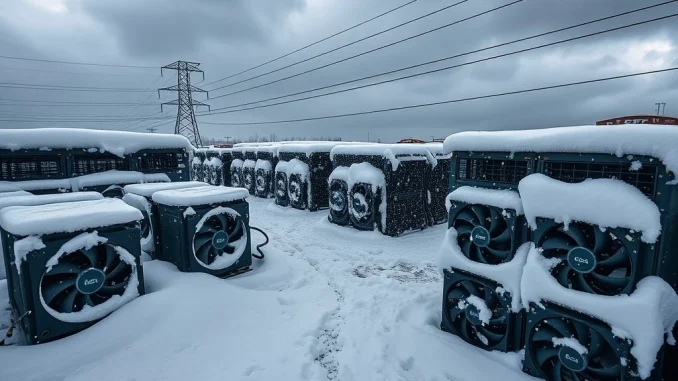
United States, February 2025: A severe winter storm sweeping across major regions of the United States has triggered a significant decline in Bitcoin’s global hashrate, exposing the cryptocurrency network’s vulnerability to extreme weather events. The unprecedented weather system, bringing freezing temperatures, heavy snowfall, and ice accumulation, has forced Bitcoin mining operations in affected states to dramatically reduce electricity consumption, directly impacting network security and transaction processing times.
Bitcoin Hashrate Experiences Sharp Decline Amid Power Grid Strain
The Bitcoin network’s total computational power, known as hashrate, has dropped approximately 15-20% from its recent peak as major mining operations in Texas, Wyoming, and other affected states voluntarily curtailed their energy usage. This reduction comes in response to emergency requests from regional grid operators struggling to maintain stable electricity supply during the extreme weather conditions. The Electric Reliability Council of Texas (ERCOT) issued multiple conservation alerts, specifically requesting industrial consumers, including cryptocurrency mining facilities, to reduce their power consumption to prevent widespread blackouts.
Industry monitoring platforms show the network’s seven-day average hashrate falling from approximately 650 exahashes per second (EH/s) to around 550 EH/s, representing one of the most significant weather-related declines in Bitcoin’s history. This reduction in computational power has immediate consequences for the network’s operation, including longer average block times and reduced transaction processing capacity during peak periods.
Understanding the Critical Link Between Weather and Mining Operations
Bitcoin mining operations consume substantial electricity to power specialized computers that solve complex mathematical problems, securing the network and processing transactions. The relationship between weather and mining efficiency operates through several interconnected mechanisms:
- Direct Power Consumption: Large-scale mining facilities typically operate 24/7, consuming megawatts of electricity comparable to small cities
- Grid Reliability Requirements: During extreme weather, grid operators prioritize residential heating and critical infrastructure over industrial users
- Cooling System Efficiency: Mining hardware generates significant heat, and cold weather normally improves cooling efficiency, but power limitations override this benefit
- Economic Incentives: Some mining operations participate in demand response programs that pay them to reduce consumption during grid stress
The current situation represents a complex intersection of energy policy, weather infrastructure, and cryptocurrency economics. Mining companies must balance their operational commitments with their responsibilities as large electricity consumers within vulnerable grid systems.
Historical Context: Previous Weather Impacts on Cryptocurrency Mining
This is not the first instance where weather has significantly impacted Bitcoin mining operations. The winter storm of February 2021, which caused widespread blackouts in Texas, resulted in an estimated 10-15% global hashrate reduction. Similarly, heat waves in summer 2022 forced Chinese mining operations (before the nationwide ban) to reduce output when hydroelectric power diminished during drought conditions.
What distinguishes the current event is its scale and the concentrated nature of modern Bitcoin mining in specific geographic regions. Following China’s 2021 mining ban, the United States emerged as the global leader in Bitcoin mining, with Texas alone estimated to host 25-30% of the network’s total hashrate. This geographic concentration creates systemic vulnerability when regional weather events affect these key mining hubs.
Technical Implications for the Bitcoin Network
The reduction in hashrate has several measurable effects on Bitcoin’s technical operation and security parameters:
| Network Metric | Normal Operation | Current Storm Impact | Change |
|---|---|---|---|
| Average Block Time | 10 minutes | 12-14 minutes | +20-40% |
| Network Difficulty | Adjusts every 2016 blocks | Next adjustment delayed | Processing slowdown |
| Transaction Fees | Market determined | Potential increase | Supply/demand shift |
| Network Security | High (650+ EH/s) | Reduced temporarily | Theoretical risk increase |
The Bitcoin network’s difficulty adjustment mechanism, which normally recalibrates every two weeks based on the previous period’s hashrate, will eventually compensate for the current reduction. However, this adjustment occurs with a lag, meaning the network experiences temporarily longer confirmation times until either miners return to full operation or the difficulty adjusts downward.
Industry Response and Operational Adaptations
Major mining companies have implemented various strategies to manage the power reduction requirements while minimizing operational disruption:
- Selective Shutdowns: Companies are powering down older, less efficient mining rigs while maintaining operation of newer equipment
- Load Balancing: Some operations are cycling equipment on and off to maintain partial operation while reducing peak demand
- Geographic Diversification: Companies with operations in multiple regions are shifting computational load to unaffected areas where possible
- Energy Source Switching: Facilities with on-site generation capabilities (solar, wind, or natural gas) are attempting to supplement grid power
Industry representatives emphasize that these voluntary reductions demonstrate the mining sector’s integration with and responsibility toward local energy infrastructure. However, analysts note that prolonged reductions could impact mining profitability, particularly for operations with high fixed costs and debt obligations.
The Broader Energy Infrastructure Challenge
The current situation highlights ongoing debates about Bitcoin mining’s role in energy systems. Proponents argue that mining operations can provide grid stability through flexible demand response, as demonstrated during this event. Critics contend that the concentration of energy-intensive operations in regions with historically vulnerable grids creates unnecessary risk.
Energy experts note that Bitcoin mining’s unique characteristics—interruptible load, predictable consumption patterns, and geographic flexibility—could potentially make it a valuable grid management tool if properly integrated. However, this requires careful planning, regulatory frameworks, and infrastructure investments that account for increasing climate volatility.
Market and Investor Implications
While the immediate impact on Bitcoin’s price has been relatively muted, the event has drawn attention to several important considerations for investors and market participants:
- Network Resilience: The event tests Bitcoin’s ability to maintain operation during significant geographic disruptions
- Mining Stock Volatility: Publicly traded mining companies with concentrated operations in affected regions may experience increased stock price volatility
- Insurance Considerations: Weather-related disruptions may affect insurance premiums and coverage for mining operations
- Regulatory Attention: The event may prompt increased regulatory scrutiny of mining operations’ energy contracts and grid impacts
Market analysts generally view short-term hashrate fluctuations as normal network behavior, but prolonged or repeated disruptions could influence longer-term investment decisions regarding mining infrastructure location and design.
Conclusion
The significant decline in Bitcoin hashrate during the severe US winter storm demonstrates the complex interdependence between cryptocurrency infrastructure, energy systems, and climate patterns. While the Bitcoin network has maintained operation throughout the event, the temporary reduction in computational power highlights both vulnerabilities and adaptive capabilities within the mining industry. As climate volatility increases and Bitcoin mining continues to concentrate in specific geographic regions, the industry faces ongoing challenges in balancing operational efficiency with grid reliability and resilience. The current situation serves as a real-world stress test that will likely inform future infrastructure planning, regulatory approaches, and industry best practices for weather-related risk management.
FAQs
Q1: What exactly is Bitcoin hashrate and why does it matter?
Bitcoin hashrate represents the total computational power dedicated to securing the network and processing transactions. A higher hashrate generally indicates greater network security against attacks, while significant declines can temporarily slow transaction processing and reduce security margins.
Q2: How long will the Bitcoin hashrate remain depressed?
The duration depends on weather conditions and power grid recovery. Most analysts expect hashrate to return to normal levels within 1-2 weeks after weather conditions improve and mining operations receive authorization to resume full power consumption.
Q3: Does this affect Bitcoin transaction speeds and fees?
Yes, temporarily. With fewer miners processing transactions, block times have increased from the target 10 minutes to 12-14 minutes. This can lead to occasional congestion and potentially higher fees during peak periods until the network adjusts.
Q4: Are other cryptocurrencies affected by the winter storm?
While Bitcoin is most significantly affected due to its energy-intensive proof-of-work consensus mechanism, some other cryptocurrencies using similar mining processes may experience minor impacts. Proof-of-stake networks are generally unaffected by geographic power disruptions.
Q5: What prevents miners from simply ignoring power reduction requests?
Most mining operations have contractual agreements with grid operators that include provisions for emergency reductions. Additionally, ignoring such requests could result in mandatory disconnection, regulatory penalties, or damage to community relations in regions where mining operations are located.
Q6: Has this happened before with Bitcoin mining?
Yes, though not at this scale since mining concentrated in the United States. Previous significant weather-related hashrate declines occurred during Texas winter storms in 2021 and during Chinese mining disruptions related to hydroelectric power shortages.