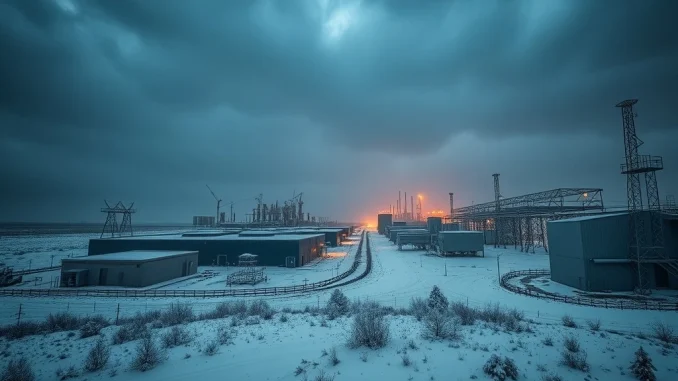
United States, February 2025: The Bitcoin network is experiencing one of its most significant operational disruptions in years. A severe and sustained drop in global hashrate—the total computational power securing the blockchain—has sent shockwaves through the cryptocurrency mining industry. This alarming decline, quantified at approximately 12% since mid-November, is directly linked to extreme winter weather conditions across key mining hubs in the United States, forcing large-scale operations offline and raising fundamental questions about network resilience and miner economics.
Bitcoin Hashrate Records Historic Decline
Data from leading blockchain analytics firms reveals a stark contraction in Bitcoin’s hashrate, falling from a peak above 630 exahashes per second (EH/s) to around 560 EH/s. This represents the most pronounced drop since China’s sweeping ban on cryptocurrency mining in 2021, which triggered a mass migration of operations to North America. The current decline is not merely a statistical blip but a multi-week trend with tangible consequences. Concurrently, daily mining revenues have slumped to near 12-month lows, hovering around $28 million, squeezing operators who face high fixed costs for energy and infrastructure. The “Miner Profit and Loss Sustainability” indicator, a key metric from CryptoQuant, has deteriorated to levels last seen in late 2024, signaling severe financial pressure across the sector.
The Weather Factor: A Direct Impact on Network Power
The primary catalyst for this hashrate collapse is an unrelenting series of winter storms and Arctic cold fronts that have gripped the central and southern United States. States like Texas, which became a global mining epicenter post-China, have been particularly hard-hit. Mining operations, which consume vast amounts of electricity, faced dual pressures: first, the physical risk of equipment failure in sub-zero temperatures, and second, urgent requests from regional grid operators to curtail power usage to prevent widespread blackouts. Many large-scale miners voluntarily shut down or drastically reduced activity to stabilize local power networks, prioritizing grid integrity over block production. This event underscores a critical vulnerability—the geographic concentration of mining power. While Bitcoin is a decentralized network, its physical infrastructure has become clustered in regions susceptible to similar climatic or regulatory shocks.
Technical Consequences and Network Mechanics
The immediate technical effect of a lower hashrate is an increase in the average time between blocks. With less computational power competing to solve the cryptographic puzzles, the 10-minute target block time can stretch longer. This temporarily slows transaction settlement times. However, Bitcoin’s core protocol contains a self-correcting mechanism designed for this exact scenario. Approximately every two weeks (or 2,016 blocks), the network automatically adjusts its “mining difficulty.” This adjustment recalibrates the complexity of the cryptographic puzzle to align with the current available hashrate, aiming to restore the 10-minute block interval. The next difficulty adjustment, expected soon, is forecast to be significantly negative, potentially dropping by 10% or more, which would lower the barrier to entry for remaining miners and help stabilize block production.
Broader Implications for Miner Profitability and Security
The financial strain on mining companies is multifaceted. While some operations have power purchase agreements that allow them to profit by selling energy back to the grid during high-demand events, prolonged shutdowns eliminate their primary revenue stream from block rewards and transaction fees. Fixed costs, however, such as loan payments on specialized ASIC hardware and facility leases, continue unabated. This squeeze could accelerate consolidation within the industry, favoring larger, better-capitalized firms with more diversified operations over smaller players. From a security perspective, a sustained hashrate decline theoretically reduces the cost to attempt a 51% attack, though Bitcoin’s sheer size still makes this prohibitively expensive. The greater risk is eroded confidence among institutional investors and network participants, for whom hashrate is a key health metric.
Historical Context and Future Resilience
This is not Bitcoin’s first confrontation with environmental forces. The Chinese mining ban caused a far more dramatic 50%+ hashrate drop, from which the network recovered and ultimately grew stronger as operations redistributed globally. The current situation tests the resilience of this new, more North American-centric landscape. It highlights the industry’s ongoing challenge in balancing operational efficiency with geographic and regulatory diversification. Looking ahead, miners may increasingly consider more resilient infrastructure designs, such as advanced cooling systems for extreme temperatures, or further geographic diversification to mitigate regional climate risks. The event also fuels discussions around energy mix, with proponents of flare-gas mining or renewable-powered operations arguing for their inherent stability against grid-directed curtailments.
Conclusion
The significant drop in the Bitcoin hashrate triggered by extreme US weather is a stark reminder that decentralized digital networks are ultimately anchored in physical reality. While the protocol’s difficulty adjustment will mechanically aid recovery, the event exposes economic and operational pressures on miners and underscores the risks of infrastructure concentration. As the climate’s influence on energy grids becomes more pronounced, the mining industry’s long-term sustainability may depend on its ability to adapt not just to market cycles, but to environmental ones as well. The network’s resilience is now being tested not by regulators, but by winter storms, proving that even the most digital of assets must weather physical-world storms.
FAQs
Q1: What is Bitcoin hashrate and why does it matter?
Hashrate is the total combined computational power used by miners to process transactions and secure the Bitcoin network. A higher hashrate indicates greater security and network health, making it more resistant to attack.
Q2: How does extreme weather affect Bitcoin miners?
Mining requires massive, constant electricity. During extreme cold or heat, grid operators often request large consumers like miners to shut down to prevent blackouts. Additionally, very low temperatures can risk damaging sensitive mining hardware.
Q3: What is a Bitcoin difficulty adjustment?
It is an automatic protocol change that occurs every 2,016 blocks (roughly two weeks) to make mining easier or harder. If hashrate drops (fewer miners), the difficulty decreases to maintain a steady 10-minute block time, and vice-versa.
Q4: Does a lower hashrate make Bitcoin less secure?
In the short term, a significant drop can marginally increase theoretical vulnerability, but Bitcoin’s overall scale still makes a coordinated attack astronomically costly. The network’s history shows it can recover from major hashrate shocks.
Q5: Will miner profitability recover after this?
Profitability depends on Bitcoin’s price, energy costs, and network difficulty. The upcoming negative difficulty adjustment will help remaining miners. Long-term recovery hinges on stable operations, efficient hardware, and favorable market conditions.
This article was produced with AI assistance and reviewed by our editorial team for accuracy and quality.