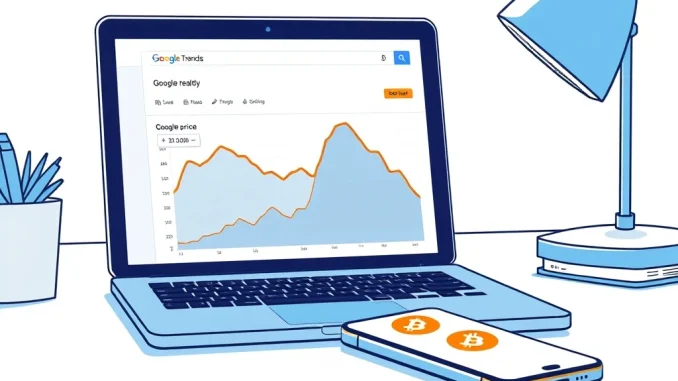
Global, May 2025: Data from Google Trends reveals a significant spike in searches for “Bitcoin” as the cryptocurrency’s price experienced a sharp correction, falling from approximately $81,500 to near $60,000. This correlation between heightened search interest and market volatility is not a coincidence but a well-documented behavioral pattern that offers a window into global retail investor sentiment and attention.
Bitcoin Google searches as a real-time sentiment indicator
When Bitcoin’s price moves dramatically, public curiosity follows. The recent surge in search volume, hitting a reported yearly high, underscores this phenomenon. Search engines like Google act as the primary tool for millions of individuals seeking immediate information. A rapid price decline triggers questions: “Why is Bitcoin crashing?” “Should I buy the dip?” “What is happening to Bitcoin?” Conversely, during parabolic rallies, searches often revolve around “How to buy Bitcoin” or “Bitcoin price prediction.” This search data provides a quantifiable, real-time metric of public attention that often lags behind professional trading desks and algorithmic systems. Analysts frequently treat these search spikes as a contrarian indicator of sorts, where peak public interest can sometimes align with local price extremes, signaling either panic or euphoria.
Historical context of search trends and price action
The relationship between Bitcoin search interest and its market cycles is pronounced. A review of historical Google Trends data against Bitcoin’s price chart reveals consistent patterns.
- 2017 Bull Run Peak: Global search interest for “Bitcoin” reached its all-time high in December 2017, coinciding with the asset’s price peak near $20,000. The subsequent decline in price was mirrored by a steady decrease in search volume.
- 2021 Cycle: Similar spikes occurred in April and November of 2021, aligning with key price highs. Each major volatility event, whether upward or downward, produced a corresponding spike in search queries.
- The “Fear and Greed” Dynamic: This pattern illustrates the cyclical nature of market psychology. Periods of low volatility and accumulation often see subdued search interest. It is the breakout events—both positive and negative—that capture the public’s imagination and concern, driving them to seek information.
This historical precedent establishes search volume as a reliable, though not predictive, companion metric to price volatility.
Analyzing the retail investor psychology behind the searches
The individuals driving these search spikes are typically retail investors or the general public, not institutional traders. Their behavior follows a recognizable emotional arc. A sharp price drop induces fear, uncertainty, and doubt (FUD), prompting searches for explanations and reassurance. For newer participants, such volatility may be their first major market test, leading to frantic information gathering. This behavior contrasts with more seasoned investors or institutions, who may rely on dedicated news feeds, analyst reports, and direct market data. Therefore, Google search trends serve as a proxy for the emotional state and engagement level of the broader, less specialized market participant base. This data is invaluable for sociologists and behavioral economists studying market dynamics as much as for traders.
The implications of rising search volume for market structure
Increased retail attention, as measured by search volume, has tangible effects on market dynamics. First, it can lead to higher trading volumes on retail-friendly platforms, sometimes exacerbating price moves through collective action—whether panic selling or FOMO-driven buying. Second, it signals to exchanges, media outlets, and content creators where to direct their resources, creating a feedback loop of coverage. Furthermore, regulatory bodies often monitor public interest levels as one gauge of mainstream adoption and potential consumer risk. A market moving on high retail search interest can be more sentiment-driven and technically reactive than one dominated by long-term, fundamental holders.
Distinguishing between informed research and reactive panic
Not all searches are equal. A critical analysis must distinguish between searches for educational content, news, and simple price checks. A sustained increase in searches for terms like “Bitcoin halving,” “blockchain technology,” or “crypto wallets” may indicate deeper, more substantive interest. In contrast, a sharp, isolated spike for “Bitcoin price” likely represents reactive behavior. The recent data suggests a mix, with the dramatic price move driving the initial spike, but potentially opening the door for more users to engage with the underlying technology and ecosystem. This nuance is important for understanding whether volatility is serving as a barrier or an onboarding ramp for new users.
Conclusion
The Bitcoin Google searches surge during the recent market downturn is a textbook example of how digital-age behavior intersects with financial markets. It highlights that price is not just a number on a screen but a trigger for global information-seeking behavior. While search volume alone does not forecast future price direction, it provides an unambiguous signal of shifting retail attention and emotional sentiment during periods of bitcoin market volatility. For observers, this trend reinforces the importance of behavioral data in understanding the complex, human-driven ecosystem of cryptocurrency markets. As Bitcoin continues to mature, monitoring these search trends will remain a key tool for gauging its penetration into the public consciousness.
FAQs
Q1: Why do Google searches for Bitcoin increase when the price drops?
Search volume spikes during price drops primarily due to retail investor reaction. Individuals seek news, explanations for the decline, and guidance on whether to sell or buy the dip, turning to Google as their first source of information.
Q2: Can Google search trends predict Bitcoin’s price?
No, search trends are not a reliable predictive indicator. They are a coincident or lagging indicator of public interest. Often, peak search interest aligns with price extremes (tops or bottoms), but it confirms sentiment rather than forecasts future movement.
Q3: What is the difference between retail and institutional behavior during volatility?
Retail investors, as reflected in search trends, often react emotionally and publicly to volatility. Institutional players typically act on pre-defined strategies, advanced data feeds, and private communications, leaving less of a visible trace in public search data.
Q4: Has this pattern been seen with other cryptocurrencies?
Yes, major cryptocurrencies like Ethereum often show similar correlations between search interest and price volatility, though the scale is generally smaller than Bitcoin’s due to its lower overall public recognition.
Q5: What other data points should be considered alongside search trends?
For a fuller picture, analysts combine search trend data with on-chain metrics (like exchange inflows/outflows), derivatives market data (funding rates, open interest), and social media sentiment analysis.
Updated insights and analysis added for better clarity.
This article was produced with AI assistance and reviewed by our editorial team for accuracy and quality.