NEW YORK, March 7, 2026 — A dramatic shift in exchange-traded fund (ETF) flows is flashing early signals of capital rotation from traditional to digital assets. Over the past 30 days, U.S. Bitcoin ETF flows have turned decisively net positive, while the largest gold-backed ETF recorded its largest single-day outflow in over two years. This divergence, occurring as gold prices retreat from a historic rally and Bitcoin sentiment stabilizes, suggests investors may be beginning to reallocate portfolios. The movement highlights a pivotal moment in the long-observed performance cycles between the two alternative stores of value.
ETF Flow Divergence Points to Shifting Sentiment
Data from Bloomberg and fund issuers reveals a stark contrast in investor behavior. According to the Kobeissi Letter, the SPDR Gold Shares ETF (GLD) experienced a massive $3 billion withdrawal on Wednesday, March 4. This marks the largest daily outflow since January 2024 and interrupts a nine-month inflow streak that saw nearly $24 billion flood into gold ETFs at the start of 2025. Concurrently, the aggregate net flow for U.S. spot Bitcoin ETFs shifted from a $1.9 billion outflow in early February to a $273 million inflow by March 6. Analysts tracking native unit holdings—the actual ounces of gold or Bitcoin held—see an even clearer picture. Gold ETF balances dropped from 1.4 million to 621,100 ounces in that period, while Bitcoin ETF balances swung from a net decrease of 42,275 BTC to a net increase of 4,021 BTC.
This rotation appears driven by profit-taking in gold after its spectacular 65% gain in 2025 and a reassessment of risk appetite. “We’re witnessing a textbook case of asset rotation,” said market strategist Anya Petrova of Clearwater Analytics, speaking from her firm’s London office. “Gold had an incredible run, fueled by geopolitical uncertainty and defensive positioning. Now, with the U.S. economy showing unexpected acceleration in Q1 2026, some of that ‘risk-off’ capital is seeking growth again. Bitcoin, with its established ETF infrastructure, is a natural beneficiary.”
Quantifying the Impact on Investor Portfolios
The scale of the movement has tangible implications for asset allocators and the broader market structure. The $3 billion GLD exit alone represents a meaningful reduction in gold exposure for institutional and retail portfolios. Meanwhile, the positive turn in Bitcoin ETF flows, though smaller in dollar terms, reverses a five-week trend of outflows and could signal renewed institutional confidence. The rotation impacts several key areas.
- Portfolio Rebalancing: Multi-asset funds that track benchmark weights are forced to sell gold and potentially buy other assets, including Bitcoin, to maintain allocations after gold’s price surge.
- Liquidity Dynamics: Large gold ETF redemptions require the fund’s authorized participants to sell physical gold in the London market, creating temporary downward price pressure.
- Volatility Transmission: Shifts of this magnitude can increase short-term volatility in both markets as large blocks of assets change hands.
Expert Analysis on the Rotation Cycle
Institutional researchers have anticipated this potential shift. Chris Kuiper, an analyst at Fidelity Digital Assets, noted in the firm’s “2026 Look Ahead” report that gold’s 2025 performance placed it potentially in the late stages of its leadership cycle relative to Bitcoin. “Historically, gold and bitcoin have taken turns outperforming,” Kuiper wrote. “With gold shining in 2025, it would not be surprising if bitcoin takes the lead next.” However, he cautioned that such rotations are rarely instantaneous. Macroeconomic strategist Lyn Alden, in a recent client note, projected Bitcoin would likely outperform gold over a two-to-three year horizon following the metal’s recent parabolic move. Joe Consorti, Head of Growth at Horizon, summarized the on-chain and flow data succinctly: “Gold is stalling out while bitcoin is soaring. The anticipated risk-off to risk-on rotation could be underway.”
Historical Context and the Bitcoin-to-Gold Ratio
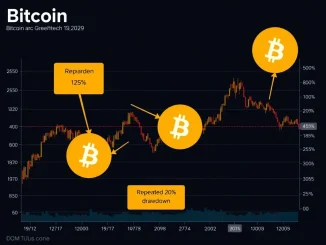
This is not the first time these assets have seesawed for investor favor. A review of the Bitcoin-to-gold ratio—which measures how many ounces of gold one Bitcoin can buy—reveals distinct cyclical patterns. After Bitcoin’s market bottom in late 2022, the ratio consolidated for roughly 21 weeks before beginning a sustained uptrend that lasted through much of 2023 and 2024. Currently, the ratio is trading in a similar consolidation zone, suggesting the market may be building a base for Bitcoin’s next period of outperformance. The chart pattern indicates that while flows are turning now, a decisive, sustained trend may still require several weeks or months to materialize fully.
| Metric | Gold ETFs (GLD Focus) | Bitcoin ETFs (Aggregate) |
|---|---|---|
| 30-Day Net Flow (USD) | ~$2.8B Outflow (Est.) | $273M Inflow |
| 30-Day Net Flow (Native Units) | -778,900 oz | +46,296 BTC |
| Primary Driver | Profit-taking after 2025 rally | Improving risk sentiment, economic acceleration |
| Price Action Context | 4.4% price drop preceding outflow | Stabilization above $70,000 support |
What Happens Next: Monitoring Key Triggers
The durability of this early rotation signal depends on several forthcoming factors. Market participants will closely watch the U.S. Federal Reserve’s policy meeting later this month for clues on interest rates, which influence the opportunity cost of holding non-yielding assets like gold and Bitcoin. Additionally, the flow data for the remainder of March will be critical; a single day’s outflow for gold does not make a trend, nor does one week of inflows for Bitcoin. Analysts will also monitor whether the outflows from gold ETFs translate into direct purchases of Bitcoin ETFs or flow into other risk assets like equities. The geopolitical landscape remains a wildcard; an escalation in the ongoing US-Israel-Iran tensions could swiftly reverse the rotation, sending investors back to traditional safe havens.
Institutional and Retail Reactions Diverge
Early reports suggest a split in behavior between large institutions and retail investors. Data from Santiment indicates retail traders have been actively accumulating Bitcoin on price dips below $70,000, even as the ETF flow picture was mixed. Conversely, the gold ETF outflows are widely attributed to institutional profit-taking and algorithmic rebalancing. This creates a nuanced picture: institutions are trimming gold winners, while a segment of the market is using Bitcoin’s consolidation as an accumulation phase. The coming weeks will reveal if institutional capital follows the early flow signal into Bitcoin ETFs or seeks returns elsewhere.
Conclusion
The simultaneous surge in Bitcoin ETF inflows and record gold ETF outflows presents compelling, though preliminary, evidence of capital rotation. This shift, driven by gold profit-taking and a cautiously improving appetite for risk, aligns with historical cycles where leadership alternates between these two asset classes. While not yet a confirmed long-term trend, the magnitude of the GLD withdrawal and the reversal in Bitcoin ETF flows demand close attention from investors. The key takeaway is that the macro environment is fluid, and the search for store-of-value assets is becoming increasingly dynamic. Readers should monitor weekly ETF flow reports and the Bitcoin-to-gold ratio for confirmation that this early March signal develops into a sustained capital rotation from traditional to digital havens.
Frequently Asked Questions
Q1: What does a $3 billion outflow from a gold ETF actually mean?
It means investors redeemed $3 billion worth of shares from the SPDR Gold Trust (GLD) on a single day. To return this cash, the fund’s authorized participants must sell an equivalent value of physical gold bullion from the trust’s holdings, impacting the gold market.
Q2: Is this capital definitely moving from gold directly into Bitcoin?
Not necessarily. The data shows money leaving gold ETFs and money entering Bitcoin ETFs around the same time, suggesting rotation. However, the capital could go to other assets like stocks or bonds. The correlation and historical patterns, however, make a direct shift plausible.
Q3: How long do these rotation cycles between Bitcoin and gold typically last?
Historical performance cycles can last several quarters to a few years. For example, Bitcoin significantly outperformed gold from late 2023 through much of 2024, while gold dominated in 2025. The initial flow signals often precede a sustained price trend by weeks or months.
Q4: Should individual investors sell gold and buy Bitcoin based on this news?
This article presents observed market data, not investment advice. Every investor’s situation is different. Such decisions should be based on personal financial goals, risk tolerance, and research, potentially with guidance from a qualified financial advisor.
Q5: What could stop or reverse this apparent rotation?
A sudden spike in geopolitical risk, a sharper-than-expected economic downturn, or a regulatory crackdown on digital assets could quickly send investors back to traditional safe havens like gold, reversing the flow pattern.
Q6: How can I track these ETF flows myself?
Daily and cumulative flow data for U.S.-listed ETFs is published by issuers like BlackRock and Fidelity, aggregated by financial data platforms like Bloomberg, and often summarized by market news outlets and analysts on social media.