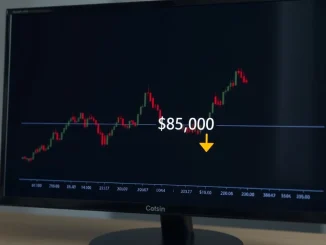
Global, May 2025: A significant wave of crypto futures liquidations swept through derivatives markets over the past 24 hours, forcibly closing over $175 million in leveraged positions. This event underscores the inherent risks of trading with borrowed funds in a volatile asset class. The data, compiled from major exchanges, reveals a pronounced squeeze on bullish Bitcoin traders, while a unique dynamic played out in gold-pegged crypto assets.
Crypto Futures Liquidations: A Detailed Breakdown of the 24-Hour Carnage
The mechanics of perpetual futures contracts, which lack an expiry date, rely heavily on funding rates to anchor their price to the spot market. When prices move violently against highly leveraged positions, exchanges automatically sell or buy the collateral to prevent losses from exceeding a trader’s initial margin. This process, known as liquidation, creates cascading sell or buy pressure. The recent 24-hour period provided a textbook example. Bitcoin (BTC) saw the most substantial single-asset impact, with an estimated $123 million in positions liquidated. Crucially, over 80% of these were long positions, meaning traders betting on a price increase were forced to sell their holdings as the market dipped. This mass selling can exacerbate downward momentum in a feedback loop often called a “long squeeze.”
Analyzing the Major Asset Liquidations and Market Implications
Beyond Bitcoin, other major cryptocurrencies experienced notable liquidation events. Ethereum (ETH), the second-largest asset by market capitalization, witnessed $42.85 million in liquidations. The ratio here was more balanced but still skewed towards longs, with 64.94% of closed positions being bullish bets. This suggests a broad, though less severe, correction across the major crypto market cap leaders. The most intriguing data point comes from XAU, a cryptocurrency token representing gold. It saw $10.83 million liquidated, but with a striking 85.21% of those being short positions. This indicates a rapid price rise caught traders who were betting on a decline, forcing them to buy back the asset to cover their positions—a phenomenon known as a “short squeeze.” The contrasting dynamics between BTC/XAU highlight how different market narratives and asset behaviors can trigger opposite liquidation cascades simultaneously.
The Role of Leverage and Funding Rates in Triggering Liquidations
Liquidation events do not occur in a vacuum. They are typically preceded by a buildup of excessive leverage and shifts in funding rates. When traders overwhelmingly take one-sided bets (e.g., long on Bitcoin) using high leverage, the market becomes structurally fragile. A minor price dip can trigger the first wave of liquidations. The subsequent forced selling pushes the price lower, triggering more stop-losses and liquidations at higher leverage tiers. Funding rates, the fees paid between long and short positions to maintain the perpetual contract’s peg, often turn highly positive during bullish frenzies. A normalization or reversal of these rates can be the first sign of leverage unwinding. Monitoring these metrics provides advanced context to raw liquidation numbers.
Historical Context and Comparison to Past Liquidation Events
To understand the scale of the recent crypto futures liquidations, historical comparison is essential. While notable, a $123 million Bitcoin liquidation event is not unprecedented. For instance, during the market downturn of June 2022, single-day liquidations regularly exceeded $500 million. The infamous crash of May 2021 saw over $2 billion in Bitcoin futures liquidated in 24 hours. The current event fits within a pattern of periodic, violent leverage resets that characterize crypto markets. However, its significance lies in its composition—the extreme skew toward long liquidations signals a swift rejection of recent bullish momentum. It serves as a stark reminder that crypto markets, despite maturation, remain prone to sharp corrections fueled by derivative instruments.
Expert Insight on Risk Management for Futures Traders
Professional traders emphasize that liquidation is not an unpredictable force of nature but a calculable risk. The key to survival lies in rigorous risk management. This involves using lower leverage multiples, setting appropriate stop-loss orders before entering a trade, and constantly monitoring the aggregate leverage and open interest across the market. Diversifying away from crowded trades, evidenced by extremely skewed long/short ratios, can also mitigate risk. Furthermore, understanding the relationship between spot market flows and futures market leverage can provide early warning signals. The recent data acts as a case study for why over-leveraging in a single direction, especially during periods of apparent bullish consensus, is a high-risk strategy.
Conclusion: Navigating Volatility in Crypto Derivatives Markets
The latest 24-hour crypto futures liquidations data provides a clear snapshot of a market correcting excessive leverage. The $123 million long squeeze in Bitcoin, coupled with significant activity in Ethereum and a short squeeze in XAU, illustrates the complex and interconnected nature of digital asset derivatives. For the broader ecosystem, these events are a necessary, if painful, mechanism that realigns contract prices with spot values and flushes out unsustainable speculation. For traders and observers, they reinforce the paramount importance of understanding leverage, funding mechanics, and crowd dynamics. As the cryptocurrency market evolves, such liquidation events will continue to be critical volatility markers, reminding all participants of the high-stakes reality of trading with borrowed money.
FAQs
Q1: What causes a crypto futures liquidation?
A liquidation occurs when a trader’s leveraged position loses enough value that their remaining collateral (margin) falls below the exchange’s maintenance requirement. The exchange then automatically closes the position to prevent further losses.
Q2: Why were most Bitcoin liquidations long positions?
This indicates the market price fell sharply. Traders who borrowed money to bet on a price increase (long) saw their positions lose value and hit their liquidation price, triggering forced selling.
Q3: What is the difference between a long squeeze and a short squeeze?
A long squeeze forces over-leveraged buyers to sell during a price drop, worsening the decline. A short squeeze forces over-leveraged sellers to buy back during a price rise, accelerating the rally.
Q4: How can traders avoid being liquidated?
Key strategies include using lower leverage, depositing additional margin (collateral), setting prudent stop-loss orders, and avoiding excessively crowded trades where liquidation cascades are more likely.
Q5: Are liquidation events bad for the overall crypto market?
They create short-term volatility and pain for affected traders. However, they are a neutral market mechanism that removes excessive leverage, which can help create a healthier, more stable price foundation in the longer term.