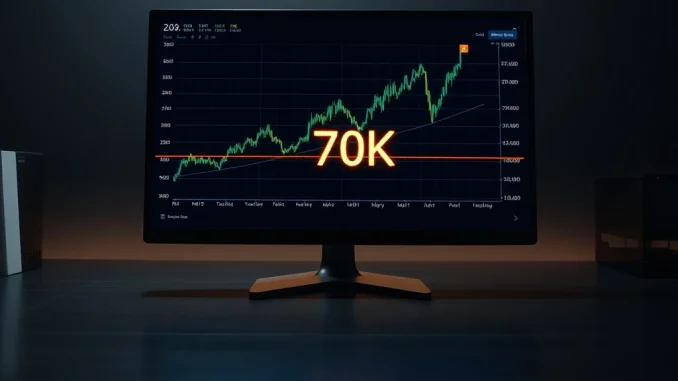
NEW YORK, May 21, 2026 — The Bitcoin price decisively broke through the $70,000 psychological barrier on Tuesday, triggering what market intelligence firm Santiment identifies as a return to ‘FOMO territory.’ This surge, representing a significant recovery from Monday’s lows, coincides with shifting geopolitical rhetoric and a notable rebound in positive social media discussions across major platforms. The move marks a critical test for the cryptocurrency’s resilience amid ongoing global tensions and provides fresh momentum for a market that has faced months of downward pressure.
Bitcoin’s Rally and the Shift to FOMO Territory
Market data from Santiment shows a clear correlation between the price recovery and a sharp uptick in optimistic social media chatter. According to their analysis, shared via an X post on Tuesday, discussions on platforms like X, Reddit, and Telegram turned markedly positive as Bitcoin reclaimed the $70,000 level. “The crowd is encouraged by developments suggesting a potential de-escalation in key geopolitical conflicts, alongside a reversal in oil prices,” the firm stated. This sentiment shift is crucial; periods of high social volume coupled with positive bias often precede sustained short-term price movements as retail interest reignites.
The rally was catalyzed by specific external events. Earlier in the week, statements from U.S. political figures regarding foreign policy created a ripple effect across traditional and digital asset markets. While markets initially reacted with caution, the subsequent framing of these statements as potentially conflict-resolving provided a catalyst for risk assets. Bitcoin, trading 24/7 globally and perceived by some as a geopolitical hedge, reacted with particular speed. Santiment noted in a separate analysis that “crypto markets tend to react quickly to uncertainty because they are not tied to any single government or financial system,” highlighting the asset class’s unique sensitivity to macro narratives.
Analyzing the Drivers Behind the Sentiment Reversal
The return to FOMO is not driven by sentiment alone. Several concrete factors are converging to support Bitcoin’s price resilience and positive trader outlook. First, the asset demonstrated notable strength by holding above its February lows despite significant external shocks, building technical confidence. Second, continued institutional interest provides a foundational bid; firms like Strategy have been reported making substantial purchases, adding billions in notional value to their holdings over consecutive weeks.
- Geopolitical Narrative Shift: Perceived progress toward conflict resolution reduces immediate ‘risk-off’ pressure, encouraging capital flow into alternative assets.
- Institutional Accumulation: Visible buying from large, named institutions validates the asset’s store-of-value thesis for other market participants.
- Technical Resilience: Successfully defending key support levels creates a more bullish chart structure, attracting technical traders.
- Macro Tailwinds: A cooling inflationary environment and anticipated monetary policy shifts on the horizon reduce headwinds for speculative growth assets.
Expert Insight: A Market Primed for a Squeeze
Ryan McMillin, Chief Investment Officer at Australian crypto investment manager Merkle Tree Capital, provided Cointelegraph with a detailed assessment. “Bitcoin has shown real strength through tough conditions,” McMillin stated, pointing to the confluence of cooling inflation and institutional momentum. He highlighted a critical market setup: “Shorts are vulnerable; liquidity on the short side could get squeezed toward $80,000 before a true higher/lower decision point. Bears ruled for months, now they could face their first test of this cycle.” This analysis suggests the current move may have further to run as positioned traders are forced to cover losing bets, potentially creating a self-reinforcing upward spiral—a classic FOMO scenario.
Contrasting Data: Fear & Greed Index vs. Social Momentum
While social media buzz turns positive, other sentiment indicators paint a more cautious picture, creating a fascinating market dichotomy. The widely watched Crypto Fear & Greed Index remained mired in “Extreme Fear” territory with a score of 15, even as prices rallied. This index aggregates multiple data sources, including volatility, market momentum, and social media, but weighs them differently than pure social volume analysis. Meanwhile, Google Trends data for “Bitcoin” search interest scored around 71, down significantly from its peak of 100 in early March.
| Sentiment Indicator | Reading | Implied Market Psychology |
|---|---|---|
| Santiment Social Volume/Bias | Rising Positive Discussions | Growing Optimism, FOMO |
| Crypto Fear & Greed Index | 15 (Extreme Fear) | Caution, Lingering Trauma |
| Google Trends Search Interest | 71 (Down from 100) | Retail Attention Not Yet at Peak |
This divergence is telling. McMillin commented on this dynamic: “FOMO frequently becomes self-fulfilling in crypto. Sentiment flips from fear to greed attracts fresh buyers, boosts volumes, and drives short-term upside, as we’ve seen in past cycles.” The lagging Fear & Greed Index may indicate that a broader sentiment shift is still in its early stages, with room for more participants to move from fear to engagement.
The Path Forward: Sustainability and Key Levels to Watch
The critical question for traders and analysts is whether this FOMO phase can translate into a sustained bullish trend. The immediate technical target sits near the $80,000 level, which McMillin identified as a potential squeeze zone for short positions. A clean break above this could open the path toward testing previous all-time highs. However, sustainability will depend on continued positive inflows, both from institutions and the returning retail cohort, and the absence of new, severe geopolitical shocks.
Market Structure and Regulatory Horizon
Beyond price, the market structure is evolving. The impending implementation of clearer regulatory frameworks, often referred to in industry discussions, provides a longer-term tailwind by reducing uncertainty for institutional adoption. Furthermore, the network itself continues its organic growth, recently producing its 20 millionth coin—a milestone that underscores its established history and operational resilience. These fundamental factors provide a bedrock that differs from purely speculative rallies of the past.
Conclusion
Bitcoin’s reclaiming of the $70,000 level and the associated shift in social sentiment to FOMO territory marks a significant psychological pivot for the cryptocurrency market. Driven by a mix of geopolitical narrative shifts, demonstrable institutional buying, and technical resilience, the move challenges the bearish dominance of recent months. While traditional sentiment gauges like the Fear & Greed Index remain cautious, the surge in positive social discussion is a leading indicator that has historically preceded retail-driven momentum. Investors should watch for a follow-through above $80,000, which could confirm a broader trend change, while monitoring whether the positive social volume translates into sustained buying pressure and network growth. The coming weeks will test whether this FOMO is a fleeting spike or the beginning of a new market phase.
Frequently Asked Questions
Q1: What does ‘FOMO territory’ mean according to Santiment?
Santiment uses ‘FOMO territory’ to describe a market state where social media discussions show a high volume of positive, optimistic, and often urgent commentary about an asset, frequently coinciding with rapid price appreciation. It suggests a psychological shift where participants fear missing out on further gains.
Q2: Why is the Crypto Fear & Greed Index still showing ‘Extreme Fear’ if social sentiment is positive?
The index incorporates multiple factors beyond social media, including market volatility, momentum, and dominance. The current reading suggests that while social chatter is improving, other metrics like volatility or recent drawdowns are still keeping the composite score in fear territory, indicating a mixed or lagging market recovery.
Q3: What is the main technical level to watch after Bitcoin crossed $70K?
Analysts like Ryan McMillin point to the $80,000 level as a critical zone. A move toward this area could trigger a ‘short squeeze,’ where traders betting on price declines are forced to buy back, potentially accelerating upward momentum.
Q4: How do geopolitical events typically affect Bitcoin’s price?
Bitcoin often experiences heightened volatility during geopolitical uncertainty. It can act as a perceived hedge against traditional market instability or specific currency risks, but its reaction is not always predictable and depends heavily on the narrative dominating trader discussions at the time.
Q5: What role are institutions playing in the current Bitcoin market?
Institutions are providing significant buying pressure, as evidenced by public filings from firms like Strategy. This activity supports price floors, adds legitimacy, and can catalyze broader market confidence, making rallies more sustainable than those driven purely by retail speculation.
Q6: Should a retail investor consider buying Bitcoin when it’s in ‘FOMO territory’?
Entering a market during a FOMO phase carries higher risk, as prices may be overheated in the short term. Experts emphasize the importance of a long-term strategy, thorough research, and never investing more than one can afford to lose, regardless of current market sentiment.