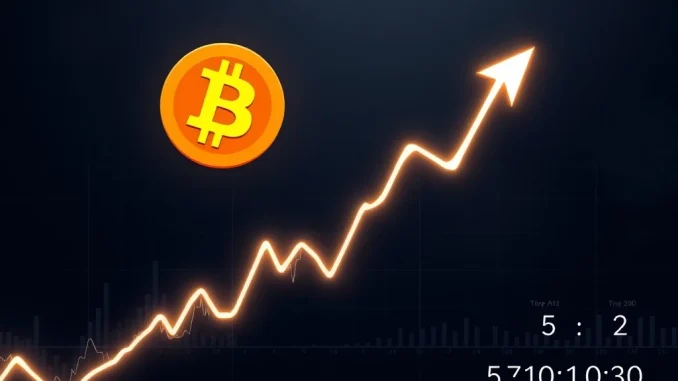
Global, May 2025: The Bitcoin price surged by a notable 1.53% within a mere five-minute window on the Binance USDT trading pair, propelling the leading cryptocurrency to a spot price of $77,922.93. This rapid upward movement, while a common feature of crypto markets, provides a compelling case study in real-time volatility, liquidity dynamics, and the mechanisms that drive short-term price discovery in digital asset markets. Such moves underscore the highly responsive and often unpredictable nature of cryptocurrency trading, where significant value can be transferred in moments based on a confluence of algorithmic activity, order book depth, and macroeconomic sentiment.
Bitcoin Price Surge: A Technical Breakdown of the Five-Minute Move
A 1.53% gain for an asset as large as Bitcoin represents a substantial movement of capital in a compressed timeframe. To contextualize, a similar percentage move in a traditional blue-chip stock might unfold over weeks or months. In the cryptocurrency market, however, this volatility is an intrinsic characteristic. The move on Binance’s USDT pair, one of the world’s most liquid Bitcoin markets, indicates a significant buy-side pressure that temporarily overwhelmed available sell orders within that specific price range. This often occurs due to a large market order, a rapid series of algorithmic trades reacting to a signal, or a sudden shift in sentiment triggered by news or a technical breakout. Analysts monitor these micro-movements to gauge underlying market strength and potential directional bias.
Understanding Cryptocurrency Market Volatility
Volatility is a measure of how drastically an asset’s price changes over a given period. Bitcoin and other cryptocurrencies exhibit higher volatility than traditional assets for several structural reasons. The market operates 24/7, allowing news and events to be priced in immediately without the cooling-off period of a market close. Furthermore, the market’s relative youth, lower overall liquidity compared to global forex or equities, and significant influence from leveraged trading (which can force rapid liquidations) all contribute to these sharp price swings. A five-minute surge of this magnitude is a textbook example of this environment in action.
- 24/7 Trading: Continuous operation means no overnight gaps; price discovery is constant.
- Leverage Effects: Widespread use of leverage can amplify both gains and losses, leading to cascading buy or sell orders.
- Market Fragmentation: Liquidity is spread across hundreds of exchanges, which can sometimes exacerbate moves on individual platforms.
- News Sensitivity: The crypto market reacts swiftly to regulatory announcements, technological updates, and macroeconomic data.
The Role of Exchange Order Books and Liquidity
The immediate catalyst for a short-term price spike is typically found in the order book. An order book lists all current buy (bid) and sell (ask) orders for an asset. A “thin” order book, where there are few large sell orders just above the current price, is susceptible to rapid price increases if a sizable market buy order is executed. It consumes all the available sell orders at progressively higher prices, pushing the last traded price up swiftly. On a deep and liquid market like Binance’s BTC/USDT pair, such a move suggests the buying pressure was exceptionally strong or concentrated, potentially involving institutional-sized orders or coordinated algorithmic strategies.
Historical Context of Rapid Bitcoin Movements
Bitcoin’s history is punctuated with episodes of extreme short-term volatility. For instance, during the bull market of late 2020 and early 2021, intraday swings of 5-10% were not uncommon. More recently, the market has shown periods of consolidation followed by explosive breakouts, often tied to developments in ETF flows, regulatory clarity, or macroeconomic shifts in interest rate expectations. A five-minute, 1.53% move, while notable, fits within the established historical volatility profile of the asset. It serves as a reminder that participants must have risk management strategies capable of weathering such sudden shifts, whether they are short-term traders or long-term holders.
Implications for Traders and the Broader Market
For active traders, a spike of this nature presents both opportunity and risk. Momentum traders might interpret it as a sign of strengthening bullish sentiment, while mean-reversion traders might see an overextended move primed for a pullback. For the broader market, sustained or repeated rapid upward movements can signal accumulating bullish momentum, potentially attracting more attention and capital. Conversely, if such a spike is quickly reversed, it can indicate a “stop hunt” or a liquidity grab, where the price is moved to trigger a cluster of leveraged buy orders before moving in the opposite direction. Discerning the driver requires analyzing volume, order flow data, and broader market conditions.
Conclusion
The recent 1.53% Bitcoin price surge on Binance over five minutes, bringing BTC to $77,922.93, is a microcosm of the dynamic and efficient—yet volatile—nature of the cryptocurrency market. It highlights the critical importance of liquidity, the impact of high-frequency and algorithmic trading, and the constant price discovery process that defines digital assets. While dramatic in isolation, this move is consistent with Bitcoin’s behavioral history and underscores why understanding market microstructure is essential for anyone engaged in this space. The Bitcoin price surge remains a key metric watched by millions globally, reflecting both technological promise and market reality.
FAQs
Q1: What does a 1.53% move in five minutes mean for Bitcoin?
It signifies a period of intense buying pressure and low immediate selling resistance on the exchange, causing a rapid re-pricing. It is a common occurrence in volatile crypto markets but highlights the speed at which large transactions can move the market.
Q2: Is a price surge like this usually sustained?
Not necessarily. Short-term spikes can be driven by technical factors like large single orders and are often partially or fully retraced as the market absorbs the move. Sustained rallies typically require continued fundamental or macroeconomic support.
Q3: Why is the Binance USDT pair specifically referenced?
Binance is one of the largest cryptocurrency exchanges by volume, and the BTC/USDT (Tether) pair is among the most liquid trading pairs in the world. Price movements on this pair are considered highly significant for the global market price.
Q4: How does leverage trading contribute to such volatility?
Leveraged positions use borrowed funds to amplify gains and losses. A rapid price move can trigger automatic liquidations of these positions, creating a cascade of forced market orders that further accelerate the price movement in the same direction.
Q5: Should long-term Bitcoin investors be concerned about these short-term moves?
For long-term investors focused on the multi-year trajectory of Bitcoin, short-term volatility is an expected characteristic of the asset class. It generally does not alter the core investment thesis, which is based on broader adoption, scarcity, and technological utility, rather than five-minute price fluctuations.
This article was produced with AI assistance and reviewed by our editorial team for accuracy and quality.