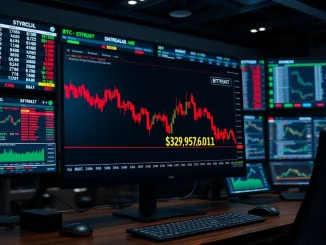
Global, May 2025: The cryptocurrency market experienced a sharp, volatile contraction over the weekend, with Bitcoin leading a decline that triggered over half a billion dollars in leveraged position liquidations. This sell-off pushed a key market sentiment indicator, the Crypto Fear & Greed Index, into a zone of “Extreme Fear,” registering a rare score of 5. Historical data suggests such extreme readings have often coincided with or preceded significant Bitcoin market bottoms, prompting analysts to scrutinize whether current price action represents a capitulation event or a pause in a larger correction.
Analyzing the Weekend Bitcoin Sell-Off and Liquidation Cascade
Bitcoin’s price action turned sharply negative during typically lower-volume weekend trading. The asset dropped approximately 5% within a two-hour window, breaking below the closely watched $65,000 support level that had held for several weeks. This breach triggered a cascade of automatic sell-offs in the derivatives market. According to data from Coinglass, total crypto liquidations surpassed $500 million in a 24-hour period, with long positions—bets on higher prices—accounting for the overwhelming majority. This liquidation event represents one of the most significant deleveraging episodes in recent months, effectively flushing out over-optimistic leverage from the system. The rapid price drop and subsequent liquidations are classic hallmarks of a capitulation phase, where weak hands exit the market en masse, often creating conditions for a potential reversal.
The Crypto Fear & Greed Index: A Historical Barometer for Market Bottoms
The Crypto Fear & Greed Index aggregates multiple data points—including volatility, market momentum, social media sentiment, surveys, and dominance—to produce a single score from 0 to 100. A score of 0 signifies “Extreme Fear,” while 100 indicates “Extreme Greed.” The index’s plunge to a reading of 5 places it firmly in the deepest fear territory. A review of historical instances reveals a compelling pattern:
- December 2018: The index hit a low of 6 during Bitcoin’s descent to a bear market bottom near $3,200.
- March 2020: During the COVID-19 market crash, the index briefly touched 8 as Bitcoin fell to around $4,000, before beginning a historic bull run.
- June 2022: The index reached 6 amid the collapse of the Terra/Luna ecosystem and Celsius Network, with Bitcoin bottoming near $17,600 later that year.
While not a perfect timing tool, sustained periods at or below a score of 10 have frequently marked areas of maximum pessimism, where long-term value investors begin accumulating. The current reading suggests a similar peak in negative sentiment may be at hand.
Technical Perspective: $60,000 as the Next Critical Support Floor
With the $65,000 support level broken, market technicians have shifted their focus to the next major price floor. The $60,000 psychological and technical zone now emerges as the critical battleground. This level represents:
- A previous major resistance point during Q1 2025 that later turned into support.
- The 0.5 Fibonacci retracement level from the 2024 low to the 2025 high, a common area for trend corrections to find footing.
- The 100-day simple moving average, a key benchmark for institutional and algorithmic traders.
A decisive break and close below $60,000 on a weekly timeframe could signal a deeper correction toward the $52,000-$55,000 range. Conversely, a strong rejection and bounce from this zone would bolster the thesis that the Fear & Greed Index signal is accurate and a local bottom is forming. On-chain data from Glassnode shows significant accumulation activity by long-term holders near this price band, indicating belief in its fundamental value.
Broader Market Implications and the Path Forward
The extreme fear reading and liquidation event have broader implications for the cryptocurrency ecosystem. Altcoins, which typically exhibit higher beta (volatility) than Bitcoin, experienced even steeper declines. This correlation underscores Bitcoin’s role as the market leader; its price stability is paramount for a sustained recovery across the sector. Furthermore, the event has likely prompted a risk reassessment by institutional participants, potentially slowing the inflow of new capital until clearer directional trends emerge. Market structure analysis suggests that while short-term pain is evident, the flushing of leverage can create a healthier foundation for the next leg up, as it reduces systemic risk and over-speculation. The coming weeks will be crucial in determining if this event was a necessary correction within a ongoing bull market or the start of a more prolonged bearish phase.
Conclusion
The plunge of the Crypto Fear & Greed Index to a rare score of 5, catalyzed by a swift Bitcoin sell-off and massive liquidations, presents a compelling historical signal for a potential Bitcoin market bottom. While no indicator is infallible, the convergence of extreme negative sentiment, a high-volume liquidation event, and a test of a major technical support level at $60,000 creates a textbook environment for a market reversal. Investors and analysts will monitor whether Bitcoin can hold the $60,000 support and if the extreme fear begins to gradually subside, which would be the first signs of sentiment recovery. This event serves as a stark reminder of the cryptocurrency market’s inherent volatility and the psychological cycles of greed and fear that drive its major turning points.
FAQs
Q1: What is the Crypto Fear & Greed Index?
The Crypto Fear & Greed Index is a sentiment analysis tool that compiles data from volatility, market momentum, social media, surveys, and trends to generate a score from 0 (Extreme Fear) to 100 (Extreme Greed), indicating the overall emotional state of the cryptocurrency market.
Q2: Why is a Fear & Greed Index reading of 5 significant?
A reading of 5 signifies “Extreme Fear.” Historically, when the index has fallen to or below 10, it has often marked periods of maximum pessimism that coincided with or preceded major Bitcoin market bottoms, as seen in 2018, 2020, and 2022.
Q3: What caused the $500 million in crypto liquidations?
The liquidations were primarily caused by Bitcoin’s rapid 5% price drop over a weekend, which triggered automatic margin calls on leveraged long positions (bets on price increases) across various cryptocurrency derivatives exchanges.
Q4: What does the $60,000 level represent for Bitcoin?
The $60,000 level is now a critical technical and psychological support zone. It represents a previous key resistance-turned-support area, a major Fibonacci retracement level, and is near the 100-day moving average, making it a focal point for traders.
Q5: Does an Extreme Fear reading guarantee a Bitcoin market bottom?
No, it does not guarantee a bottom. While it is a strong historical contrarian indicator, markets can remain in fear or decline further. It should be used in conjunction with other technical, on-chain, and fundamental analysis to assess overall market health.
This article was produced with AI assistance and reviewed by our editorial team for accuracy and quality.