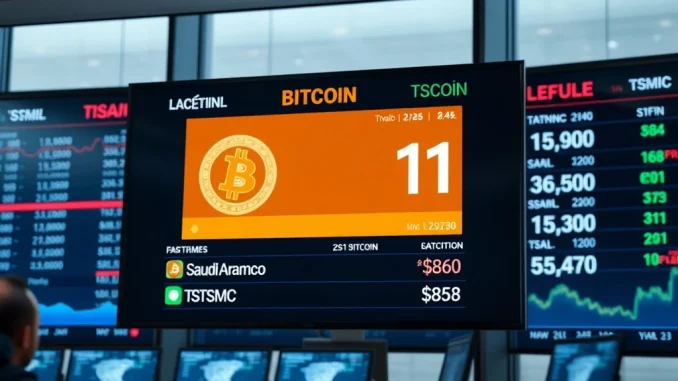
Global Markets, February 2026: Bitcoin has experienced a significant milestone, though not the one its proponents hoped for. The pioneering cryptocurrency has fallen out of the world’s top 10 most valuable assets by market capitalization, a development that marks a notable shift in its standing among global investment vehicles. This descent to 11th place, behind established giants like Saudi Aramco and Taiwan Semiconductor Manufacturing Company (TSMC), comes amid a period of intense market volatility and raises questions about the digital asset’s short-term trajectory within the broader financial landscape.
Bitcoin’s Market Cap Plunge and Ranking Shift
The data reveals a stark contrast from Bitcoin’s recent peak. In October, Bitcoin’s market capitalization approached a staggering $2.5 trillion, buoyed by a price surge near $126,000. This positioned it firmly within the elite tier of global assets. However, the current landscape tells a different story. As of late January 2026, Bitcoin’s market cap has contracted to approximately $1.65 trillion, precipitating its fall from 10th to 11th place in global rankings. This represents a decline of roughly 34% from its autumn high. The price of Bitcoin concurrently dropped from nearly $90,000 to below $82,000 within a compressed timeframe, highlighting the asset’s characteristic price sensitivity.
The Mechanics of a Sharp Correction
This rapid devaluation was not an isolated event but was catalyzed by specific market mechanics. Analysts point to a wave of forced liquidations, primarily affecting leveraged long positions, as the immediate trigger. Estimates suggest these liquidations totaled around $1.6 billion, creating a cascade of selling pressure that the market struggled to absorb. The scale of these liquidations underscores a persistent technical fragility within cryptocurrency markets, where high leverage can amplify both gains and losses. When a critical mass of positions is liquidated, it can trigger a self-reinforcing downward spiral, as margin calls force additional sales into a declining market.
Historical Context and Market Psychology
To understand this event, one must consider Bitcoin’s historical volatility. While the asset has demonstrated remarkable long-term growth since its inception, its journey has been punctuated by severe corrections. Periods of euphoria, often driven by narratives of institutional adoption or macroeconomic hedge, are frequently followed by sharp pullbacks as speculative excess is unwound. The recent decline from its October peak fits this historical pattern, serving as a reminder that Bitcoin remains a high-beta asset. Its price action often exhibits greater magnitude than traditional equities during both risk-on and risk-off market environments.
Macroeconomic Crosscurrents and Divergent Performance
The backdrop to Bitcoin’s stumble is a complex macroeconomic picture. Interestingly, several factors that have historically been viewed as bullish for cryptocurrencies were present. The U.S. dollar showed signs of weakness, and political developments, such as the confirmed appointment of a perceived crypto-friendly figure to a key advisory role at the Federal Reserve, provided ostensibly positive signals. Despite this, Bitcoin’s performance decoupled negatively from other asset classes. While traditional risk assets like equities rebounded, and safe-haven assets like gold reached new all-time highs, Bitcoin languished. This divergence suggests that its price drivers may be evolving or that it is facing unique headwinds not affecting other stores of value.
Comparative Analysis: The New Top 10 Landscape
Bitcoin’s exit reshuffles the leaderboard of the world’s most valuable assets. To appreciate the significance, one must consider the companies it now trails. The current top tier is dominated by technology behemoths, energy giants, and luxury conglomerates, each representing vast, revenue-generating enterprises with global reach and physical assets. For instance, Saudi Aramco, now ranked above Bitcoin, is the world’s largest integrated oil and gas company, with its valuation underpinned by massive hydrocarbon reserves and cash flows. TSMC, the other entity that overtook Bitcoin, is the globe’s foremost semiconductor foundry, essential to modern technology. Bitcoin’s valuation, by contrast, is derived purely from network adoption, perceived scarcity, and speculative demand—a fundamentally different proposition.
Implications for the Crypto Narrative
This ranking shift inevitably impacts the narrative surrounding Bitcoin. For years, proponents have championed its potential as “digital gold” and a legitimate alternative asset class for institutional portfolios. Falling out of the top 10, even temporarily, challenges the perception of steady, irreversible ascent. It forces a reassessment of its maturity and stability relative to century-old corporations. The event may prompt investors to scrutinize the cryptocurrency’s correlation with other assets more closely and reconsider its role within a diversified portfolio, particularly during periods of macroeconomic uncertainty or market stress.
Market Structure and Future Trajectory
Looking forward, the key question is whether this represents a temporary setback or the beginning of a more prolonged consolidation phase. Market technicians will watch key support levels, while fundamental analysts will monitor on-chain metrics like exchange flows, holder behavior, and network activity. The scale of the recent liquidations may have flushed out excessive leverage, potentially creating a healthier foundation for future price discovery. However, regaining a top 10 position will require not only a price recovery but also sustained growth that outpaces the leading traditional companies, which are themselves not static in value.
Conclusion
Bitcoin’s exit from the world’s top 10 most valuable assets is a significant event that underscores the volatile and dynamic nature of the cryptocurrency market. Driven by a perfect storm of leveraged liquidations and shifting macroeconomic perceptions, the drop highlights the asset’s ongoing struggle for stability amidst its quest for mainstream legitimacy. While its long-term story remains unwritten, this moment serves as a stark reminder of the high-risk, high-reward paradigm that continues to define the bitcoin and broader digital asset space. Its path back into the elite ranks will be a critical test of investor confidence and the resilience of its underlying value proposition.
FAQs
Q1: What ranking did Bitcoin fall to, and what assets are now above it?
Bitcoin fell to 11th place globally by market capitalization. It now sits behind companies including Saudi Aramco (the state-owned oil giant) and TSMC (the Taiwanese semiconductor manufacturer).
Q2: What caused Bitcoin’s market cap to drop so sharply?
The primary immediate cause was a wave of forced liquidations totaling approximately $1.6 billion, triggered when the price fell and leveraged long positions were automatically closed by exchanges, creating cascading sell pressure.
Q3: How does Bitcoin’s current market cap compare to its recent peak?
Bitcoin’s market capitalization has fallen from around $2.5 trillion in October to roughly $1.65 trillion, representing a decline of about 34% from its high.
Q4: Does falling out of the top 10 mean Bitcoin is no longer a valuable asset?
Not necessarily. Rankings are relative and fluctuate. It remains one of the world’s most valuable assets, but the event highlights its volatility and the competitive nature of global market valuations.
Q5: What would Bitcoin need to do to re-enter the top 10?
To re-enter the top 10, Bitcoin’s market capitalization would need to increase sufficiently to surpass that of the current 10th-ranked asset. This requires either significant price appreciation for Bitcoin, a decline in the value of the companies ahead of it, or a combination of both.
This article was produced with AI assistance and reviewed by our editorial team for accuracy and quality.